Monster Headphones: A Data-Driven Guide for 2026
Explore monster headphones with data-driven guidance on bass tuning, build quality, battery life, and buying tips from Headphones Info.


Monster headphones represent a bass-forward category that emphasizes bold low-end, rugged build, and dramatic styling. For buyers, the key is balancing bass impact with overall balance, comfort, and durability. In 2026, data-driven guidance from Headphones Info suggests comparing driver size, impedance, battery life, and fit across models to avoid overpaying for branding.
The Monster Headphones Landscape
Monster headphones occupy a niche that blends boom bass with rugged aesthetics. The term 'monster' is less a formal spec and more a shorthand for a family of models that emphasize a pronounced low end, aggressive styling, and often, high-output amplification. In practice, you’ll find both wireless over-ears and wired designs marketed toward gamers, hip-hop fans, and listeners who crave head-turning sound and visual impact. According to Headphones Info, the appeal is twofold: a satisfying bass response that can drive modern tracks with energy, and a durable chassis that stands up to daily use, travel, and intense sessions. That said, a larger driver and louder sound do not automatically guarantee a better listening experience; tuning quality, impedance, and the headphone's fit in your ears or around your ears matter just as much.
When evaluating monster headphones, start with your listening context. If you primarily listen on a commute, you’ll want batteries that last long enough to cover your route, plus efficient drivers that can reach comfortable volumes from portable devices. If you game, latency and wireless stability take on more importance; if you’re into studio-like accuracy, you’ll likely prefer a more neutral option. The market also shows a spectrum of build philosophies: some models lean into metal and synthetic leather, other designs favor foldable cups and lightweight materials to reduce fatigue. Beyond aesthetics and marketing, you should assess a few technical basics—sensitivity, impedance, and driver efficiency—to estimate how loud they’ll play on your usual playback gear. In addition, consider how the headphone cups seal against your ears, as poor sealing can mute bass clarity and create fatigue over long sessions. In short, the best monster headphones deliver satisfying bass without overwhelming the rest of the mix, while offering comfortable wear and reliable durability.
This lens of practical, data-driven evaluation is exactly what Headphones Info aims to provide. We'll compare models on core specs, then translate those specs into real-world performance across music, film, and gaming contexts. This approach helps you separate flashy branding from actual listening value and avoid paying a premium for style alone.
Sound Quality and Tuning: What to Listen For
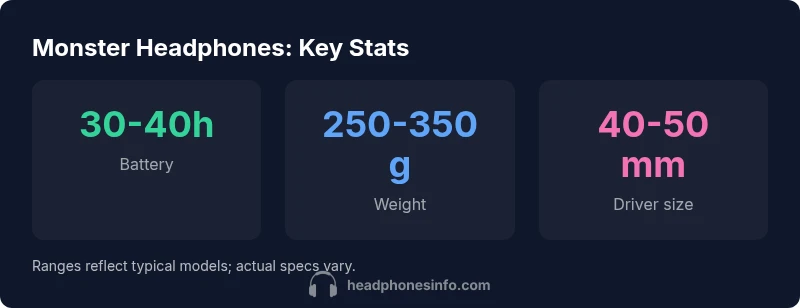
Monster headphones are built around a bass-forward tuning philosophy, but what that means in practice varies. Many models use large drivers in the 40–50 mm range to move more air and deliver impactful low end. The key is how the rest of the frequency response is managed: do the mids stay present when bass hits, or do they recede? Look for a balanced overall tonal footprint rather than a single-note bass boost. If you listen to electronic, hip-hop, or cinematic soundtracks, you’ll hear the bass; if you prefer acoustic or classical, you may notice the midrange vocal clarity. Impedance and sensitivity determine how much power you need from your source; higher impedance often means you’ll benefit from a dedicated amplifier for maximum volume, while lower impedance headphones can play loudly from a phone or laptop. In addition, acoustic design—such as venting, cup geometry, and seal—shapes how the bass interacts with the rest of the spectrum. Headphones Info analysis shows that even within this category, there is a wide variance in how aggressive the bass is, how fast the response is, and how much a bright treble can emphasize attack on percussion. If you’re shopping in this space, listen to a few tracks with complex bass lines to gauge how the headphones resolve the low end at different volumes. Finally, keep your expectations aligned with the intended use: gaming headphones with a strong bass kick may also deliver punchy sound in music, but you might miss the precision you’d get with a flatter monitor-like response.
Build Quality and Comfort for Long Sessions
Beyond raw sound, the physical build and wearing comfort of monster headphones matter most when you plan to wear them for hours at a stretch. A sturdy headband with padded clamping force helps prevent fatigue, while supple earpads reduce pressure around the ears. Heavier models often use metal frames and leather or faux-leather cushions to withstand daily bumps and travel. The right balance between weight and support is crucial: too much pressure squeezes the temples or ears, while too little support can cause flex or audible movement during vigorous activity. Moisture management becomes relevant in warm climates or during long listening sessions, so look for breathable materials on the cushions. When evaluating cushioning, ensure the ear cups fully enclose the ears without pressing against the ears’ inner edges, which can cause discomfort over time. Durability also means checking hinges, swivels, and foldability for signs of stress resistance. If you frequently travel, consider models with a protective case and a reliable latch system for the cups. The best monster headphones combine strong, durable construction with comfortable ergonomics so you can enjoy extended sessions without distraction or fatigue. Headphones Info notes that a surprisingly large portion of perceived value comes from comfort and resilience, not purely from the bass impact alone.
Battery Life, Connectivity, and Durability
Battery life and wireless connectivity drive practical performance in monster headphones more than almost any other spec, because most users want to sustain epic listening marathons, late-night gaming, and movie marathons without constant recharging. Typical wireless models offer 30–40 hours of listening on a single charge, though real-world life varies with volume, codec, and feature usage like active noise cancellation. Connectivity has evolved beyond basic Bluetooth to include low-latency codecs and multipoint pairing, enabling smoother gameplay and cross-device listening. When bandwidth or proximity changes, you’ll notice drops in fidelity or occasional dropouts if the device doesn’t handle interference gracefully. Durability pairs with battery life: rugged finishes, strong cables, and IP ratings improve resilience to dust and moisture for outdoor listening. It's worth noting that charging times and battery health matter as well; some models will gradually show reduced life with repeated cycles, so select a model known for battery longevity and robust warranty. Headphones Info’s analysis indicates that the best value in this category comes from models that balance long battery life with dependable wireless performance, comfortable wear, and a solid warranty that covers normal wear and tear.
Buying Guide: How to Compare Monster Headphones
To avoid paying a premium for branding, follow a structured buying process. Start by defining your primary use case: gaming, casual music, travel, or a hybrid setup. Then compare core technical specs: driver size and tuning versus impedance and sensitivity, battery life, latency, and codec support. Comfort and fit should be tested in a real-world environment, since cushions and headband pressure influence long sessions as much as the sonic signature. Consider the source you’ll pair with most often; a strong bass signature may require a flatter reference model for mixing or critical listening, while a bass-forward model can add excitement to most genres if you primarily indulge in entertainment listening. Always review warranty terms and accessibility of service centers. Finally, seek independent testing and user reviews to validate the on-paper claims and verify that bass emphasis remains musical rather than overwhelming. By systematically comparing these attributes, you’ll pick monster headphones that deliver meaningful value across your favorite music, films, and games.
Monster headphones at a glance
| Aspect | Typical range | Notes |
|---|---|---|
| Battery life | 30-40 hours | Wireless models; varies by codec and usage |
| Weight | 250-350 g | Over-ear designs; heavier than on-ear |
| Driver size | 40-50 mm | Affects bass and dynamics |
| Latency (Bluetooth) | 20-60 ms | Lower latency improves gaming sync |
People Also Ask
What sets monster headphones apart from regular headphones?
Monster headphones emphasize bass-forward tuning, larger drivers, and rugged builds. They often color the sound, prioritizing impact and excitement over absolute neutrality. Consider your genre and listening context when choosing.
Monster headphones emphasize bass and rugged design, so pick based on how you listen the most.
Are they suitable for studio monitoring?
They are generally not ideal for studio monitoring, which benefits from a flatter, more accurate response. Some models can serve as reference for creative work, but use caution when mixing.
Not ideal for studio work; for critical mixing, choose a flatter, neutral pair.
How should I compare models quickly?
Focus on driver size, impedance, sensitivity, battery life, connectivity, and comfort. Read independent reviews and check real-world tests to verify bass response.
Compare drivers, impedance, battery life, and comfort to find the best fit.
Do they require an amp?
Some high-impedance models benefit from a DAC/amp, especially if you crave maximum loudness or fidelity from desktop sources. Check impedance specifications.
Some models may perform better with a DAC or amp; check impedance.
What’s the best way to test bass response?
Test with familiar tracks that reveal bass texture, depth, and control. Listen for overpowering lows that mask mids, and verify balance across genres.
Use tracks you know well to judge bass impact and balance.
“Monster headphones can deliver impactful bass and rugged durability, but the right pick depends on your source, listening space, and comfort. Trust your audition alongside data-driven guidance.”
What to Remember
- Prioritize comfort and fit for long listening sessions.
- Check battery life for your use-case and devices.
- Evaluate bass tuning and soundstage relative to music preferences.
- Assess build quality and warranty when investing in monster headphones.
- Test with your preferred audio source to confirm real-world performance.