Planar headphones vs dynamic: An objective comparison
An objective, data-driven comparison of planar headphones vs dynamic drivers, covering speed, bass, amplification needs, durability, and comfort to help you decide.


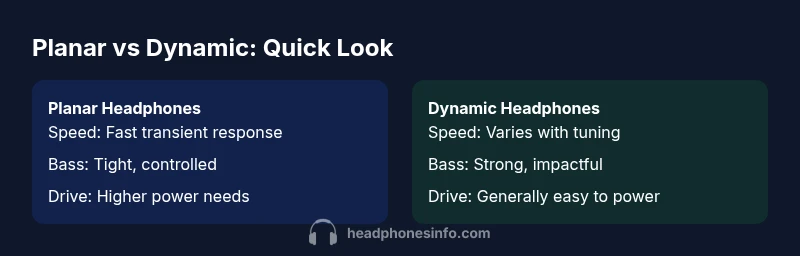
Planar headphones vs dynamic: In most setups, planar headphones deliver faster transients and lower distortion at high SPL, while dynamic drivers often punch harder bass and are easier to drive from portable sources. For critical listening, planars can reveal detail and treble clarity; for casual listening and portable use, dynamics remain practical and versatile. This guide compares the two to help you decide.
Introduction to Planar Headphones vs Dynamic Drivers
Planar headphones and dynamic driver headphones embody two different approaches to how sound is produced. Planar designs use a flat, membrane-based diaphragm suspended in a magnetic field, which allows for exceptionally fast transient response and very low distortion at higher listening levels. Dynamic headphones rely on a traditional moving coil attached to a diaphragm, with a bulky but highly configurable structure that can deliver substantial bass punch and broad popular appeal. According to Headphones Info, planar headphones vs dynamic headphones are distinguished more by driver geometry and material behavior than by a single feature; the choice often boils down to listening goals, amplification availability, and budget. For critics and engineers, the planar approach offers speed and precision; for everyday listeners, dynamics offer versatility and accessibility. This contrast sets the stage for a deeper, data-driven comparison that goes beyond slogans and marketing claims.
How Planar Headphones Work
Planar headphones use a large, lightweight diaphragm embedded with a conductive coil that sits in a uniform magnetic field created by an array of magnets. When a current passes through the coil, it interacts with the magnetic field, pulling the diaphragm evenly across its surface. The result is very low moving mass, minimal resonance, and highly linear excursion. Planars tend to deliver ultra-low distortion at moderate to high SPLs and exhibit excellent tonal balance across the spectrum. However, because the diaphragm is larger and the magnetic field is distributed across a wide area, planar headphones usually require more current from your source and can be heavier, which affects comfort during long sessions.
How Dynamic Driver Headphones Work
Dynamic driver headphones utilize a small voice coil attached to a cone or dome-shaped diaphragm, suspended in a magnetic circuit. When current flows, the coil moves the diaphragm in and out, producing sound waves. Dynamic drivers are highly versatile, capable of strong bass response and solid midrange clarity across a broad price range. They are typically lighter than planar designs and more forgiving to drive from consumer devices, though some high-end dynamic models can also demand substantial amplification to reach their full potential. The variability of motor design and tuning means dynamics can deliver a compelling, punchy sound signature suitable for a wide audience.
Sound Quality: Planar vs Dynamic
Sound quality is the most debated area in this matchup. Planar headphones are often praised for their speed, low distortion, and linear extension, which helps reveal micro-detail in complex passages and smoothing of high-frequency transients. Dynamics, by contrast, often stand out with engaging bass, dynamic range, and a strong, emotionally connective sound that many listeners find instantly gratifying. The best planars provide pristine technical accuracy, while the best dynamics deliver scale and impact. In practice, the perceived difference depends heavily on driver iteration, tuning, enclosure design, and the source chain. Headphones Info emphasizes that the perceived “best” choice is highly subjective and context-dependent.
Frequency Response and Distortion Characteristics
Planar designs typically maintain a flat or gently extended frequency response with very low total harmonic distortion at higher SPLs. The uniform magnetic field reduces coil wobble, which can translate to cleaner imaging and better treble precision. Dynamic drivers often show a more variable response depending on tuning—some models emphasize bass for impact, while others aim for a balanced profile. Distortion figures tend to be lower for well-designed planar headphones at similar listening levels; however, dynamic drivers can achieve very low distortion with proper tuning and high-quality materials. The practical takeaway is that both families can reach professional benchmarks when built with quality components and paired with a suitable amplifier.
Bass, Mids, Treble and Imaging
Bass performance in planar headphones tends to be tight and controlled, with fast decay that preserves transient detail. Mids are typically clean with little masking, which benefits vocal clarity and instrument separation. Treble can be extended and airy but may reveal harshness if the tuning is overly bright. Dynamics often deliver a more immediate bass presence that users associate with “fun” or visceral impact, sometimes at the expense of microscopic detail. Imaging in planars can feel very precise due to uniform driver action, while dynamics emphasize spaciousness and a strong stage impression. The best choice depends on whether you prioritize technical precision (planar) or emotional engagement (dynamic).
Comfort, Build, and Design Considerations
Planar headphones are often heavier due to the larger magnet assemblies and stiffer frames, which can press on the head over long sessions. They also require careful clamping force and headband design to avoid hot spots. Dynamic headphones vary widely in weight and build quality; many models strike an excellent balance between comfort and durability, especially at mid-range prices. Enclosure design, padding quality, and overall fit play large roles in perceived comfort. If you have a headphone amplifier or DAC with ample current headroom, planars can shine; otherwise, dynamics may deliver better daily usability.
Practical Buying Considerations: Amping, Impedance, and Source
Power requirements matter more with planar headphones due to their typically higher impedance and the need for clean, controlled amplification. Check impedance ratings and expected sensitivity to determine if your source can drive them effectively. Dynamic headphones cover a broader price and impedance spectrum, from easy-to-drive models compatible with smartphones to high-end models requiring dedicated amps. Consider the synergy between your audio chain components (DAC, amp, cables) and the headphone’s impedance curve. If you plan on portable usage, dynamics provide more flexibility; for a fixed listening setup or studio work, planars can deliver superior fidelity with the right gear.
Use Cases: Studio, Mixing, Gaming, Travel
In a studio or neutral mastering environment, planar headphones can reduce coloration and reveal subtle details in the mix. They are preferred by engineers who value predictive accuracy and low fatigue over long sessions. Dynamic headphones are favored for casual listening, gaming, and travel due to their strong bass, portability, and compatibility with phone or laptop outputs. Yet, there are high-end dynamic models that approach planar clarity; the decision reduces to whether your priority is studio-grade precision or all-around versatility. Think about your typical listening scenarios, portability needs, and how much you value bass presence versus spectral detail.
Common Misconceptions and How to Avoid Them
A common myth is that planar headphones automatically sound “better” in every aspect. The truth is that planars excel in speed and low distortion at high SPLs but sacrifice portability and often cost more. Another misconception is that dynamics always deliver inferior imaging; well-tuned dynamic headphones can offer compelling imaging and a strong sense of space. Finally, many assume heavier equals better durability—weight alone doesn’t guarantee comfort or resilience. Avoid these traps by auditioning models with similar tunes and source chains, not just headline specs.
How to Evaluate Them: A Practical Buying Checklist
Create a short audition list with three planar and three dynamic headphones in your price range. Listen to a few familiar tracks that test bass, mids, and treble; note how each model handles fast transients, piano lines, and vocal texture. Check amplification necessities by pairing with your intended source; ensure the model maintains consistent loudness without noticeable distortion. Compare comfort by wearing for at least 20–30 minutes and consider build quality and warranty. Finally, read independent reviews focusing on measurement data and subjective evaluation to balance expectations.
Comparison
| Feature | Planar headphones | Dynamic driver headphones |
|---|---|---|
| Sound signature characteristics | Very fast transient response; typically neutral to slightly analytical | Engaging bass; often warmer, with more musical color depending on tuning |
| Power requirements | Higher amplification current; may need dedicated amp | Lower amplification needs; often usable with portable gear |
| Impedance/Sensitivity | Higher impedance common; needs capable source | Broad range; many models easier to drive from phones |
| Size/Weight | Typically heavier due to magnets and diaphragm | Generally lighter and more compact in many models |
| Price range | Often higher upfront cost; premium options common | Wide range; approachable entry models exist |
| Best-use scenarios | Studio, critical listening, mastering; precision-focused | Casual listening, gaming, portable use; versatility |
Upsides
- Excellent transient response and low distortion at higher SPLs
- High-fidelity detail retrieval in studio contexts
- Smooth treble extension with accurate timbre
- Less listener fatigue during long sessions (in some models)
- Potential for consistent imaging with accurate tuning
Disadvantages
- Typically higher upfront cost
- Requires more powerful amplification or a dedicated amp
- Heavier and less portable than many dynamic models
- Limited selection of budget-friendly planar options compared to dynamics
Planar headphones excel for critical listening when you have the right amplification; dynamic headphones win on practicality and value for most listeners.
If you prioritize technical precision and low distortion, planars are a strong choice with a capable rig. If you want broad compatibility, cost efficiency, and portability, dynamics are the safer, more versatile option. The best decision aligns with your typical use-case and source strength.
People Also Ask
What defines planar headphones vs dynamic driver headphones?
Planar headphones use a flat diaphragm and magnetic array for even, fast motion, delivering high accuracy and low distortion in many scenarios. Dynamic headphones use a moving-coil driver for bass impact and broad tuning, often providing strong engagement and accessibility across price points.
Planar sound is very precise and fast, while dynamic sound tends to feel more bass-forward and plug-and-play.
Are Planar headphones worth the extra cost?
Planars can be worth it if you’re doing critical listening, mixing, or mastering and you can pair them with a capable amplifier. For casual listening, many dynamic models offer excellent value and portability.
If you value ultra-clear detail and low distortion at high volumes, planars are compelling; otherwise, dynamics are often the better value.
Will I need a special amp for planar headphones?
Yes, many planar headphones benefit from a dedicated or high-quality amp due to higher impedance and the demand for clean current. Check the impedance and sensitivity ratings of the model and match it to your source.
Usually, planars perform best with a good amp; phones can struggle to drive them fully.
Are dynamic drivers better for travel?
Dynamic headphones are typically easier to drive from portable devices and tend to be lighter, more compact, and more affordable for travel use. If you value convenience over absolute speed and detail, dynamics are a solid choice.
For traveling, dynamics usually win on weight and everyday compatibility.
Do planars exaggerate bass?
Planars generally offer fast, controlled bass with less boom than many budget dynamics, but there are tuned planar models with strong bass that can feel exaggerated if the rest of the spectrum isn’t balanced. Always audition with your typical music.
Depends on the model; some planars have tight bass, not bass boost.
How should I test these at a store?
Bring familiar tracks, test across genres, listen for detail, imaging, and comfort. Compare multiple models in the same price range and note how they respond to dynamics and fast transients.
Try a few tracks you know well and sit with them long enough to judge comfort and consistency.
What to Remember
- Audition both types to understand comfort and tuning
- Planar vs dynamic: speed and bass influence your choice
- Amplification matters more for planars; dynamics are more source-flexible
- Consider use-case: studio accuracy vs. portable versatility
- Budget and weight influence long-term satisfaction