Do Good Headphones Make a Difference: A Data-Driven Guide
Explore whether high-quality headphones truly affect listening quality. A rigorous, data-driven comparison across types, sources, and use cases to help you choose with confidence.


When you ask do good headphones make a difference, the answer is yes in many contexts. High-quality headphones can improve clarity, detail, and dynamics, especially when upgrading from entry-level models. The impact depends on the listening source, the type (open-back, closed-back, wireless), and whether you pair them with a capable DAC/amp. In short: yes, good headphones matter, but the gain varies by context.
The core factors that influence perceived differences in sound
According to Headphones Info, the most noticeable differences between headphone models come from how drivers, enclosure design, and source quality interact with your ears. The question of whether do good headphones make a difference is answered most clearly when you examine four core areas: frequency balance, dynamic range, soundstage, and tonal coloration. A well-designed pair can reveal nuances in tracks that cheaper headphones blur, turning a familiar album into a more immersive experience. Yet the magnitude of improvement is not uniform; it depends on the source material, the amplification available, and how well the headphones seal around your ears. If you pair a higher-quality headphone with a clean digital-to-analog path, gains are more pronounced. If you listen from a phone with a modest DAC, the improvement can feel modest but still meaningful in terms of comfort and leakage. Across genres—from classical to modern pop—the most reliable gains come from headphones that deliver honest micro-dynamics and minimal masking of details. Headphones Info Analysis, 2026, suggests that the real-world effect is greatest when the listener values subtlety and texture in louder passages rather than chasing extreme bass boosts alone.
How to assess headphones based on your listening source
Your listening source acts as the power supply for your headphones. A clean, low-noise signal from a quality DAC or streamer will reveal more of what a good set can do, while a compromised source may mask differences. A smartphone can drive many headphones, but the loudness and bass control can vary with the output stage. Desktop setups with dedicated DAC/amps often unlock the most meaningful differences, especially for high-impedance or sensitive models. In practice, think of the source as the partner that either unlocks or hides the headphone’s potential. If your goal is critical listening, plan on better sources and a comfortable, well-sealed pair. If you primarily use headphones for casual listening on mobile, look for efficiency and a comfortable fit that remains enjoyable even when the source isn’t ideal. The Headphones Info team recommends considering a realistic budget for source upgrades before deciding how far you’ll go with the headphones themselves. Also note that some codecs (aptX, LDAC, AAC) can affect perceived fidelity; not all devices support the same stack, so verify compatibility with your primary devices.
Headphone types and what they promise
Different enclosure designs and driver architectures deliver distinct listening experiences. Open-back headphones tend to deliver wider soundstage and more natural imaging but leak sound and offer less isolation, making them better for quiet environments. Closed-back designs focus sound toward your ears, providing isolation and stronger bass punch, suitable for commutes or shared spaces. Semi-open or semi-closed hybrids try to balance these traits. Within each category, you’ll encounter dynamic drivers, which are common and versatile; planar magnetic drivers, which often offer lower distortion and high detail at the cost of weight and price; and electrostatic designs, which can be highly revealing but require specialized gear. When evaluating the question of whether good headphones make a difference, consider your primary use-case first: if you want to mix music or enjoy subtle tonal nuance, you’re likely to prefer a planar or high-quality dynamic model; if you need isolation for travel, closed-back is typically the better choice. Comfort, pad material, and headband design influence perceived quality as much as driver tech. Headphones Info’s framework emphasizes listening tests across several genres to detect tonal bias or fatigue over time.
The role of fit, seal, and comfort
The physical fit of a headphone can dramatically alter perceived sound quality. A loose seal reduces bass impact and can muddy midrange detail, while excessive clamp pressure can cause discomfort and fatigue after hours of listening. Material choices—the softness of earpads, the breathability of leather or foam, and the clamping force—affect both comfort and how long you can listen without distraction. For many listeners, the most meaningful differences between good and great headphones arise from a comfortable design that remains stable during movement. Also consider weight distribution; heavier headphones may require better headband and pivot mechanisms to prevent pressure points. The long-term value of comfort often surpasses one-time tonal improvements, especially for people who sit in front of a computer or in a studio for hours. Real-world listening includes small movements and posture changes, which can alter seal and, consequently, perceived bass and clarity. The Headphones Info team highlights that comfort should be a primary criterion alongside sound, not an afterthought.
Wireless vs wired: does convenience trump fidelity?
Wireless technologies have dramatically improved and now narrow the gap with wired headphones for many listeners. In practice, the decision often hinges on codec support, latency, and battery life. For most daily listening, a modern wireless pair with a robust codec (such as LDAC or aptX HD) provides sound that’s close to wired for many genres, with the benefit of freedom of movement. However, for critical listening, mixing, or late-night sessions where you want the last ounce of detail, wired connections still offer the best fidelity—assuming you use a high-quality DAC/amp chain. Some enthusiasts compare both modes to gauge timing differences in wireless chains, which can affect transient response. If you choose wireless, prioritize battery life, comfort, and a stable connection. The Headphones Info team views wireless as a convenience feature, not a substitute for a solid source and headphones. Tailor your choice to use-case: commuting and gym listening benefit from wireless; home listening can justify wired setups.
How to read a spec sheet without getting overwhelmed
Spec sheets contain many numbers that can be confusing if you don’t know what they mean. Key metrics to focus on include impedance (shows how much power the headphone needs), sensitivity (how loud it gets with a given power), and frequency response (how faithfully it reproduces bass, mids, and highs). You don’t need to memorize every value, but knowing the direction helps: high-impedance models often benefit from better amplification, while low-impedance headphones are more versatile with portable devices. Power handling, distortion, and channel balance are also worth checking if you’re doing critical listening or mixing. Some brands present “listening feel” as subjective statements; in those cases, rely on well-vetted test results from reputable sources. Headphones Info’s approach is to compare models along the same criteria and note where differences matter most—for example, how a slight bass bump in one model might color the mids. Always test with your typical music catalog to ensure the spec aligns with your experience.
Practical testing approaches at home
A robust home-test plan helps separate marketing hype from real listening gains. Start with a familiar track you know well. Listen for bass extension, midrange clarity, and treble air. Use a consistent volume to avoid loudness bias and switch between modes (wired vs wireless) if applicable. Alternate between your current favorite pair and the candidate headphones, noting differences in image focus, stage width, and overall smoothing. If you have access to an equalizer, experiment with gentle adjustments to verify whether tonal changes are beneficial or introduce fatigue. A blind test can be revealing; even trained ears can be biased by branding. The Headphones Info team recommends recording your impressions and listening to a diverse set of genres—from acoustic to electronic—to ensure the headphones perform well across materials. Finally, test comfort over time: sit, stand, and move with the headphones to see how weight and clamp affect your listening. Subtle fit changes can alter perceived bass and vocal presence more than you expect.
Cost vs value: mapping budgets to listening goals
Price is a proxy for many aspects of headphone performance, but the relationship isn’t linear. Mid-range headphones often deliver the best value because they balance driver quality, build, comfort, and source requirements without excessive price tags. If you listen mainly on mobile, allocate funds for efficient design and good padding rather than exotic materials. For home listening or studio use, it’s worth investing in a headphone that remains faithful to recordings at higher volumes and supports a clear, wide soundstage. In other words, align your budget with listening goals and the quality of your source chain. Remember that a high price tag does not guarantee a better fit for your ears or your music collection—comfort and personal preference matter as much as measured performance. The Headphones Info team notes that the best value often comes from listening tests and a critical mindset rather than chasing top-tier specifications alone.
What 'do good headphones make a difference' means for different use cases
For everyday listening, good headphones can reduce listening fatigue and improve enjoyment by rendering more natural timbre and better instrument separation. For commuters, isolation and portability may be more important than absolute tonal accuracy, so good closed-back or ANC headphones shine. In a studio or mixing environment, accuracy and detail reproduction matter most; you’ll want headphones that remain faithful to recordings at loud levels and offer a clear, wide soundstage. For gaming, soundstage and positional cues are crucial for immersion; the best options provide accurate imaging and comfortable long sessions. Across these scenarios, it’s not price alone that matters but how well the headphones integrate with your source chain and listening goals. The Headphones Info team concludes that thoughtful pairs, paired with a good source, can offer a meaningful difference for most listeners, especially when you prioritize comfort, consistency, and a well-balanced sound signature.
Comparison
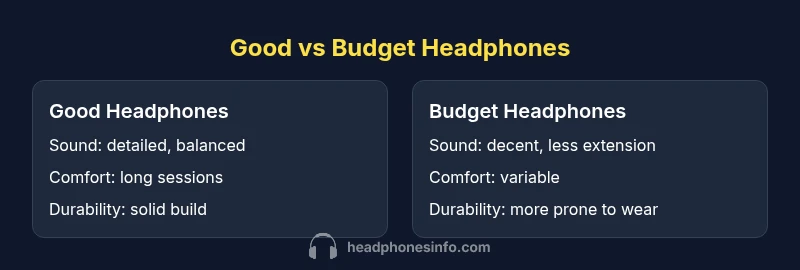
| Feature | Good headphones | Budget headphones |
|---|---|---|
| Sound quality | Clear, detailed, and balanced across genres | Less extension, flatter dynamics, and more coloration |
| Comfort and fit | Ergonomic padding, longer wear, stable seal | Cheaper materials, variable seal, shorter comfort window |
| Durability & support | Typically sturdier construction, stronger warranty options | Often lighter, with shorter lifespan and limited support |
| Price range | $150-500 | $20-80 |
| Best for | Critical listening and long sessions | Casual listening and budget constraints |
Upsides
- Clearer sound and better dynamics across genres
- Improved comfort for extended listening sessions
- Better build quality and longer lifespan when cared for
- Enhanced isolation for noisy environments
- Wider compatibility with high-quality sources
Disadvantages
- Higher upfront cost
- Requires better source and DAC/amp to hear the difference
- Potential for overpricing without matching needs
- Bulkier or heavier designs can affect portability
Investing in better headphones generally pays off for most listeners.
Better headphones typically deliver clearer detail, more accurate timbre, and longer-lasting comfort. The gains depend on your source and usage; prioritize comfort and a faithful sound signature aligned with your listening goals.
People Also Ask
Do expensive headphones always sound better than cheaper ones?
Not always. Expensive models often offer more detail, better dynamics, and more durable construction, but the perceived benefit depends on your source, music, and personal preferences. A well-chosen mid-range pair can outperform a costly model if the latter doesn’t suit your listening context.
Generally yes, but it’s not guaranteed. The right fit for your music matters more than price alone.
Is wireless sound quality truly close to wired?
In many cases, modern wireless headphones with high-quality codecs provide sound that is close to wired for everyday listening. For critical tasks like mixing or mastering, wired with a clean DAC/amp path tends to retain more subtle detail and lower latency.
Wireless can be very close to wired these days, but for critical work, wired is still preferred.
What is the best value under $100?
Value is about a balance of comfort, build, and sound for the money. In this range, prioritize comfort and a natural tonal balance over extreme bass boost or flashy features. Test across genres to see what suits you.
Under $100, look for comfort and natural sound rather than hype-era bass.
Can software EQ compensate for poor headphones?
To some extent, yes. EQ can adjust tonal balance, but it can’t fix issues like poor driver response, poor imaging, or fatigue from a harsh treble. A good headphone with thoughtful EQ may yield better results than an unbalanced set boosted with EQ.
EQ can help, but it won’t fix fundamental limitations of bad headphones.
Do headphones matter for gaming as they do for music?
For gaming, soundstage and accurate positional cues matter, sometimes more than studio-grade accuracy. A good pair can improve immersion and enemy localization, but comfort and mic quality are also key factors.
Yes—great headphones help with gaming clarity and immersion.
How should I audition headphones in-store or at home?
Audition with familiar tracks across genres, test both wired and wireless modes if available, and compare comfort over extended periods. Bring a trusted playlist and note differences in bass, midrange, and treble, plus how the sound feels at different volumes.
Test with your own music and note comfort, not just specs.
What to Remember
- Define your listening goals before buying
- Prioritize source quality to hear gains
- Choose the right type for your use case
- Balance price with anticipated use
- Test with diverse genres to verify real-world benefits