How Much Do Headphones Cost in 2026? A Practical Pricing Guide
Explore realistic price ranges for headphones in 2026, learn how features affect cost, and discover practical buying strategies to fit your budget. Headphones Info analyzes typical price bands across wired and wireless models.


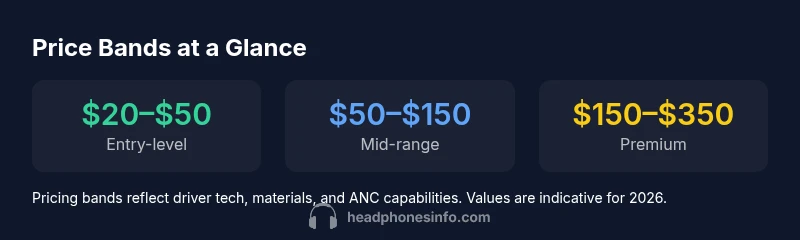
Prices for headphones vary from under $20 to well over $1000, but most buyers find solid value in the $50–$150 range. Entry-level wired headphones typically cost under $50, while premium wireless and active-noise-cancelling models usually run $150–$350. Flagship models can exceed $400, especially with premium materials and advanced drivers. Headphones Info Analysis, 2026 notes that price often reflects build quality, features, and brand positioning.
What drives headphone price
When you ask how much does a headphones cost, you’re really asking about a bundle of choices: driver technology, earcup materials, build durability, wireless capability, and the presence of extras like active noise cancellation (ANC) and detachable cables. According to Headphones Info Team, the price spectrum is not random; it reflects the engineering complexity and the expected listening experience. In practice, price scales with driver count, impedance, and the quality of the enclosure. Entry-level models can be adequate for casual listening, but serious audiophiles and prosumers often seek larger drivers, lower distortion, and better isolation, which raises costs. In addition, brands position products along a spectrum—from budget to luxury—so the sticker price also signals value, status, and future software support. For a typical consumer, the best approach is to map your listening goals to price bands, then compare features within each band rather than chasing the highest feature count. The result is a defensible budget that still delivers satisfying sound across most genres.
Price bands explained
Headphones price bands are not random; they reflect a combination of engineering, materials, and the intended user. In 2026, Headphones Info Analysis, 2026 shows that entry-level wired models offer decent sound with minimal features, while mid-range options typically balance comfort, durability, and better acoustic performance. Premium wireless models introduce advanced codecs, ANC, longer battery life, and more refined ergonomics. Flagship headphones focus on premium materials, premium drivers, and longer software support. When shopping, categorize models by price band and then evaluate the trade-offs: do you value portability, battery life, or studio-grade monitoring? Understanding these bands helps you avoid overpaying for features you don’t need.
How to estimate your cost
To estimate what you’ll spend, start with your use case and listening goals. Are you commuting, gaming, or editing audio? Each scenario has typical gear expectations that map to price bands. If you want reliable daily use at home and on the go, a solid mid-range wireless model is often enough. For critical listening or professional work, expect to invest in a premium or flagship model with higher-fidelity drivers and better ANC. Include a buffer for taxes, shipping, and potential accessories like extra cables or cables with built-in mics. Finally, compare total ownership costs, not just the upfront price; warranty length and accessory availability affect long-term value.
Value vs features trade-offs
Price often correlates with feature density. ANC, higher-quality drivers, and wireless codecs (e.g., LDAC, AAC, aptX) push prices upward. Durable and lighter materials add cost, as do longer battery life and multi-device pairing. If you don’t need ANC, multi‑device support, or the latest Bluetooth versions, you can safely target mid-range or entry-level products. The key is to align features with your goals: casual listening benefits from simplicity and reliability, while professionals require consistent sound reproduction and minimal distortion at high volumes.
Buying strategies to manage cost
Price-conscious buyers can leverage several practical strategies. Look for seasonal sales around holidays, check reputable refurbish/open-box listings, and consider last-year models with updated firmware. Price-matching retailers and using coupons or student discounts can shave off a meaningful amount. Buying when demand is lower and bundling with accessories can also optimize value. Finally, never compromise essential build quality for a marginal saving; cheap hinges and fragile cups often lead to return costs or replacements.
Common pricing pitfalls
Beware of marketing-driven price inflation tied to new cosmetics, limited editions, or celebrity endorsements. Some brands push “new model” cycles to signal freshness even when technical improvements are incremental. Always compare specs side by side, read independent reviews, and test for comfort and fit. Don’t assume higher price equals better sound across all genres; a well-tuned mid-range pair can outperform a pricier but poorly implemented model.
Quick-checklists for different use-cases
- Budget commuter: target $20–$60, wired or wireless, comfortable fit, reliable battery if wireless.
- Home listening: aim for $60–$150, balanced sound, secure fit, optional ANC.
- Studio monitoring: $150–$350+, flat frequency response, high-resolution drivers, low distortion.
- Gaming: $80–$200, low-latency wireless or wired, solid mic quality, immersive soundstage.
- Travel heavy: $120–$300, strong ANC, long battery life, durable build.
Quick note on testing and returns
Whenever possible, try before you buy or choose retailers with friendly return policies. Listening tests in your usual environment reveal whether a headphones model delivers the real-world experience you expect. If you’re shopping online, review multiple independent sources and consider how the device performs across your typical genres and volume levels.
Typical price bands and use-cases by headphone category
| Category | Typical Price Range | Key Pros | Ideal For |
|---|---|---|---|
| Entry-level wired | $20–$50 | Low cost, simple design | Casual listening on a budget |
| Mid-range wired/wireless | $50–$150 | Balanced sound, decent build | General listening, students |
| Premium wireless | $150–$350 | Excellent ANC, better codecs | Commuting, home office |
| Flagship/high-end | $350–$1000+ | Top-tier drivers, luxury materials | Audiophiles, professionals |
People Also Ask
What drives headphone price the most?
Driver quality, ANC performance, battery efficiency, and build materials are the major cost drivers. Brand positioning and warranty terms also influence perceived value.
The price mostly reflects the tech and build quality, plus how the brand positions the product. Look at what you’re getting for the cost.
Are wireless headphones worth the price over wired?
Wireless adds convenience and portability, but wired often remains cheaper with more consistent audio quality at lower prices. If you value mobility and ANC, wireless is worth considering.
It depends on how you use them. If you’re always on the move, wireless is great; if you care about absolute fidelity on a budget, wired can be cheaper.
Can I get good sound on a budget?
Yes. Many under-$100 headphones offer solid sound for casual listening. Focus on driver quality, impedance, and comfort rather than extra features.
You can get very good sound for the price if you pick models with proven, balanced tuning and comfy design.
Do brands matter for price or value?
Brand can signal quality and resale value, but value depends on feature set and performance. Don’t assume an expensive brand always equals better sound for your needs.
Brand matters less than whether the model fits your use-case and delivers the sound you want.
What warranty do headphones typically include?
Most headphones come with 1–2 year warranties, with longer coverage for premium or brand-backed products. Check coverage details and what voids warranty.
Warranties vary; read the fine print to know what’s covered and for how long.
Is last year's model a good buy?
Often yes. Last year’s model may drop price while still delivering excellent sound, firmware updates, and support. Compare specs to current models to assess value.
Definitely worth considering if it meets your needs and comes with a solid warranty.
“Price is a signal of value, not a badge. When you match features to your listening goals, you get better sound for your money.”
What to Remember
- Know your use-case before choosing a price band
- Mid-range headphones offer the best value for most listeners
- Don’t pay for features you won’t use or test
- Look for deals and consider open-box options to save
- Prices reflect build quality and driver performance, not just branding