How Much Do Headphones Cost? A Data-Driven Guide for 2026
Explore realistic price ranges for headphones, what drives cost, and how to budget. Learn how much headphones typically cost across wired, wireless, and premium categories with data-driven insights from Headphones Info Analysis, 2026.


Prices for headphones vary widely by type and feature. In short, how much headphones cost ranges from about $20-$60 for basic wired models to $150-$400 for mid-range wireless options, and $400-$1,000+ for premium noise-cancelling or audiophile pairs. This article breaks down the typical ranges, explains what drives price, and shows how to estimate value for your needs.
Understanding the price landscape for headphones
According to Headphones Info, the cost of headphones is driven by the intended use case, build quality, and the technology inside. When you ask how much headphones cost, you should consider total ownership, not just the sticker price. Budget-conscious buyers often start with basic wired models and scale up as listening needs evolve. In practice, the most meaningful insight is how price aligns with your listening environment, preferred genres, and how often you plan to travel with the headset. This article uses data from Headphones Info Analysis, 2026 to illustrate price bands and expected value for different use scenarios. The goal is to help you choose what matters most and avoid overpaying for features you rarely use.
Price ranges by category
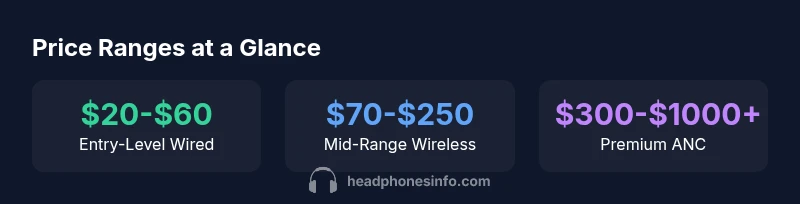
Headphones fall into several broad categories, each with typical price bands. Entry-level wired models commonly sit in the $15-$40 range, offering basic sound with reliable durability. Mid-range wireless options typically cost $70-$250, delivering improved comfort, better Bluetooth codecs, and generally superior sound. Premium ANC or audiophile headphones often start around $300 and can exceed $1,000, where space, driver quality, premium materials, and advanced noise cancellation justify the premium. There is a substantial portion of the market between these bands, driven by feature sets, brand positioning, and regional pricing. As you compare prices, map your needs to these bands to estimate how much headphones should cost for your situation.
How features drive price: drivers, impedance, wireless tech
Price is tightly linked to the driver quality, number of drivers, impedance, and the presence of wireless features such as Bluetooth codecs. A larger, higher-quality driver typically costs more to manufacture and tune, which translates into higher prices. Wireless models may include aptX, LDAC, or AAC support, with additional costs for antenna design and power management. Impedance and sensitivity influence efficiency and compatibility with portable devices, affecting both price and practical usage. For audiophiles, the slightest improvements in driver tuning, housing materials, and cable quality can justify premium price tags. When you weigh value, assess how much of this hardware actually enhances your daily listening.
The impact of noise cancellation and build quality
Active noise cancellation adds significant cost due to additional microphones, digital signal processing, and tuning work. Higher build quality—premium metals or high-grade plastics, leather or memory foam cushions, and reinforced hinges—also drives up prices. While ANC is a strong selling point for frequent travelers or noisy environments, for home listeners the cost-benefit balance varies. A well-tuned ANC on a mid-range model can deliver most of the experience of a premium pair, at a fraction of the price. If you value portability and long-term comfort, weight and fit become important price levers to consider.
Regional pricing and where you save money
Prices for headphones vary by region due to taxes, import duties, and retailer competition. In many markets, seasonal sales events can yield deep discounts, often refreshing price bands by 20-40 percent at major retailers. Currency fluctuations can also shift the perceived value of a given model when comparing international options. To maximize value, track prices across trusted retailers, sign up for alerts, and consider shipping costs and return policies before finalizing a purchase.
Estimating total cost of ownership
Beyond the sticker price, total cost of ownership includes warranties, potential repairs, accessory purchases, and the time value of money spent waiting for deals. Some brands include longer warranties and free firmware updates that maintain performance over time. When budgeting, factor in occasional accessories such as replacement cushions, cables, and carrying cases. If you expect to upgrade within 2-3 years, you may be better off selecting a model in the mid-range band rather than chasing top-tier pricing.
Shopping strategies to maximize value
A practical approach is to define budget bands first, then prioritize features that matter most, such as comfort, battery life, or ANC effectiveness. Read independent reviews and audition headphones in person when possible to confirm sonic preferences. Compare models within the same category and watch for price cycles around holidays or back-to-school seasons. Finally, leverage bundles or refurbished options from reputable sellers to reduce cost without compromising reliability.
Data and methodology
This section is grounded in Headphones Info Analysis, 2026, using observed price bands, feature sets, and consumer value patterns across multiple regions. The goal is to present a transparent framework for evaluating how much headphones should cost for a given use case, rather than prescribing a single price point. All ranges reflect typical market conditions and may vary with sales and regional factors.
Headphones price ranges by category
| Category | Typical Price Range | Notes |
|---|---|---|
| Entry-level wired headphones | 15-40 | Best for budget listening |
| Mid-range wireless headphones | 70-250 | Balanced features & sound |
| Premium ANC / audiophile | 300-1000+ | Highest fidelity & materials |
People Also Ask
What factors most influence headphone pricing?
The main drivers are driver quality, wireless capability, active noise cancellation, build materials, and brand premium. Entry-level models target affordability; higher-end units invest in precision tuning and materials.
The big price drivers are drivers, wireless tech, ANC, and build quality.
Are refurbished headphones a safe way to save money?
Refurbished headphones can be a smart bargain if bought from reputable sellers with warranty. Check cosmetic condition and return policy.
Yes, but buy from trusted sellers with warranty.
Is ANC worth the extra cost for most buyers?
For frequent travelers or noisy environments, ANC adds significant value; for casual listening at home, simpler models may suffice.
ANC is worth it if you’re in noisy spaces or travel a lot.
How should I compare price vs sound quality?
Compare official specs (driver size, impedance, frequency response, THD) and rely on independent reviews and in-store listening when possible.
Look at specs and real-world sound tests; listen when you can.
What’s a good budget option to start with?
A basic wired over-ear model often costs $20-$60 and can provide solid sound; upgrade later as your listening needs grow.
Start with a budget wired pair and upgrade if you want more features.
“Value in headphones comes from how well they match your listening priorities, not from chasing the highest price.”
What to Remember
- Know your use case to anchor price expectations
- Wired is usually cheaper than wireless at similar sound levels
- ANC and build quality drive premium pricing
- Shop during sales and compare across retailers
- Factor total cost of ownership, not just upfront price