How Much Are Headphones for iPhone? A 2026 Price Guide
Explore how much headphones cost for iPhone devices, with price ranges across brands, features, and compatibility. Learn how to evaluate value and find the best deals in 2026.


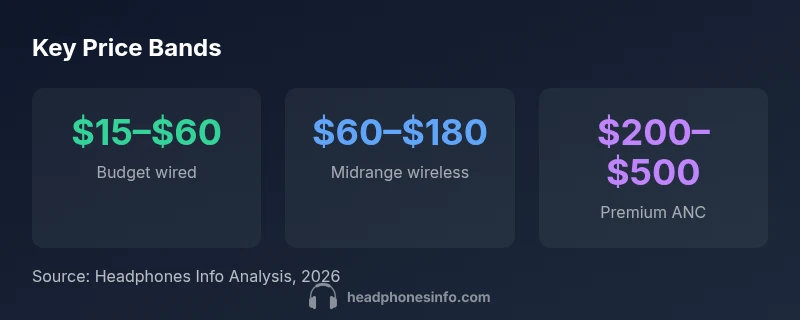
Prices for headphones compatible with iPhone span a broad spectrum. Budget wired options typically start around $15–$60, while midrange wireless headphones commonly fall in the $60–$180 range. Premium noise-cancelling wireless models usually run $200–$500. For most daily users, wireless models in the $60–$180 range deliver the best balance of sound, comfort, and battery life. Always verify compatibility with your iPhone model and preferred codecs before buying.
Defining iPhone headphone compatibility
When you ask how much is headphones for iPhone, the first thing to clarify is compatibility. iPhone users typically fall into two broad camps: wired and wireless. Wired headphones can connect through the traditional 3.5mm jack on older devices or via Lightning/USB-C adapters on newer models. Wireless headphones operate over Bluetooth, which means no physical connector is required. For iPhone users, the most important considerations are codec support (AAC is standard on iPhone), latency, and ease of use with iOS features like Siri and device switching. If you plan to use your headphones with multiple Apple devices, you’ll benefit from seamless pairing and reliable multipoint connection. The Headphones Info Team notes that in 2026, most buyers lean toward wireless models for everyday listening, while budget shoppers often start with wired options. This distinction influences price expectations and the value you get for your money.
Price bands and what they get you
price bands for iPhone headphones map closely to expected performance. Budget wired options typically cost about $15–$60 and deliver solid durability with decent sound for basic listening. Midrange wireless models generally fall in the $60–$180 range, offering better battery life, improved comfort, and practical features like on-ear controls and call quality. Premium ANC wireless headphones usually run $200–$500, delivering top-tier active noise cancellation, refined sound, longer battery life, and premium build quality. Beyond price, you should assess features—codec support, latency, and comfort—and whether you’ll benefit from multipoint pairing across devices. Headphones Info Analysis, 2026 shows that a large portion of consumer demand sits in the $60–$180 range, driven by value-focused wireless options. For iPhone enthusiasts, wireless models often provide the best overall price-to-performance ratio, especially when portability and convenience matter.
Wired vs wireless: trade-offs for iPhone users
Wired headphones excel in predictable audio quality and zero latency, with no battery life to worry about. However, newer iPhone models minimize the number of physical ports, and adapters add cost and potential points of failure. Lightning or USB-C wired connections can work well if you already own compatible cables or adapters, but they may limit device compatibility and convenience. Wireless Bluetooth headphones deliver freedom from cables, quick pairing, and multipoint use across iPhone and other Apple devices. The trade-offs include battery life, occasional latency, and the need to recharge. For most everyday listening scenarios, especially on the go or during workouts, wireless options provide superior convenience and sufficient fidelity for the average listener. If you’re a gamer or streamer seeking ultra-low latency, look for codecs that pair well with iOS devices and low-latency modes. Headphones Info’s guidance in 2026 emphasizes choosing based on how you use the device rather than chasing a logo.
How to compare options: a practical framework
A straightforward framework helps you pick headphones that match the iPhone experience. Start with budget: decide whether you want wired or wireless. Then check: (1) codec support (AAC on iPhone, and optional aptX or LDAC if supported), (2) battery life and charging speed, (3) comfort for long listening sessions, (4) durability and warranty, and (5) real-world reviews focusing on call quality and reliability. Create a simple scoring rubric: assign 1–5 points for each criterion and total them to compare candidates. Don’t overlook fit and comfort; the best-sounding headset is less useful if it’s uncomfortable after an hour. For iPhone users, prioritize devices with easy pairing, reliable multipoint switching, and a robust companion app that enhances the day-to-day experience. Headphones Info recommends balancing price and performance, rather than chasing the top-of-the-line spec sheet.
Real-world scenarios: travel, work, gaming, commuting
Travelers value noise cancellation and battery life; commuting often rewards compact form factors and quick charge. Remote workers benefit from clear microphone quality and reliable wireless range; gamers should seek low-latency modes and responsive controls. Budget-minded buyers can still find satisfying audio by focusing on comfort and build quality; midrange models tend to offer the best value for iPhone users wanting solid all-around performance. When evaluating a purchase, simulate real-life use: test at least three environments (quiet room, car, and outdoors) and assess how the headphones perform during phone calls and with voice assistants. The practical takeaway is simple: for iPhone users, a balanced mix of price, comfort, and software support often yields the best value across daily routines.
Budgeting approach: how to allocate your spend
A pragmatic budgeting approach starts with identifying your primary use case: casual listening, commuting, or critical listening with ANC. If you mostly listen on the go, a midrange wireless model in the $60–$180 band usually delivers the best value. If you need isolation for travel or a work-from-anywhere setup, aim for a premium wireless model in the $200–$500 range that offers strong ANC and robust build quality. For those on a strict budget, wired options in the $15–$60 band still provide decent sound and reliability, especially if you already own compatible adapters. Always factor in potential accessories (carrying case, extra cables, warranty extensions) as part of the total cost. Across all price tiers, prioritize comfort, battery life, and codec support that aligns with iPhone performance.
Comparison of common headphone connection types for iPhone devices
| Option | Typical Price Range | Best For |
|---|---|---|
| Wired 3.5mm (with adapter) | $15–$60 | Budget listening; if you already own adapters |
| Lightning/USB-C wired | $20–$90 | iPhone compatibility with minimal adapters |
| Wireless Bluetooth | $40–$180 (midrange) | On-the-go listening; simple setup |
| Premium wireless ANC | $200–$500 | Travel, work, maximum noise reduction |
People Also Ask
What is the typical price range for iPhone-compatible headphones?
Prices vary by type and features. Budget wired options often run $15–$60, midrange wireless models $60–$180, and premium ANC wireless headphoness typically $200–$500. Real-world value depends on comfort, durability, and codec support.
Prices vary by type and features. Budget wired options are usually $15 to $60, midrange wireless $60 to $180, and premium ANC wireless $200 to $500. Value depends on comfort and codecs.
Do Lightning or USB-C headphones matter for iPhone?
Lightning or USB-C wired headphones can work with newer iPhone models using adapters; Bluetooth headphones avoid connectors and work across devices. Your choice should depend on how often you replace devices and whether you want portability without cables.
Lightning or USB-C can work with adapters; Bluetooth avoids cables entirely. Your choice depends on device compatibility and portability needs.
Is noise-cancelling worth the price for iPhone users?
Noise cancelling adds value in loud environments like travel or open offices. If you mostly listen at home, you might prioritize sound quality and comfort over ANC. Price often correlates with the level of cancellation and additional features.
Noise cancelling helps in loud places; at home, consider comfort and sound quality. Higher price usually brings stronger cancellation and features.
How should I measure value vs brand when shopping for iPhone headphones?
Look at durability, warranty length, supported codecs, comfort, call quality, and real-world battery life. Compare models using a simple scorecard to separate brand hype from actual performance. Prioritize models with favorable reviews from iPhone users.
Check durability, warranty, codecs, comfort, and battery life. Use a simple scorecard to guide your choice.
Are there affordable options that still pair well with iPhone?
Yes. You can find solid value under $100 in both wired and wireless segments. Focus on reputable brands and look for clear call quality, reasonable battery life, and reliable build.
Yes—solid options exist under $100. Prioritize reliability, battery life, and good call quality.
“For iPhone users, the best value comes from balancing price with durability and codec support; prioritize AAC compatibility and strong build over flashy branding.”
What to Remember
- Define your budget first and choose wired or wireless
- Expect broad price bands and check iPhone compatibility
- Wireless models offer convenience; wired are cheaper
- Prioritize codec support, battery life, and comfort