What’s the Newest Headphones in 2026? A Data-Driven Guide
Discover what's new in headphones for 2026 with data-driven insights, trend analysis, and practical buying guidance from Headphones Info to help you pick the best models.


What's the newest headphones? In 2026, models emphasize adaptive ANC, multi-device pairing, and efficient wireless codecs. Expect USB-C charging, firmware updates, and longer battery life as standard. The Headphones Info team notes LE Audio and LC3 adoption is becoming common, improving efficiency and sound quality across price levels. For buyers, understanding these features helps identify strong contenders quickly.
Why the newest headphones matter
According to Headphones Info, the landscape of audio devices evolves quickly, and what's the newest headphones in 2026 reflects how manufacturers push feature sets. This guide explains why staying current matters for sound quality, comfort, and long-term value. The cadence of launches tends to cluster around mid-year and late-year windows, with incremental improvements rather than sweeping overhauls. For enthusiasts and shoppers, recognizing these patterns helps plan a better upgrade cycle and avoid overpaying for marginal gains. In practice, the latest models deliver more refined tuning, better fit, and smarter app ecosystems that tune themselves to your environment.
From a user perspective, the newest headphones typically offer improved comfort through lighter materials, more balanced clamp force, and softer cushions; plus longer battery life and faster pairing. A subtle but meaningful trend is the integration of smarter assistants, on-device EQ, and richer personalization through companion apps. All this matters because the perceived value is not just sound; it’s the overall package: latency for gaming, call quality, and durability. Headphones Info analyses show that firmware-enabled improvements can extend a model’s relevance by many months after launch.
How 'new' is defined in 2026
In practice, 'new' can mean several things: a model is launched within the last 12 months, it includes a fresh design or significant feature upgrade, or it receives firmware updates that unlock new capabilities. Manufacturers often stagger launches by region and by price tier, so the exact year of introduction varies. To avoid confusion, shoppers should check the product page's release date, the manufacturer's press release, and major review outlets for cross-verification. In 2026, the lines between 'new' and 'older' batches are blurred by software updates that extend usability and push feature parity upward across portfolios.
Another lens is to watch for hardware refreshes that pair with software updates—rarely a full redesign, but enough to redefine perceived value. This means you may already own a headphone that becomes notably better after a firmware bump. When in doubt, target models with a robust update policy and clear upgrade paths.
Core technologies shaping the latest models
The newest headphones are less about one blockbuster feature and more about a suite of upgrades that work together. Expect adaptive noise cancellation that learns from your environment, and latency-reducing codecs such as LE Audio/LC3 that boost battery life and efficiency. Multi-device pairing remains a cornerstone, with smoother handoffs between devices and improved device-switch speed. Other notable tech includes stronger dielectric housings for durability, lighter drivers for comfort, and improved impedance matching that yields more consistent sound across genres. On the software side, companion apps now offer personalized EQ, transparency modes that adapt to ambient noise, and firmware update ecosystems that add features after purchase. In short, the latest models aim to deliver better sound, longer sessions, and a more seamless user experience across devices.
Practical buying scenarios: gaming, travel, daily commute
For gamers, latency and low-profile fit are crucial, so look for models with low-latency wireless modes and stable Bluetooth connections. Travelers should prioritize battery life, quick-charging, and a compact foldable design, plus solid ANC to combat cabin noise. Daily commuters benefit from comfortable clamps, top-tier microphone quality for calls, and a reliable USB-C charging path. Across these scenarios, the newest headphones tend to combine comfort, codecs, and firmware-driven features that adapt to your environment. Consider also the ecosystem: if you use a specific device (PC, Android, iOS, or console), verify cross-platform compatibility and any platform-specific features or software quirks.
Price and value: navigating the market
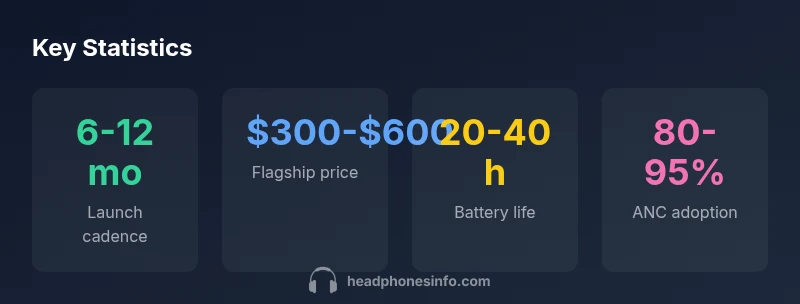
Price is a meaningful signal, but it isn’t the only one. The newest headphones often sit in a tiered spectrum: entry-level models that deliver core features, mid-range models with smarter software capabilities, and premium options with premium materials, studio-grade drivers, and richer feature sets. Expect flagship ranges to hover around the $300-$600 mark, with occasional promotions that can adjust the effective price. The true value comes from sustained performance, durable build quality, and ongoing software support. When evaluating value, consider long-term ownership costs like replacement parts, warranty coverage, and how frequently firmware updates unlock new capabilities.
The Headphones Info team emphasizes that value is not solely a price tag but a balance of initial cost, feature depth, and long-term reliability. A model that remains relevant through several firmware upgrades and compatible accessories can outperform a more expensive option that lacks update potential. In practice, a thorough test plan—fit, comfort, battery, and feature intuition—will reveal true value over time.
How to compare quickly: a practical framework
To compare the newest headphones efficiently, build a quick rubric:
- Core sound and comfort: audition across multiple genres and verify comfort for long sessions.
- ANC and transparency modes: test in real environments and measure noise suppression when possible.
- Connectivity: ensure reliable pairing, low latency for gaming, and cross-device switching.
- Software and updates: review the update policy, app usability, and feature rollouts.
- Battery life and charging: check real-world endurance vs. spec and the speed of charging.
- Build quality and warranty: inspect materials, foldability, and warranty terms.
- Ecosystem and accessories: ensure compatibility with your devices and available accessories.
A practical test checklist helps you decide quick: listen with your typical music, test calls, and confirm comfortable wear for longer periods. The newer models often deliver notable gains in codec efficiency and adaptive ANC, but the biggest payoff comes from sustained firmware support and a smooth user experience across devices.
Real-world performance expectations
In real-world use, the newest headphones should feel effortless rather than daunting. You’ll notice improved comfort with lighter headbands and softer ear cushions, and a more natural sound with better bass control and midrange clarity. ANC effectiveness varies by environment, but contemporary models typically suppress low-frequency noise well while preserving voice intelligibility for calls. Battery life can meet the stated ranges under normal listening, though high-volume usage or demanding codecs can shorten endurance. Latency is a frequent talking point for gaming and watching videos; premium models strive to keep lip-sync aligned with minimal perceptible delay. Firmware updates often unlock discrete features like adaptive EQ, smarter ANC profiles, and better device handoff. Overall, the newest headphones balance performance, comfort, and software support for a more consistent daily experience.
Testing and evaluation tips for 2026 models
A hands-on evaluation is essential. Bring your most-used playlists and test across genres to assess tonal balance. Check comfort by wearing for at least 30 minutes and note pressure points or heat buildup. Run a call test to evaluate microphone quality and wind noise. In addition, test ANC by comparing ambient noise reduction in a quiet room versus a noisy environment. Finally, verify the claim of firmware upgrades by updating the device and exploring new features in the companion app. If possible, compare multiple new models side-by-side to better isolate the incremental benefits of each feature set.
The roadmap for 2026: future-proofing your purchase
The newest headphones indicate a future where firmware updates extend the life of devices and codecs improve energy efficiency. Expect more widespread LE Audio adoption across price tiers, better cross-device interoperability, and more intelligent software that learns from your listening habits. Manufacturers will likely continue refining fit, reducing weight, and widening battery capacities. For shoppers, the best bet is to prioritize models with robust update policies, easy access to firmware upgrades, and a track record of long-term support. This approach reduces the risk of early obsolescence and maximizes the return on your investment.
Comparison of common headphone configurations
| Model Type | Key Features | Typical Price Range | Battery Life (Hours) |
|---|---|---|---|
| Over-ear Wireless | ANC, multi-device, USB-C | $150-$600 | 20-40 |
| In-ear Wireless | ANC on select models, USB-C | $100-$300 | 6-14 |
| Wired/USB-C | No battery required, best fidelity | $20-$100 | N/A |
People Also Ask
What does 'newest headphones' mean in 2026?
In 2026, 'newest' typically means recently launched models with updated ANC, codecs, or software features. It includes devices released within the last 12 months and any firmware-enabled upgrades applied after purchase.
In 2026, 'newest' means recently released headphones with updated features and firmware.
Are the newest headphones more expensive?
Not always. Most flagship models are pricier, but mid-range options increasingly offer similar core features. Expect broader price bands and frequent promotions.
New releases can be more expensive, but many offer similar core features at mid-range prices.
Which features really define the newest headphones?
Key features include adaptive ANC, LE Audio/LC3, USB-C charging, multi-device pairing, and improved firmware updates that extend functionality.
Adaptive ANC, LE Audio, USB-C, and firmware updates define the latest models.
Should I chase every new model?
Chasing every release rarely pays off. Focus on features that matter to you (sound, comfort, latency) and assess long-term support.
Don't upgrade with every release; pick features that matter and check support.
Do the newest headphones support LE Audio and codecs?
Many 2026 models include LE Audio and LC3, which improve efficiency and battery life while maintaining sound quality.
Most 2026 models support LE Audio and LC3 for efficiency and better battery life.
“The newest headphones in 2026 reflect a shift toward efficiency, smarter codecs, and longer firmware support, making feature-rich models more compelling value.”
What to Remember
- New headphone launches cluster around 6-12 months.
- Expect LE Audio/LC3 and USB-C as standard features.
- Value depends on feature-set, firmware support, and comfort.
- Test battery life and latency in real-world use.
- Prioritize future-proofing over marginal gains.