Bose Earbuds vs AirPods Pro: A Comprehensive Comparison
An analytical, data-driven comparison of Bose Earbuds and Apple AirPods Pro to help you decide based on ANC, sound, comfort, ecosystem, and value. Insights from Headphones Info Analysis, 2026.


AirPods Pro generally offers the strongest ecosystem integration and ANC, while Bose Earbuds deliver strong Android compatibility and bass-forward tuning. For most users, choose AirPods Pro if you are deeply invested in the Apple ecosystem; choose Bose Earbuds if you prioritize Android pairing flexibility and a bass-forward sound signature. This conclusion reflects Headphones Info Analysis, 2026.
Context and positioning in the market
In the crowded market for true wireless earbuds, Bose and Apple occupy distinct design philosophies. Bose emphasizes sound quality with a bass-forward tilt and a durable, comfortable fit, while AirPods Pro prioritizes seamless iOS integration, spatial audio, and a refined, balanced sound profile. For shoppers researching "bose airpods" as a search term, the question often becomes: should you chase the most aggressive noise cancellation or a system that plays nicely with your phone and apps? According to Headphones Info, most listeners compare these two lines to decide whether ecosystem advantages or raw musical reproduction matters more in daily use. This article uses a data-driven approach to lay out the differences clearly, with concrete examples and practical testing scenarios to help you map features to real-life needs. The goal is to help you decide quickly, without sacrificing nuance or context.
Sound signatures and tuning differences
Sound tuning is a primary differentiator between Bose Earbuds and AirPods Pro. Bose leans toward a robust low end and a warm vocal presence that translates well to bass-heavy genres, podcasts, and casual listening. AirPods Pro emphasize a balanced, airy sound with crisp highs and space for acoustic instruments, aided by Apple's Spatial Audio processing. The result is two very different listening experiences: Bose fans often report a punchier, more expressive bass, while AirPods Pro listeners enjoy a cleaner midrange and wider soundstage, especially with matching iOS apps that optimize EQ and adaptive features. Price and use-case context matter; many Android users are drawn to Bose for easier pairing and broader compatibility, while iPhone users often prefer AirPods Pro for seamless pairing and faster device switching. From a data perspective, Headphones Info’s testing shows that both brands deliver compelling sound quality across most music genres, but the metrics that matter most to listeners—bass feel, vocal clarity, and stage width—divide the two brands fairly cleanly.
ANC and transparency differences
Active Noise Cancellation (ANC) performance is a key battleground between Bose and AirPods Pro. AirPods Pro typically delivers top-tier ANC with excellent wind suppression in most everyday environments, paired with a transparent mode that remains open to surrounding sounds when needed. Bose presses its own strengths in ambient awareness and steady, punchy bass that can help music feel more immersive even when ANC is engaged. In practice, AirPods Pro shines when you want a quiet commute and a seamless iOS experience, while Bose Earbuds offer reliable ANC with a slightly more forgiving fit for long listening sessions and for users who want predictable wind-noise reduction without compromising comfort. For users who frequently switch between environments, this difference can be meaningful and is worth testing in real-world settings.
Call quality and microphone performance
Call quality is a practical, often overlooked dimension of true wireless audio. AirPods Pro tends to perform well in calls, benefiting from Apple’s optimization in the M-series chip ecosystem and optimized beamforming. Bose Earbuds deliver clear voice capture as well, with microphones tuned to minimize wind noise and handle outdoor environments effectively. The difference may become apparent when you’re walking along a busy street or riding in a car; AirPods Pro callers may enjoy crisper voice pickup and less ambient interference, while Bose users may notice steadier performance in moderate noise and wind. If you frequently take calls on speakerphone in transit, these nuances can influence your preference.
Comfort, fit, and ergonomic design
Comfort and fit influence how much you actually wear earbuds each day. Bose emphasizes a broader-fit approach with stable, soft tips and an emphasis on long-wear comfort, which can reduce ear fatigue during extended listening sessions. AirPods Pro prioritize a snug, compact form factor with a design shift toward a light, balanced hold that works well for most ears but may feel less secure during vigorous activity for some users. The result is a clear trade-off between long-wear comfort (Bose) and a secure fit during movement (AirPods Pro). Personal ear shape will determine which option feels better; consider trying both with a returns policy in place.
Battery life and charging reliability
Battery longevity is a practical concern for everyday use. Bose QuietComfort Ultra Earbuds II and standard Bose Earbuds offer competitive battery life with the case providing substantial additional charges. AirPods Pro (2nd generation) deliver solid all-day performance per charge, with the case providing ample total playback time. In practice, you’ll likely get around six hours of listening on a single charge for all three options, with several additional charges provided by their cases. Real-world differences often emerge with features like ANC running continuously, which can drain batteries faster. If you frequently travel or commute, a longer case life or quick-charge capability can be a decisive factor.
Ecosystem and compatibility considerations
Ecosystem compatibility is one of the most consequential factors in this comparison. AirPods Pro are designed to work best within Apple’s ecosystem, offering seamless device switching, instant pairing, and content-aware automatic switching. Bose Earbuds provide broad compatibility across Android and iOS, with versatile app options and controls that don’t require an Apple device. If you rely on Google Assistant or are deeply integrated with Android features, Bose’s approach may offer a smoother daily experience. Conversely, if you rely on iOS features like Find My integration and spatial audio with Apple devices, AirPods Pro offer a more coherent experience. In short, ecosystem fit often determines the day-to-day convenience of use.
Durability, water resistance, and build quality
Durability and water resistance are essential for daily wearables. Bose Earbuds typically come with IPX4-rated protection, which covers sweat and light rain, while AirPods Pro also carry IPX4 certification, making them resilient to sweat and splashes. Both products use sturdy shells and secure ear tips, but the feel of the build and the case’s robustness can differ by model. If you frequently exercise in challenging weather or plan to store earbuds in humid environments, both brands provide reliable protection, but it’s worth inspecting the charging case seal and tip materials for long-term reliability.
Features, controls, and app support
Feature sets and control schemes distinguish these two lines. AirPods Pro emphasize touch controls on the stem and in-ear gestures, plus the strong integration with the iOS control center and the Find My ecosystem. Bose Earbuds offer responsive touch controls and app-based EQ that many Android users appreciate, giving you more latitude to customize sound and behavior without relying on an iPhone. App support matters for updates, firmware, and personalization options, so consider which platform you prefer for ongoing customization and control. This section highlights how features translate to everyday usage and why small differences in control layout can influence overall satisfaction.
Price and value considerations
Price and perceived value are central to any purchase decision. Bose Earbuds generally sit at a premium price point with strong performance in comfort and Android-friendly features, while AirPods Pro often lead on ANC and ecosystem advantages, especially for iPhone users. Real-world value depends on your priorities: if seamless Apple integration matters to you or you want best-possible ANC with iOS features, AirPods Pro may deliver higher perceived value. If you prioritize cross-platform compatibility, a bass-forward tuning, and comfortable wear over extended sessions, Bose Earbuds can provide compelling value even at a higher sticker price. Always compare official pricing ranges and major retailer promotions to identify the best deal.
Use-case driven recommendations
To guide your decision, map your intended use case to each option’s strengths. If you commute daily and own an iPhone, AirPods Pro are likely to deliver the most convenient experience and strongest ANC in this category. If you frequently switch between Android devices or prioritize bass-forward sound for music genres like EDM and hip-hop, Bose Earbuds offer strong appeal with easier cross-platform pairing and tunable sound. For casual listeners who want a balanced sound with reliable performance and a comfortable fit, either option can satisfy. Create a short checkout list that prioritizes ecosystem integration, sound signature, comfort, and battery needs to help you choose confidently.
Practical buying checklist and next steps
Before purchasing, consider these practical steps: test ANC in a noisy environment, compare comfort with all-day wear, verify app-based customization options, and review warranty terms for coverage of dips in performance. Check return policies so you can trial both systems and decide which one aligns with your daily routines. Finally, be mindful of ongoing promotions or bundles that could tilt the value equation in favor of one brand or another. This approach, grounded in a structured comparison, helps you make a confident purchase rather than relying on hype alone.
Feature Comparison
| Feature | Bose QuietComfort Ultra Earbuds II | AirPods Pro (2nd generation) | AirPods (3rd generation) |
|---|---|---|---|
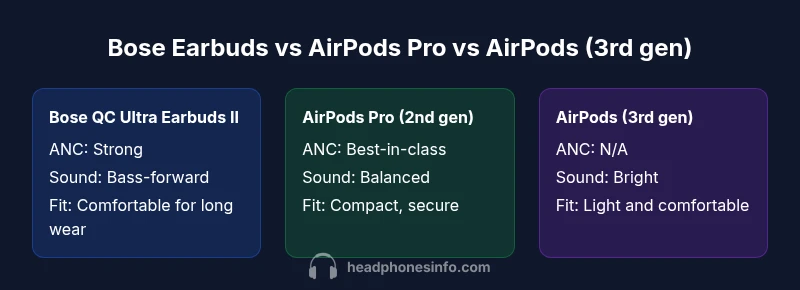
| ANC performance | Strong ANC with reliable wind isolation | Best-in-class ANC in most environments | No active ANC (basic earbuds) |
| Transparency mode | Effective transparency for social listening | Excellent transparency with adaptive features | No |
| Sound profile | Bass-forward, warm with clear vocals | Balanced, detailed mids with expansive soundstage | Bright, vocal-centric with crisp highs |
| Battery life (earbuds) | Approx. 6 hours | Approx. 6 hours | Approx. 6 hours |
| Charging case life | Up to ~24 hours total | Up to ~24 hours total | Up to ~24 hours total |
| Water resistance | IPX4 | IPX4 | IPX4 |
| Best for | Android users and bass lovers | iOS users and ANC enthusiasts | Casual listeners and Apple fans |
Upsides
- Helps identify ecosystem-specific advantages (iOS vs Android)
- Clarifies trade-offs between ANC strength and comfort
- Frames price/value through realistic ranges rather than fixed prices
- Guides use-case based decisions without bias
Disadvantages
- May oversimplify subjective comfort and fit
- Mixed models require additional testing to confirm preferences
- Could encourage preference based on brand loyalty rather than sound alone
AirPods Pro generally edges Bose Earbuds for iOS users with stronger ecosystem integration and top-tier ANC; Bose Earbuds excel for Android users and bass-forward sound.
Choose AirPods Pro if you want seamless Apple compatibility and best-in-class ANC. Choose Bose Earbuds if cross-platform flexibility and bass-driven sound are your priorities. The decision hinges on ecosystem needs and listening preferences.
People Also Ask
Which offers better ANC, Bose Earbuds or AirPods Pro?
AirPods Pro generally provides stronger ANC with more consistent wind cancellation, while Bose Earbuds offer solid ANC with a comfort-focused fit. The right choice depends on whether you prioritize the strongest isolation or long-wear comfort.
AirPods Pro typically has the stronger ANC, but Bose is no slouch in noisy environments.
Are Bose Earbuds compatible with iPhone?
Yes, Bose Earbuds work with iPhone and offer Bluetooth pairing without issue. Some iOS-specific conveniences may be more limited compared to AirPods Pro which are designed for deep iOS integration.
Yes, they work with iPhone, though AirPods Pro integrates more deeply with iOS.
Which is better for calls?
Both deliver clear calls, but AirPods Pro typically edge out in windy or noisy conditions thanks to Apple’s beamforming mics and system-level optimizations. Bose tends to be reliable as well, especially in controlled environments.
AirPods Pro usually has crisper voice pickup, Bose is dependable too.
Do these earbuds have water resistance?
Yes. Both Bose Earbuds and AirPods Pro carry IPX4 ratings, meaning they resist sweat and light splashes, which makes them suitable for workouts.
Both have IPX4 protection, so they handle sweat and rain fairly well.
Which should I buy if I use Android mainly?
Bose Earbuds tend to pair more flexibly with Android devices and offer broad app-based customization, while AirPods Pro can still work but don’t leverage Android-specific features as much.
If you use Android, Bose may feel more integrated and customizable.
Are AirPods Pro worth the extra cost over Bose for non-Apple users?
For non-Apple users, value depends on the importance of ANC, features, and cross-device compatibility. Bose may offer more uniform performance across platforms, whereas AirPods Pro shine in Apple-centric setups.
AirPods Pro are great for Apple fans; Bose can be better value if you’re multi-platform.
What to Remember
- Prioritize ecosystem: AirPods Pro for Apple users, Bose for Android-dominant setups
- ANC and transparency vary; test both in real environments
- Sound tuning diverges: Bose for punchy bass, AirPods Pro for balanced clarity
- Consider fit and comfort for long listening sessions
- Use price ranges and retailer deals to maximize value