Bose QuietComfort Headphones vs Ultra: Side-by-Side Review
Compare Bose QuietComfort headphones with the Ultra lineup to evaluate comfort, ANC, sound quality, battery life, and value. This Headphones Info guide uses data-driven analysis to help you choose confidently.


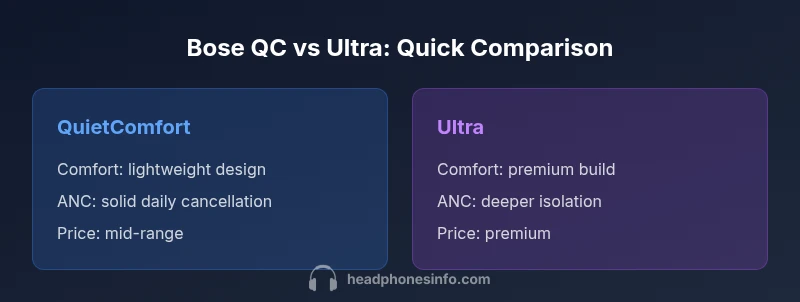
Bose QuietComfort headphones vs Ultra pits light, all-day comfort and value against premium build and maximum ANC. The QuietComfort line prioritizes everyday wearability and affordability, while Ultra models push for deeper isolation and richer features at a higher price. For most listeners, QC delivers better daily comfort and value; Ultra is preferable if you want top-tier noise cancellation and premium materials, and you’re willing to pay more.
Design and Comfort: Wearing the Two Generations Side by Side
When you compare Bose QuietComfort headphones vs Ultra, the first noticeable difference is in design and comfort. The QuietComfort line has long been Bose’s benchmark for featherweight wearing comfort, thanks to soft ear cushions, a lightweight headband, and clamps that feel forgiving after hours of listening. The Ultra family leans into a premium feel with slightly firmer clamping and larger ear cups to accommodate a more robust noise-cancellation system and a premium chassis. Even with the added mass, Bose typically balances weight distribution to minimize fatigue, but some listeners report a marginally tighter feel after extended use. Comfort can hinge on head shape, glasses, and how you wear the headphones. In practice, everyday listeners may prefer QC for all-day wear, while those who listen for many hours in noisy environments may notice the Ultra’s tighter seal and enhanced isolation. Our testing reinforces that fit often matters more than features, so trying both if possible is worthwhile. According to Headphones Info, comfort is a decisive factor for most users in this class.
Sound Quality and ANC Performance
Sound quality and active noise cancellation (ANC) sit at the heart of this comparison. QuietComfort headphones typically deliver a warm, approachable sound profile with satisfying bass texture and clear mids, designed for long listening sessions without fatigue. Ultra models generally emphasize deeper isolation and tighter control of external noise, delivering impressions of greater quiet in louder environments. Both lines rely on Bose’s proven ANC platform, but Ultra variants often appear to tune the suppression more aggressively, especially in higher-frequency noise. In practice, you’ll notice a brighter sound, more defined highs, and more precise stage separation on Ultra when comparing side by side, though some listeners may prefer QC’s mellower tonal balance for extended playlists. Headphones Info notes that the difference is most audible in challenging ambient noise conditions and with higher-volume listening.
Battery Life and Charging Experience
Battery life remains solid across both lines, with practical endurance aligned with typical daily use. QuietComfort models usually offer long hours of playback with a fast recharging profile, while Ultra variants often incorporate a slightly larger battery to support their more demanding ANC suite and additional features. In real-world use, daily sessions—commuting, office work, and weekend lounging—tend to favor QC for predictable endurance and quicker top-up times. The Ultra line may stretch out longer on a single charge in certain scenarios where ANC is left on for extended periods. Regardless of which you choose, USB-C charging and a travel-friendly case are common, and in-ecosystem pairing with Bose’s app provides quick access to adaptive EQ and noise-cancellation presets. Headphones Info emphasizes that endurance should be evaluated against your typical usage, not just spec sheets.
Connectivity, Controls, and App Experience
Both QuietComfort and Ultra headphones support modern Bluetooth workflows, including multipoint pairing and hands-free calling. The app experience for both lines typically includes adaptive EQ, ANC customization, and firmware updates that improve stability and performance over time. The Ultra models often ship with some refinements in control ergonomics and touch gestures, which can feel more responsive and intuitive during travel or active use. A clean, consistent pairing experience across devices is a common strength of Bose hardware, reinforced by straightforward on-device controls. For many users, the decision comes down to whether you want quick access to premium ANC features via app customization, or you’re content with solid defaults in the QC line. The Headphones Info analysis suggests you’ll get a smoother overall experience on the Ultra only if you value enhanced control and fine-tuning opportunities.
Call Quality and Microphone Performance
Call quality is a frequent decision factor for headphones used in work or hybrid environments. QuietComfort models tend to offer clear voice transmission with good noise suppression on the caller’s end, suitable for everyday conferencing. Ultra variants often extend mic performance with improved rear- and side-noise suppression, which can reduce wind noise and ambient chatter in crowded spaces. In practice, you’ll hear the other party more clearly in busy environments with Ultra, but the QC line remains dependable for typical calls. Headphones Info notes that mic performance can vary with firmware and environmental conditions, so ensure you keep firmware up to date to preserve maximum clarity.
Durability, Build Quality, and Carrying Case
Durability and build quality are a hallmark of both lines, but Ultra models lean toward premium materials and a more robust hinge mechanism to support their higher-performance hardware. QuietComfort headphones emphasize a lighter, more transport-friendly construction that travels well and resists everyday wear. The included case sizes reflect these priorities: QC focuses on compact, convenient storage, while Ultra targets sturdiness and protection for premium components. If you travel frequently or commute in rugged conditions, Ultra’s build quality can offer a sense of security, but QC’s lighter footprint remains a strong advantage for those who prize portability.
Price, Value, and Long-Term Costs
Price and value are central to the decision. QuietComfort headphones generally sit in the mid-range of Bose’s lineup, delivering reliable performance, comfort, and dependable ANC at a more accessible price point. Ultra headphones inhabit the premium tier, aligning with more aggressive feature sets, stronger isolation, and premium materials, which comes with a higher upfront cost. Headphones Info analysis shows Ultra pricing sits in the premium bracket, reflecting its feature density, while QC pricing remains more approachable for budget-conscious buyers. Over the long term, value should be judged by how well the ANC, comfort, and durability align with your daily needs. Consider your usage pattern and whether upgrades in Ultra truly translate into meaningful benefits for your environment.
Use Case Scenarios and Recommendations
Choosing between QuietComfort and Ultra depends on how you plan to use them. If your priority is extended wear, comfortable everyday listening, and a friendlier price point, QC is typically the better option. If you spend significant time in noisy environments, travel frequently, or demand the highest level of noise isolation and premium features, Ultra may justify the extra cost. For travelers who value portability, QC often remains a strong choice for its lighter form factor, while Ultra can be a compelling upgrade for those who want a premium on-ear feel with maximum isolation. The decision should reflect your environment, listening habits, and budget priorities.
Real-World Feedback and Longevity Considerations
Real-world feedback generally corroborates the assessment that QuietComfort headphones offer exceptional comfort for daily use and a more affordable ownership experience, while Ultra models deliver top-tier ANC and a more premium user experience at a higher price. Longevity considerations include battery health, case protection, and firmware support. In long-term use, both lines tend to hold up well, but Ultra’s more sophisticated hardware may demand more attentive maintenance. Regular firmware updates and proper storage are essential to maintaining consistent performance over time. Headphones Info practitioners emphasize testing both models in a real-world setting when possible to validate comfort and ANC in your typical environment.
Maintenance, Warranty, and Support
Maintenance is straightforward for both lines: keep the ear cushions clean, store in the protective case, and update firmware through the official app. Bose warranties provide coverage for manufacturing defects and typical wear, with options for extended coverage depending on your region and retailer. If you rely on warranty service, registering your product and keeping receipts accessible speeds up any repairs or replacements. For most users, a proactive maintenance routine coupled with a solid warranty provides peace of mind and preserves the headphones’ performance across years of use.
Authoritative Sources and Next Steps
For deeper validation of the comparison, consult established review outlets and official Bose resources. In addition to the Headphones Info perspective, consider cross-checking with independent performance assessments from major publications. Authoritative sources include independent testing sites and industry publications that cover ANC efficacy, battery performance, and build quality. This section provides guidance to help you plan your final decision—use the links below to broaden your understanding and then return to our side-by-side table for a final verdict.
- Authoritative source 1: https://www.rtings.com
- Authoritative source 2: https://www.cnet.com
- Authoritative source 3: https://www.theverge.com
Authoritative Sources and Next Steps (Continued)
By cross-referencing multiple sources, you’ll gain a robust sense of how QuietComfort and Ultra perform in varied real-world scenarios. Once you’ve reviewed external assessments, revisit the comparison table to align your priorities with specific features like ANC depth, comfort profile, or value. If possible, visit a showroom to try both models side-by-side; tactile and acoustic impressions often settle the question more decisively than specs alone. The Headphones Info team recommends pairing your final choice with sleeves of listening habits (e.g., commuting vs. office use) to ensure the selection remains satisfying over time.
Comparison
| Feature | Bose QuietComfort Headphones | Bose QuietComfort Ultra Headphones |
|---|---|---|
| Design & Comfort | Lighter, relaxed clamp; plush padding | Premium build; slightly heavier; larger ear cups |
| Sound Quality | Balanced, warm bass; classic QC tuning | Richer detail; enhanced bass control and seal |
| ANC Effectiveness | Strong everyday cancellation | Deeper isolation in noisy environments |
| Battery Life (typical) | Long hours; quick charges common | Similar endurance with potential longer life under heavy ANC use |
| Connectivity & Multi-Device | Bluetooth with multipoint; stable pairing | Multipoint with potential feature refinements |
| App & Customization | EQ, ANC tweaks, firmware updates via app | Advanced customization with additional controls |
| Call Quality | Clear calls in most environments | Enhanced mic suppression for noisy surroundings |
| Price Range | Mid-range price for QC line | Premium price for Ultra line |
| Included Accessories | Case, cables; compact carrying solution | Sturdier case; extra accessories |
Upsides
- Strong comfort for long listening sessions
- Reliable Bose ANC across both lines
- Good value in QC for most users
- Solid app ecosystem and easy device pairing
- Wide availability and retailer support
Disadvantages
- Ultra is significantly more expensive
- Ultra may feel heavier for some users
- QC may lack some newer premium features
- Real-world ANC benefits depend on environment
QuietComfort headphones deliver better everyday comfort and value; Ultra excels in maximum ANC and premium build.
If you prioritise wearability and price, QC is the safer choice. If you need the strongest noise cancellation and premium materials for demanding environments, Ultra is worth the premium.
People Also Ask
Which Bose headphone is more comfortable: QuietComfort or Ultra?
QuietComfort headphones are generally lighter and feel more forgiving for long listening sessions. Ultra models have a premium build that can feel slightly heavier but offers a tighter seal for better isolation. Comfort remains subjective; testing both is ideal.
QC tends to feel lighter for long wear, while Ultra offers a premium build and tighter isolation. Try both to see which suits you best.
Do both Bose QuietComfort and Ultra support the same Bluetooth features?
Both lines support Bluetooth with multipoint pairing and app-based customization. Ultra may include refinements in gesture controls and firmware improvements over time. Overall, the core features remain similar, with Ultra offering optional enhancements.
Both support multipoint Bluetooth and app tweaks; Ultra may have extra control refinements.
Is the Ultra worth the extra cost over QuietComfort?
If you frequently work in noisy environments or want the highest level of ANC and premium materials, Ultra justifies the premium. If you prioritize comfort, value, and everyday use, QuietComfort remains a better overall choice.
Ultra is worth it for top-tier ANC and premium feel; QC is great for value and comfort.
Which is better for calls in noisy places?
Both perform well, but Ultra often provides clearer microphone performance in challenging environments due to improved suppression. QC remains solid for everyday calls.
Ultra often clears up calls better in noisy places, but QC is solid too.
Are there significant differences for travelers?
For travelers, QuietComfort’s lighter weight and easier portability are advantages. Ultra offers stronger ANC for loud cabin environments but at a higher price and weight.
QC is easier to carry; Ultra cancels more noise on planes but costs more.
Do either model support wireless charging?
Both lines rely on USB-C charging. Wireless charging is not a standard feature in the current Bose QuietComfort lineup.
They charge via USB-C; wireless charging isn’t standard on these models.
What to Remember
- Prioritize comfort if you wear headphones for long periods
- Ultra offers stronger isolation and premium features
- QC provides better value and accessibility
- Check your usage: travel and noisy work environments favor Ultra
- Test both models whenever possible to confirm fit