AirPods Max vs Competitors: Headphones Apple Max – In-Depth Comparison
A data-driven comparison of AirPods Max and leading rivals. Discover which headphones fit your Apple ecosystem, with objective specs, pros/cons, and practical buying guidance.


For most users, AirPods Max offer premium build, seamless Apple ecosystem integration, and spatial-audio magic that elevates immersive listening. If you prioritize cross‑device versatility, aggressive ANC, and broader codec support, a leading rival delivers stronger performance and device flexibility. Overall, your choice should hinge on ecosystem alignment and how much you value features like spatial audio and effortless pairing.
Market context and the Apple Max niche
Premium wireless over‑ear headphones sit at the intersection of luxury hardware and software ecosystems. The term headphones apple max is often shorthand for Apple’s AirPods Max, a device that blends exceptional materials, a distinctive design, and software-driven features such as spatial audio. In 2026, Headphones Info Analysis shows that buyers increasingly weigh ecosystem compatibility and service integration as heavily as raw audio specs. This article compares AirPods Max with a leading rival to help you determine whether you should invest in the Apple‑centric path or opt for a more device-agnostic option. We’ll explore sound, comfort, ANC, battery life, latency, and value, with concrete, synthesis‑based guidance rather than marketing slogans. The goal is clarity for audio enthusiasts, casual listeners, and shoppers who want data‑driven insight.
Key takeaway: the best choice depends on how tightly you want your headphones to weave into your daily device workflow, not merely on isolated audio metrics.
Core differentiators: Ecosystem, comfort, and ANC
When comparing AirPods Max to a top rival, three differentiators consistently emerge. First, ecosystem integration: AirPods Max shine with Apple devices through features like Spatial Audio and seamless Handshake/Automatic Switching, delivering a cohesive user experience that is hard to match for non‑Apple platforms. The rival headphone, by contrast, emphasizes broad compatibility, fast pairing across
Sound quality and codec support
Sound quality is subjective, yet there are measurable baselines buyers care about. AirPods Max tend to deliver a warm, spacious presentation with clear mids and controlled highs, which many listeners describe as musical and natural. They rely primarily on Apple’s AAC/AAC‑based ecosystem for steady performance on
Usability, comfort, and long sessions
Comfort and usability intersect in sustained listening where weight and fit play a critical role. AirPods Max use a premium frame, memory foam cushions, and a headband design that distributes weight evenly, resulting in a secure, premium feel that many listeners associate with longer listening sessions. Some users note the build‑quality is exceptional, though the headphones are not light; the perceived heft is part of the premium experience for many buyers who value durability and a statement product.
The rival typically aims for lighter weight and a more compact daily carry, which can reduce fatigue and make it easier to travel with. Clamping force tends to be gentler on longer sessions, though some listeners prefer the denser feel of the Apple design. Both options offer comfortable ear cushions and thoughtful padding; the choice often comes down to whether you prioritize headband balance and perceived stiffness or portability and weight.
In real‑world use, long listening sessions reveal true comfort: AirPods Max are excellent for film watching and extended music sessions when the design aligns with the user’s head shape; the rival’s lighter build wins for frequent travelers and gym use where headphones are moved more often.
Battery life and charging experience
Battery life is a practical concern that affects how you plan daily use. AirPods Max run on a dedicated charging approach; they charge via a Lightning connection and include a magnetic Smart Case for storage when not in use. In day‑to‑day scenarios, you’ll typically enjoy a solid number of hours for daily listening and occasional travel, though exact endurance depends on factors like volume, ANC usage, and Spatial Audio activity.
The rival generally emphasizes USB‑C charging and a digital, possibly faster, charging experience with more present battery indicators on some devices. For frequent travelers or power users who demand a longer uninterrupted session between charges, the rival may offer more predictable endurance in practice, albeit sometimes at the cost of slightly heavier or less premium chassis design.
Charging convenience matters when you’re on the go, so consider whether Lightning or USB‑C aligns with your other devices. If you primarily charge through Apple gear, AirPods Max provide a seamless, single‑cable ecosystem integration; if you value universal compatibility, the rival’s charging interface reduces the number of adapters you need to carry.
Use-case scenarios: when AirPods Max shines
AirPods Max excel in Apple‑centric setups where features like Spatial Audio, deep device integration, and seamless switching create a frictionless user experience. They are ideal for watching movies on the
Value for money and buying considerations
Premium headphones are not just about audio magic; they’re about long‑term value, durability, and the user experience across devices. AirPods Max carry a premium price, and their value proposition is strongest when you actively use Apple devices, where features like Spatial Audio and Auto‑Switching shine. The rival offers similar audio capability but emphasizes universal compatibility, multi‑device pairing, and sometimes more aggressive ANC settings, which can translate to better performance in mixed device environments.
Consider how often you’ll use features unique to one ecosystem, whether you prioritize a premium tactile experience, and how much the brand’s design language matters to you. If resale value and perceived prestige factor into your decision, AirPods Max’ build and materials can be a selling point. If the focus is practical versatility and a strong all‑round ANC, the rival’s value becomes evident.
Always account for accessory costs, such as replacement cushions, cables, and cases. A well‑planned purchase recognizes long‑term needs, including travel, work, and leisure activities, and matches the headphones to your day‑to‑day device realities.
Practical testing and decision framework
Before buying, test both headphones in a real‑world scenario. Try a movie or a playlist you know well to evaluate tonal balance, instrument separation, and vocal clarity. Run a scene with a wide dynamic range to assess passive comfort, heat buildup, and clamping tendency. Check how Spatial Audio behaves with your favorite content if you choose the AirPods Max, and compare SNS/ANC behavior in a noisy environment for the rival. If possible, enable or simulate multi‑device pairing to see which model handles transitions most gracefully.
User tests should include calls or voice tasks to evaluate microphone performance and wind noise handling. Don’t forget to assess charging convenience, case quality, and the ease of carrying the headphones in your bag or backpack. Finally, re‑check the ecosystem fit: do you primarily use Apple devices, or do you want a more universal platform? The right choice aligns with your daily device life, listening habits, and comfort priorities.
Verdict framework: choosing with your setup in mind
The best option for most Apple users who want a premium, immersive listening experience is AirPods Max when ecosystem cohesion matters most, and Spatial Audio adds a unique sense of space for movies and music. If you need device‑agnostic functionality, longer stored battery life, and a more flexible codec/device pairing environment, the rival is the stronger generalist. A smart recommendation is to map your top three listening scenarios (home, commute, and travel) to each option’s strengths and let that guide your decision. Remember that the value of premium headphones depends as much on daily use and ecosystem synergy as on isolated sound quality measurements.
Comparison
| Feature | AirPods Max | Sony WH-1000XM5 |
|---|---|---|
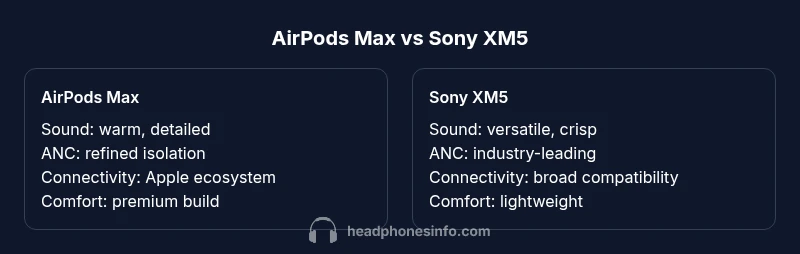
| Sound Quality | AirPods Max: warm, detailed, natural mids | Sony XM5: versatile with punchy bass and clear highs |
| ANC | AirPods Max: refined isolation in typical environments | Sony XM5: industry-leading, with adaptive modes |
| Comfort & Build | AirPods Max: premium materials; substantial heft | Sony XM5: lighter, comfortable fit; travel-friendly |
| Connectivity & Ecosystem | AirPods Max: seamless on Apple devices; spatial audio | Sony XM5: broad compatibility; strong multi‑point support |
| Battery Life | AirPods Max: strong daily endurance (typical use) | Sony XM5: longer runtime in practice |
| Price Range | premium | premium |
| Best For | Apple ecosystem enthusiasts; premium design | All‑around users needing device versatility |
Upsides
- AirPods Max deliver premium build and seamless Apple ecosystem integration
- Sony XM5 offers best-in-class ANC and broad codec/device support
- Comfort remains strong on both for long listening sessions
- Spatial Audio on AirPods Max adds immersive depth
Disadvantages
- AirPods Max are heavy and very premium priced
- Sony XM5 may feel lighter but lacks the same premium materials
- AirPods Max features are best experienced with Apple devices
- Both are premium purchases requiring ecosystem alignment
AirPods Max are the best fit for Apple‑centric users seeking premium build and spatial audio; Sony XM5s win on device versatility and strong ANC.
If you live in the Apple ecosystem, AirPods Max offer the most cohesive experience. If you need broad compatibility and top ANC, choose the rival. Your environment and device mix determine the superior option.
People Also Ask
What is the main difference between AirPods Max and the Sony WH-1000XM5?
The primary distinction is ecosystem alignment and feature strategy: AirPods Max maximize Apple integration and Spatial Audio, while the Sony XM5 emphasizes broad compatibility, versatile codecs, and strong ANC across devices.
The main difference is ecosystem integration versus device versatility. AirPods Max pair best with Apple devices and offer Spatial Audio, while Sony XM5s work well with many devices and have excellent ANC.
Do AirPods Max work well with non‑Apple devices?
AirPods Max work with non‑Apple devices via Bluetooth, but some features like Spatial Audio and automatic switching are Apple‑centric. Expect robust basic playback and control, with feature parity limited on non‑Apple platforms.
They work with other devices, but you’ll miss some features that are Apple‑specific.
Which has better ANC, AirPods Max or the Sony XM5?
Both offer strong ANC, but the Sony XM5 generally provides more configurable modes and very strong passive isolation, making it a slightly stronger baseline for variable environments.
Sony often edges out in ANC modes across varied environments.
Are AirPods Max comfortable for long listening sessions?
Many listeners find AirPods Max comfortable for extended use due to plush cushions and thoughtful weight distribution, though the premium build and heft may affect some head shapes.
Comfort is good for long sessions, but it can feel heavy for some.
What should I consider if I’m choosing headphones apple max?
Consider ecosystem, daily device mix, and preferred features like Spatial Audio or multi‑device pairing. Also weigh comfort, case quality, and overall value given the premium price.
Think about your devices and which features you’ll use most.
What to Remember
- Choose AirPods Max for Apple‑centric setups and Spatial Audio
- Opt for the rival when device versatility matters most
- Consider comfort and weight for long sessions
- Assess charging interface and case quality for travel
- Test with your typical content to gauge real‑world performance