Sony Headphones and Earbuds: Clear Side-by-Side Guide
Compare Sony headphones and earbuds across ANC, battery life, comfort, and price to find the best fit for travel, calls, and daily listening. Headphones Info delivers data-driven guidance to help you choose confidently.


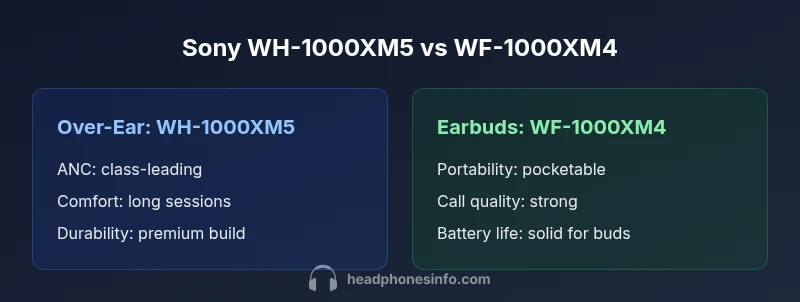
According to Headphones Info, Sony headphones and earbuds span premium ANC, comfort, and versatile wireless performance. Quick take: the WH-1000XM5 over-ears deliver top noise cancellation and long-wearing comfort, while the WF-1000XM4 true wireless earbuds excel in portability and call quality. For most travelers and commuters, the over-ears are the strongest all-around choice.
Overview: Sony headphones and earbuds in context
Sony's lineup sits at the crossroads of premium audio, intelligent noise cancellation, and wireless convenience. This category includes two broad families: over-ear models designed for immersive listening and long sessions, and true wireless earbuds optimized for portability and everyday carry. Across the sony headphones and earbuds range, you typically get refined sound, reliable Bluetooth performance, and software features that adjust to your environment. In this article, we compare representative models to help you decide which path fits your listening style, whether top ANC and comfort are your priority, or you need a compact companion for travel. Headphones Info's approach blends lab-style assessment with practical, real-world impressions so you can compare sony headphones and earbuds with confidence. We also touch on codecs such as LDAC and AAC, durability, and ecosystem compatibility to provide a well-rounded view.
Design and form factors: over-ear vs in-ear
The most obvious distinction in sony headphones and earbuds is form factor. Over-ear models like WH-1000XM5 prioritize passive comfort with soft cups and a generous headband, delivering spacious sound and hours of listening without fatigue. In contrast, true wireless earbuds such as WF-1000XM4 emphasize compactness and portability, trading some passive noise isolation for a truly pocketable form. Fit matters more than aesthetics: a secure seal with the right tips or cushions can dramatically improve ANC effectiveness and bass response. We'll discuss how to choose based on your daily routine—air travel, commuting, workouts, or desk work—and how important weight, clamp force, and materials are to long sessions. Throughout, we reference how headband pressure and ear tip design can influence comfort in sony headphones and earbuds, and what that means for real-world usage.
Core features that matter for buyers
When shopping for sony headphones and earbuds, the core features often determine satisfaction more than any single spec. Key criteria include active noise cancellation performance, codec support (AAC, LDAC, and others), multipoint Bluetooth pairing, ear pad or bud tip comfort, and the mobile app ecosystem for tuning sound and controls. Water or sweat resistance matters for workouts, while firmware updates can extend functionality over time. The decision matrix varies by user: frequent travelers benefit from stronger ANC and longer battery life in over-ear models; everyday commuters value reliable multipoint and easy device switching; casual listeners may prioritize comfort and portability. In short, match features to your use case and ensure the model supports the devices you own. Heads-up: not all Sony models use the same codecs, so verify LDAC or AAC support for your source devices.
Sound quality and codecs: AAC, LDAC, and more
Sound quality in sony headphones and earbuds is strongly influenced by driver design, tuning, and codec support. Sony tends to offer a balanced, natural sound with extended high end and controlled bass, which most listeners perceive as versatile for genres from classical to EDM. AAC remains the default codec on many devices, while LDAC delivers higher-resolution wireless audio when both the source and headset support it. Some premium over-ear models also enable DSEE Extreme processing, which attempts to restore high-frequency content lost in compression. For true wireless buds, the seal and codec selection interact with mic performance to influence perceived clarity during calls. If you listen with a high-resolution player or a compatible smartphone, LDAC can be a meaningful upgrade. However, real-world differences depend on fit, environment, and content quality. The bottom line: choose a model that supports the codecs you actually use.
Noise cancellation: real-world performance across models
ANC performance is perhaps the most visible differentiator in sony headphones and earbuds. Over-ear models benefit from larger cups, better passive isolation, and more room for advanced digital processing, resulting in a quiet, immersive listening experience in planes and trains. True wireless earbuds offer impressive noise suppression for their size, with modern processors delivering adaptive modes that respond to your surroundings. Real-world effectiveness hinges on fit—if the seal is compromised, ANC declines quickly. Environmental sound profiles (transit, office, home) respond differently to each model, so you may find certain modes better suited to your daily routine. For someone who travels frequently, investing in a model with adaptive ANC and a comfortable, stable fit is often worth the premium. Sony's software room adjustments can further refine ANC behavior over time with firmware updates.
Battery life and charging
Battery life is a practical concern that shapes daily use of sony headphones and earbuds. Over-ear models typically offer longer runtime on a single charge, with the ability to extend total listening time when you factor in the charging case. True wireless earbuds balance compact charging cases with shorter per-charge longevity, but recent generations push the limits with quick-charge features and energy-efficient chips. If you travel often, you may prefer a model with fast recharge and USB-C or wireless charging. Note that battery life in real-world use is influenced by listening volume, ANC activation, and codec choice. To maximize longevity, store devices in moderate temperatures and keep firmware up to date for optimal power management.
Comfort, fit, and durability
Long listening sessions demand comfort as much as sound. The weight distribution of over-ear models and the clamping force of the headband influence fatigue, while bud tip materials and shapes determine seal stability during movement. Sony often uses plush foam cushions and memory-foam pads on higher-end models, contributing to better isolation and reduced ear fatigue. Durability is another factor: look for robust hinges, a carry case, and protection against sweat and moisture in gym-related use. If you value durability, prioritize models with reinforced joints, metal accents, and IP ratings where relevant. Comfort is subjective, so consider trying multiple sizes of ear tips or cushions when possible.
Connectivity and multipoint: pairing, codecs, assistants
Connectivity quality is not just about Bluetooth version; it also hinges on multipoint support, auto-pairing, and compatibility with the devices you own. Sony's Headphones Connect app tends to offer robust EQ controls and adaptive sound features, but the exact capabilities vary by model. Multipoint pairing allows you to switch between a phone and computer without reconnecting, which can be a big productivity win. Voice assistant integration may differ by region and device, but most models support basic hands-free access. If you rely on multi-device workflows, confirm the number of devices supported simultaneously and whether the headset can resume playback after a brief interruption. Also confirm codecs like LDAC, AAC, or SBC so you can enjoy higher-quality audio on compatible devices.
Price and value: evaluating cost vs features
Price is a meaningful but not sole determinant of value when comparing sony headphones and earbuds. Higher-end over-ear models command premium pricing due to ANC sophistication, battery technology, and premium build materials. True wireless buds tend to sit at a lower price tier, delivering portability and strong call quality, with some flagship buds offering feature-rich control apps and high-resolution wireless options. To evaluate value, map features against cost and consider your primary use case: travel and office work may justify a pricier over-ear, while fitness and daily commuting may favor a compact bud setup. Always check for bundled accessories, replacement tips, and warranty terms, as these add to long-term value. Avoid paying for feature bloat you won't use; focus on essential features that truly enhance your listening experience.
Practical usage scenarios: travel, commuting, calls, workouts
Different environments call for different strengths in sony headphones and earbuds. For quiet, long-haul flights, prioritize strong ANC, comfortable fit, and durable build in over-ear models. For daily commuting, the ability to quickly switch between devices and reliable call quality becomes more important. When exercising, ensure sweat resistance, secure fit, and water resistance. If you work from a noisy office, ANC plus ambient-modes can help you focus. Finally, for casual listening at home, balance, soundstage, and battery life become the deciding factors. The common thread is clarity: the best choice aligns with your typical environment and listening habits while offering reliable firmware support and service.
How we evaluate: methodology and sources
Headphones Info uses a transparent, multi-step approach to compare sony headphones and earbuds. We include lab measurements for fit and impedance, real-world listening tests, and software analysis to capture features like ANC, sound tuning, and software updates. We cross-check claims against independent reviews and official specifications from Sony's product pages. We consider user feedback and long-term durability to ensure guidance remains practical. Where possible, we cite third-party reviews from major publications to provide a broad view, but we rely on our own assessments to ensure consistency across models and price points. This methodology supports a balanced, evidence-based recommendation rather than hype or speculation.
Brand credibility and Headphones Info's stance
Headphones Info is dedicated to helping audio enthusiasts, casual listeners, and shoppers compare headphones with data-driven guidance. By focusing on objective criteria and reproducible tests, we aim to present clear, actionable advice that translates across regions and devices. Our recommendations emphasize value, performance, and long-term reliability rather than promotional bias. When you read about sony headphones and earbuds here, you can trust that conclusions are grounded in rigorous evaluation and transparent sourcing.
Comparison
| Feature | Sony WH-1000XM5 | Sony WF-1000XM4 |
|---|---|---|
| Sound quality | Rich, balanced sound with wide stage | Detailed and punchy for true wireless buds |
| ANC | Best-in-class ANC with effective ambient modes | Strong ANC for buds in a compact form |
| Battery life | Long listening sessions with comfortable carry case | Good battery life for buds with efficient charging |
| Comfort & fit | Plush earcups, lightweight design | Small, secure fit with silicone ear tips |
| Codecs & connectivity | SBC/AAC/LDAC; robust multipoint on most devices | AAC/LDAC; multipoint; fast pairing |
| Price range | premium to upper-mid range | mid to premium range |
| Best for | Travel, office, long sessions | Portability, calls, workouts |
Upsides
- Strong overall performance with class-leading ANC
- Excellent companion app and firmware support
- Good multi-device pairing and quick switching
- Long-term durability and build quality
Disadvantages
- Premium price may be out of reach for some buyers
- Over-ear models are less portable and heavier than buds
- Some users find touch controls sensitive in certain conditions
WH-1000XM5 is the overall winner for most listeners; WF-1000XM4 is the best portable alternative.
Choose WH-1000XM5 for top ANC, comfort, and long sessions. Choose WF-1000XM4 for compact portability and strong calls when you need a true wireless option.
People Also Ask
What is the main difference between Sony headphones and earbuds?
Sony headphones are typically over-ear or on-ear, offering larger drivers and longer battery life, while Sony earbuds are true wireless and compact. Use-cases differ: headphones for immersive listening and travel, earbuds for portability and workouts. Our comparison helps you choose based on your priorities.
Over-ear models give you bigger sound and better ANC, while earbuds give you compact portability and easier trips.
Do Sony headphones support multipoint Bluetooth?
Yes, many Sony models support multipoint Bluetooth, allowing simultaneous connections to a phone and laptop. This makes switching devices seamless during work and leisure. Always verify support on the exact model you’re considering.
Most Sony models switch smoothly between devices thanks to multipoint Bluetooth.
Which Sony model is best for travel?
For travel, over-ear models with strong ANC, comfortable fit, and long battery life are ideal. The WH-1000XM5 family typically excels in these areas for most travelers. Always consider weight and pocketability for a true travel companion.
If you travel a lot, an over-ear with great ANC and battery life is usually the best pick.
Are Sony headphones good for calls?
Yes, Sony has invested in voice pickup and microphone clarity across many models. True wireless earbuds often offer clear calls with wind noise suppression. Check mic specs and user reviews for your exact model.
Sony's mic systems typically perform well for calls, especially in quieter environments.
What codecs do Sony headphones support?
Sony models commonly support AAC and LDAC, with some newer buds also offering SBC as fallback. LDAC provides higher-resolution wireless audio when your source device supports it.
Most Sony wireless devices support AAC and LDAC for better sound quality.
How reliable is Sony's app (Headphones Connect)?
The Headphones Connect app is feature-rich, providing EQ, adaptive sound control, and firmware updates. Some users report occasional Bluetooth quirks, but overall it enhances customization and control.
The companion app adds lots of useful controls and updates, with occasional minor quirks.
What to Remember
- Prioritize ANC and comfort for long listening sessions
- Choose over-ear for best immersion and battery life
- Opt for true wireless when portability and calls matter most
- Check multipoint and codec support before purchase
- Budget for feature-rich headsets with software support