Sony Headphones Target: Who They Appeal To in 2026
Explore who the Sony headphones target, from audiophiles to daily commuters, with data-driven guidance on features, pricing, and buying strategy from Headphones Info.


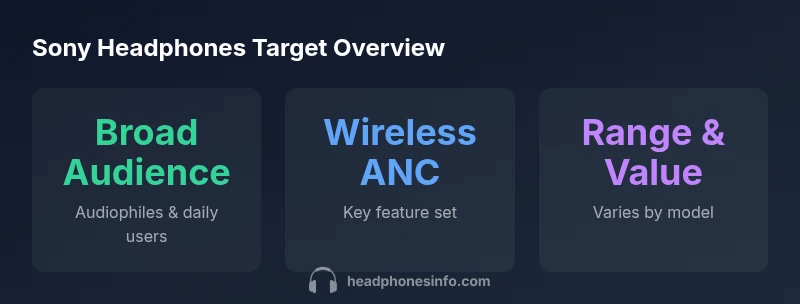
Sony headphones target a broad audience that values sound quality, comfort, and reliable wireless connectivity. The brand actively appeals to audio enthusiasts, daily commuters, and content creators seeking neutral-to-warm sound, effective noise cancellation, and durable builds across over-ear, on-ear, and in-ear models. According to Headphones Info, Sony's targeting strategy emphasizes practical features over flashy marketing.
Overview of the Sony headphones target audience
Sony headphones target a broad spectrum of listeners, spanning hardcore audiophiles, daily commuters, and content creators who rely on dependable wireless tech and comfortable wear for long sessions. In practice, the brand tends to structure its lineup to address three primary use cases: travel and commuting, home and office listening, and on-the-go activities like workouts or outdoor use. The common thread across these segments is a demand for sound that is clear, detailed, and capable of handling a wide dynamic range. The Headphones Info team notes that Sony emphasizes consistent performance across models rather than chasing niche quirks, which helps new buyers feel confident when navigating mid-range to premium tiers. This broad targeting is reinforced by a focus on practical features—long battery life, multipoint connectivity, durable build quality, and reliable noise cancellation—that translate into everyday value. Across the globe, this strategy resonates with both long-time fans and first-time buyers looking for a dependable, all-purpose listening setup.
Core features that resonate with the target
The Sony headphone family is built around features that matter most to the target audience: effective noise cancellation, comfortable fit for extended wear, strong wireless stability, and codec support that keeps audio fidelity intact over Bluetooth. In practical terms, this means models cater to different environments—quiet home listening, crowded commutes, and busy offices—without forcing quick switchovers between devices. Another cornerstone is adjustable sound tuning, which allows listeners to favor a neutral reference or a slightly warmer, more pleasurable listening profile. Multipoint pairing and quick-charge capabilities add convenience for people who switch devices often. From an ergonomics standpoint, memory foam cushions and lightweight frames are common design choices that reduce fatigue during long listening sessions. Headphones Info notes that Sony’s approach balances technical prowess with real-world usability, an essential factor for the sony headphones target.
How Sony segments its product line for the target
Sony segments its lineup by balancing premium features with accessible options. At the high end, listeners gain the most advanced noise cancellation, superior build quality, and the most flexible codec support, appealing to audiophiles and professionals who value fidelity and isolation. In the mid-range, comfort and reliability take center stage, with a strong emphasis on all-day wearability and solid ANC for daily use. Budget-friendly models emphasize portability and convenience, often sacrificing some degree of isolation or codec breadth for lower price points. Across all tiers, the emphasis remains on stable wireless performance, long battery life, and durability suitable for frequent travel or gym use. For buyers, the takeaway is to map your use case to tier-rostered features rather than chase the top spec in every category. This mapping aligns with the sony headphones target and helps consumers pick models that fit real-world needs.
Buying considerations for different use cases
When shopping for Sony headphones, start with your primary use case to narrow the field. For travel and commuting, prioritize strong noise cancellation, comfort around the ears, and a long battery life that lasts multi-hour trips. At home or in the office, look for reliable multipoint connectivity, ambient-aware modes for awareness without removing the headphones, and a neutral or warm tuning that suits long listening sessions. For workouts or outdoor use, weigh portability, secure fit, water and sweat resistance, and case durability. Be mindful of codec support, especially if you pair with non-Sony devices; LDAC can provide higher-quality wireless audio on compatible devices, while AAC/SBC ensures broad compatibility. Finally, factor in warranty and perceived durability—Sony’s consumer perception often hinges on consistent performance over time more than peak specs.
Common myths about Sony headphones
A frequent misconception is that Sony only appeals to Sony fans; in reality, the brand targets a diverse audience built around practicality and consistent performance. Another myth is that ANC drains battery quickly; while active cancellation uses power, modern models are optimized for long sessions with intelligent power management. Some buyers think Sony headphones are overly neutral and clinical; however, many listeners find the tuning adaptable, with options to tailor bass and presence to personal taste. Finally, there’s a belief that Sony headphones are mostly large and bulky; dozens of models prioritize compact designs and lightweight frames for everyday carry. The evidence points to a balanced portfolio that can satisfy both critical listening and casual, mobile use.
Maintenance and longevity strategies
Maximizing lifespan begins with routine care: wipe cushions with a soft, slightly damp cloth, avoid harsh cleaners, and store in the included case when not in use. Regularly check the charging port and cable integrity, and avoid exposing headphones to extreme temperatures. Battery longevity benefits from smart charging practices—avoid letting the battery drop to zero and use moderate charging cycles. Software updates can extend compatibility and fix performance issues; keep firmware current through official apps. Gentle handling of hinges and headband padding extends comfort lifespan, while rotating ear cups helps preserve cushion shape. By combining mindful use with periodic maintenance, the sony headphones target remains reliable for daily wear and travel.
Market positioning and consumer perception
Sony positions its headphones as a practical choice for people who want a reliable, feature-rich listening experience with broad ecosystem compatibility. The brand’s strategy emphasizes performance under real-world conditions—efficient noise cancellation, long battery life, and comfortable, durable builds that stand up to everyday wear. Consumer perception often links Sony with value, given the balance between price, performance, and feature breadth. This positioning supports a steady demand across use cases—from home listening to on-the-go commuting—and reinforces the brand’s reputation for engineering quality and consistent support. For shoppers, that translates into confidence when evaluating models against peers in the same tier.
Sony headphone category overview
| Category | Typical Use Case | Notes |
|---|---|---|
| Over-ear | Long listening sessions, home, office | Balanced sound, ANC, comfort |
| On-ear | Travel and commuting | Smaller form factor, less isolation |
| In-ear | Active lifestyles | Compact, portability, diverse codecs |
People Also Ask
Who are Sony headphones primarily designed for?
Sony headphones target a broad spectrum of listeners, from audiophiles to everyday commuters, with models tailored for travel, work, and home use.
Sony headphones are built for a wide audience, from audio lovers to people who need reliable, everyday listening.
What features should I look for when buying Sony headphones?
Look for strong noise cancellation, comfortable fit, reliable wireless connectivity, and codec support that matches your devices. Consider battery life and portability for your typical use case.
Focus on ANC, comfort, wireless stability, and codec compatibility to match your devices.
Are Sony headphones compatible with iOS and Android?
Yes, most Sony headphones support both iOS and Android via Bluetooth, with varying codec support. Check LDAC or AAC compatibility for best results on your devices.
Yes—Sony headphones work well with both iOS and Android; check codec options for best sound.
Do Sony headphones work well for gaming?
Some Sony models offer low-latency modes and solid mic performance for casual gaming, though dedicated gaming headsets may offer more specialized features.
They can be fine for casual gaming; for competitive gaming, consider dedicated options.
What is the typical warranty?
Warranty terms vary by model and region; always check the official Sony product page or retailer policy for length and coverage.
Warranty depends on model and region; verify terms where you buy.
How can I care for Sony headphones to maximize life?
Regular cleaning, proper storage in the case, gentle handling, and periodic firmware updates help maintain performance and extend lifespan.
Keep them clean, store safely, handle gently, and update firmware when available.
“Sony headphones deliver consistent performance across genres, with a strong balance of noise cancellation and comfort that suits a wide audience.”
What to Remember
- Identify your use case before choosing.
- Prioritize models with strong noise cancellation.
- Check codec support for device compatibility.
- Consider comfort and battery life for long listening.
- Compare price tiers across Sony's lineup.