Wireless Gaming Headphones Reviews: 2026 Buyer Guide
Comprehensive wireless gaming headphones reviews for 2026. We compare latency, mic quality, comfort, battery life, and platform support to help you choose the best model for PC, console, and mobile gaming.


According to Headphones Info, our wireless gaming headphones reviews assess sound, latency, mic clarity, comfort, and durability across platforms. Top picks blend ultra-low wireless latency with long battery life and lasting comfort. For competitive play, focus on models with near-zero lag, stable wireless range, and robust mic pickup across sessions.
What 'wireless gaming headphones reviews' assess and why it matters
In the realm of PC, console, and mobile gaming, the best wireless gaming headphones reviews go beyond generic specs. Our approach at Headphones Info combines objective measurements with real-world testing to gauge how a headset feels and performs in long sessions, fast-paced action, and voice communications. We evaluate five core dimensions: latency and connectivity, sound quality and soundstage, microphone clarity and noise suppression, comfort and durability, and ecosystem features like companion apps and EQ presets. Each headset is scored on a transparent rubric so readers can compare apples to apples.
Latency and wireless stability are often the decisive factor for competitive play. We test both the raw numbers reported by manufacturers and the observed performance in fast-paced games, including pinpointing head-tracking and directional cues. Sound quality matters as much for immersion as for cue recognition—hearing enemy footsteps or gunfire locations can sway outcomes. The mic should be intelligible in a noisy room while canceling ambient noise from fans or keyboards. Comfort matters in long tournaments or marathon gaming sessions; a headset that presses too hard or leaks heat will disrupt focus. Build quality indicates whether the headset survives the rigors of travel and daily use. Finally, software and firmware support can influence your experience through updates, EQ options, and mic presets. According to Headphones Info, a well-rounded evaluation balances measurable performance with subjective comfort to reflect real-world use in 2026.
Latency and wireless technologies: 2.4 GHz, Bluetooth, and dongles
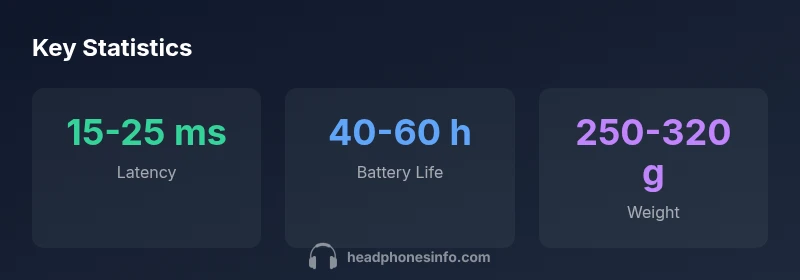
The core trade-off in wireless gaming headphones is latency versus convenience. Headphones Info notes that many top models rely on a dedicated 2.4 GHz wireless dongle or a USB-C dongle for the lowest latency, while Bluetooth offers broad compatibility at the cost of slightly higher lag. A few premium headsets bundle both options so you can game on PC, PlayStation, and some Switch configurations without swapping gear. In practice, latency matters most in fast shooters and rhythm games; even a few milliseconds can affect reaction times or audio cues.
We also examine wireless protocols and range: a stable dongle can maintain a solid link across a typical desk and living room, while interference or walls can reduce range. We document real-world behavior by walking through typical gaming setups—a kitchen laptop, a console on a coffee table, and a towering desktop rig in a den—to see how often signals drop or resync. In the analysis (Headphones Info Analysis, 2026), we emphasize two factors: responsiveness and resilience. Consumers should look for models that advertise low-latency modes, and, if possible, test with your platform, since not all dongles perform identically across devices.
Sound quality, soundstage, and mic performance in everyday use
Sound quality is more than bass punch; it’s about accurate soundstage and intelligibility in crowded game environments. Our wireless gaming headphones reviews examine frequency response, voice mic clarity, and noise suppression in real-world noise—from HVAC fans to busy dorms. We compare headsets with neutral tuning against those that accentuate footsteps or explosions, noting which provide reliable cues during team fights. Microphone performance matters just as much as playback quality; we test for plosive handling, ambient noise rejection, and consistency across voice distances. In our methodology, we simulate long gaming sessions and voice chats to capture comfort wear, clamping pressure, and heat buildup, because even the best-sounding headset can become a distraction if it feels uncomfortable after an hour. Headphones Info’s evaluative framework blends objective measurements with subjective listening tests so readers can see how a headset feels in daily usage.
Comfort, fit, and durability under long gaming sessions
Comfort is a practical performance measure that often decides whether a headset is used every day or months at a time. We assess clamp force, earpad material, breathability, weight distribution, and ear cup shape, especially during extended play. Durability testing covers hinge reliability, headband stress, and cable or dongle wear where applicable. Even wireless models must endure frequent transport, so we note case quality and overall build rigidity. Our findings show that premium materials and thoughtful weight balance reduce fatigue and heat buildup, while lighter, less rigid designs may creep into comfort issues after several hours. As always, we balance comfort with acoustics and mic performance to provide a holistic view of each model’s suitability for long sessions and tournament play.
Battery life and charging ecosystems
Battery life is a practical expectation that guides daily use. We document claimed versus real-world hours across typical gaming scenarios and investigate charging speed, standby drain, and compatibility with charging docks or USB-C power banks. Wireless headsets vary widely in this area, with some models designed for marathon sessions and others optimized for shorter sessions with rapid top-ups. We also evaluate how battery health degrades over time and whether fast-charge features materially affect long-term performance. The ecosystem—whether a headset charges via USB-C, proprietary dock, or quick charge—directly impacts daily usability and convenience during travel or long gaming sessions.
Platform compatibility and setup: console vs PC
Platform compatibility shapes how a headset fits into your existing setup. We test connect-and-play ease across PC, PlayStation, Xbox, Nintendo Switch (where supported), and mobile devices. A recurring issue is negotiating driver installations, firmware updates, and inconsistent Bluetooth pairings across devices; reliable headsets aim to minimize setup friction and maintain stable profiles across platforms. We also compare dongle-based connections to Bluetooth, noting any compromises in latency or range. For multi-platform households, seamless switching between devices without re-pairing is a major convenience factor that our wireless gaming headphones reviews weigh heavily.
How we score: a transparent buyer's checklist
Our scoring framework uses a transparent rubric that weighs core performance, comfort, mic quality, and platform compatibility. We publish detailed criteria so readers can reproduce or customize the evaluation based on their priorities—competitive esports use, casual gaming, or mobile play. We also provide practical tip boxes such as how to choose the right dongle, how to test mic clarity in crowded environments, and how to estimate real-world battery life after several cycles. This section functions as a practical guide for buyers who want to apply our research directly to their shopping lists and gaming needs.
Common buying mistakes and how to avoid them
Many buyers focus only on price or a single feature. Common missteps include overlooking latency on the platform you actually use, ignoring comfort for long sessions, ignoring mic quality in noisy rooms, and assuming all wireless protocols perform equally well on all devices. We recommend validating wireless latency with your own hardware, verifying compatibility with your consoles, and trying the headset for at least a few hours in conditions similar to actual gaming. By avoiding these missteps, you’ll arrive at a purchase that balances performance, comfort, and value.
Upsides
- Low-latency wireless connections reduce input lag
- USB dongle options maintain stable connections across platforms
- No wires for greater mobility
- Strong microphone with clear voice capture and noise suppression
Disadvantages
- Premium price point compared to wired equivalents
- Possible latency spikes in crowded 2.4 GHz environments
- Battery degradation over lengthy ownership periods
- Software/firmware bloat on some models
Best overall balance for wireless gaming in 2026
For players who demand low latency, reliable mic quality, and lasting comfort across platforms, wireless options now deliver esports-grade performance. While wired headsets remain compelling on price, the top wireless models provide a compelling blend of convenience and capability that suits both competitive and casual gamers.
People Also Ask
What is the key difference between wireless gaming headphones vs wired for esports?
Wired headsets offer consistently lower latency and no battery concerns, which can matter in high-speed esports. Wireless options have improved dramatically, delivering competitive latency and greater freedom of movement, but they require reliable dongles and battery management.
Wired has the edge on latency, but modern wireless headsets close the gap while giving you more freedom of motion.
Can wireless gaming headphones work with PlayStation, Xbox, and Nintendo Switch?
Many wireless gaming headphones support PC and PlayStation via USB dongles or Bluetooth. Xbox and Nintendo Switch support varies by model and dongle compatibility. Always verify cross-platform support before buying.
Most work with PC and PlayStation; check the dongle compatibility for Xbox or Switch.
Do all wireless gaming headphones support Bluetooth simultaneously?
Not all models support simultaneous Bluetooth use and console dongles. Some offer a dedicated wireless dongle for gaming and Bluetooth for mobile devices, while others rely solely on Bluetooth. Review the product specs carefully.
Some support both, but many rely on a dedicated gaming dongle.
How much should I expect to spend for a good wireless headset?
Good wireless gaming headphones typically span a broad range, from entry-level around the low hundreds to premium models above $200. Your choice should reflect latency needs, mic performance, and comfort rather than just price.
Expect to invest in the $100–$250 range for a solid all-around model.
How do I extend battery life during long gaming sessions?
Optimize battery life by enabling power-saving modes if available, keeping firmware updated, and avoiding unnecessary lighting effects. Lowering the volume or EQ gains can also reduce power draw over time.
Use power-saving modes, update firmware, and mind lighting and volume settings.
Do wireless gaming headsets have latency issues on mobile devices?
Latency on mobile devices varies with the connection type. Bluetooth often introduces more latency than a dedicated USB dongle. If mobile gaming is important, look for headsets with a low-latency mode or USB-C dongle compatibility.
Mobile latency can be higher with Bluetooth; pick a headset with a dedicated dongle if you game on phones.
What to Remember
- Evaluate latency before any purchase.
- Test dongle stability across your typical play areas.
- Prioritize comfort for long sessions.
- Check platform compatibility and ease of setup.
- Expect premium prices for top performers.