How Long Should a Headphone Cable Be? A Practical Guide
Discover how headphone cable length affects practicality, signal quality, and comfort. Learn common lengths, ideal use cases, measurement tips, and how to pick the right wired cable for your setup.


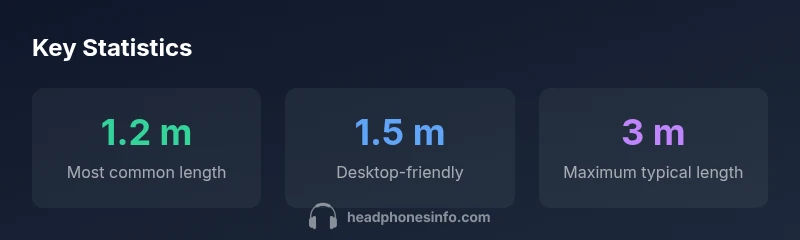
The typical wired headphone cable length ranges from about 1 meter to 3 meters, with common stock options at 1.2 m, 1.5 m, and 2 m; longer cables are available for DJ or studio use. The actual length you need depends on your setup, seating position, and whether you use an inline microphone or remote control. Shorter cables reduce clutter and signal loss, while longer cables increase tangling and resistance. Always verify connector type and shielding to ensure compatibility. For stereo listening, most users are comfortable with 1.2–1.5 meters; DJs or producers may prefer 2–3 meters for flexibility. If you plan to move around, consider wireless alternatives or coiled cables that lengthen on demand.
Understanding headphone cable length: what matters
Length influences how close you sit to your audio source and how much slack you have to move without yanking the plug. It also interacts with impedance and shielding: longer cables introduce more capacitance, potentially impacting high-frequency response if the cable, connectors, or shielding are poor. In practice, the question isn't just 'how long is the cable' but 'how long should the cable be for my listening position and gear?' The right length balances portability, comfort, and signal integrity. Shorter cables are lighter, reduce clutter, and minimize RF pickup near sources, while longer cables enhance reach when devices sit farther away or when you need to sit back from a desk. A quality cable with robust shielding and secure connectors can mitigate some losses associated with length.
Common lengths and typical use cases
For most consumer-grade headphones, stock cables span from about 1.0 meter to 3.0 meters. The majority of listeners end up with around 1.2 meters, a length that fits most portable devices and laptop workstations. For desktop listening or editing, 1.5 to 2.0 meters offers comfortable reach to speakers, keyboards, and microphones without excessive slack. Club, DJ, or stage environments often require 2.5 to 3.0 meters to accommodate movement on a chair or stage, plus space for cables to route around equipment. If you frequently travel, consider a shorter 1.0 to 1.2 meter option for portability, or opt for a detachable or coiled design that can lengthen when needed. Lastly, detachable cables enable upgrades (e.g., higher-purity conductors or low-resistance terminations) without replacing the entire headset.
How to measure for your setup
To size a headphone cable accurately, start by measuring the typical distance from your ear to the audio source in your usual listening posture. Do this with your chair at its normal distance from the desk and with any accessories in place (mic, controller, or stand). Add 20–30 cm of slack to accommodate head movements and occasional reaching for controls. If you listen from a sofa or bed, measure from ear height to the wall-mounted source or portable player. Consider cable routing: under desks, along the baseboard, or across arms-reach paths. Finally, pick a length that covers the maximum measured distance plus a safety margin, without creating tension on the plug or y-splitter. If unsure, circular or modular solutions such as detachable cables allow you to swap lengths quickly.
Longer cables vs wireless: trade-offs you should know
Choosing a longer cable can be beneficial when flexibility matters or distances are fixed, such as a professional studio or a shared workspace. However, as length increases, the cable's resistance and capacitance rise, which can subtly attenuate high frequencies if the build quality is not up to par. A well-shielded, heavier-gauge cable mitigates these issues, but costs more and is less forgiving to tugs. Wireless alternatives avoid most length-related losses but introduce latency, potential compression artifacts, and battery dependence. For stationary listening at a desk, a mid-length cable (around 1.2–1.5 meters) often provides a balanced compromise between signal integrity and convenience; if you'll be mobile around a room, a clip-on extension or detachable longer cable might be preferable.
Cable quality factors to consider
Not all cables are equal. Key quality factors include shielding (foil, braided, or combined), conductor gauge (AWG rating), conductor material (oxygen-free copper, silver-coated copper), and connector build (3.5 mm TRS, 2.5 mm balanced, or USB-C). Price generally correlates with robustness: heavier gauges reduce resistance, but only if the conductors and terminations are well manufactured. Detachable cables offer easier replacement and potential upgrades, and many high-end models use replaceable cables to maintain performance over time. If your setup is prone to interference, look for cables with ferrite cores and high-quality shielding to minimize RF noise and crosstalk.
Replacing or extending a headphone cable safely
Extending a headphone cable can be done with dedicated extension cables or detachable replacement cables designed for your headset. Always verify connector compatibility (3.5 mm TRS, TRRS, or balanced 2.5/4.4 mm) and impedance matching to avoid mismatches. Avoid cheap adapters or non-dedicated extensions, which can degrade signal and damage jacks. When possible, use a replacement cable from the same line or an equivalent aftermarket cable engineered for your impedance and driver size. If you must extend, use a higher-quality inline extension with shielding and a robust plug, and test for audible changes across your frequency range.
Maintenance and care to extend cable life
Store cables loosely wound, not tightly coiled, to prevent conductor kinking. Use a cable tie or Velcro strap to manage slack rather than stuffing the cable into a pocket. Inspect connectors and shielding for wear; replace immediately if you notice loose connections or frayed insulation. Avoid heavy wraps around devices, and keep cables away from heat or moisture. A well-maintained, properly stored cable retains flexibility and minimizes microphonic noise, ensuring consistent performance over time.
Practical scenarios: quick decision guide for length choices
Scenario A: You sit 1 meter from your laptop. A 1.0–1.2 meter cable is typically ideal. Scenario B: You sit at a desk with speakers nearby. A 1.5–2.0 meter length provides comfortable reach and clean routing. Scenario C: You move frequently around a room for gaming or editing. Consider a detachable or coiled design that can lengthen to 2–3 meters when needed. Always prioritize shielded, quality cables to preserve fidelity as length increases. If possible, favor detachable cables for easy upgrades.
Common headphone cable length ranges and use cases
| Length (m) | Best For | Notes |
|---|---|---|
| 1.0–1.2 | Casual listening / portable | Short and tidy for portable use |
| 1.5–2.0 | Desktop / studio | Balanced reach with minimal clutter |
| 2.5–3.0 | DJ / stage | Maximum length with some signal loss risk |
People Also Ask
What is the typical headphone cable length?
Most consumer headphones ship with cables ranging from 1.0 to 3.0 meters. The most common length is around 1.2 meters, with longer options available for desktop use, DJing, or studio work. If you need more reach, detachable or coiled cables can provide flexibility without permanently changing your headset.
Most headphones use about 1.2 meters by default, with longer options for desks or DJ setups.
Does longer cable degrade audio quality?
Longer cables can increase resistance and capacitance, potentially affecting high-frequency performance if the cable is poorly shielded or built. High-quality shielding, proper gauge, and reliable connectors minimize these effects, so length alone isn’t a guarantee of worse sound.
Yes, longer cables can affect sound if quality is low, but good cables mitigate most issues.
What length should I use for a desktop setup?
For desktop listening or editing, 1.5–2.0 meters is a common sweet spot, offering comfortable reach to speakers and peripherals while avoiding excessive slack. If your desk is particularly compact, 1.2–1.5 meters can work well.
1.5–2.0 meters normally fits desktop setups.
Can I extend a headphone cable safely?
Yes, but use a proper inline extension or a detachable replacement designed for your headset’s connector and impedance. Avoid generic adapters that may degrade signal or damage jacks. When in doubt, opt for a purpose-built extension from a reputable brand.
Use a quality extension or detachable cable designed for your headset.
What is the difference between coiled and straight cables?
Coiled cables lengthen as you move, reducing tension, but can introduce more resistance and potential tangling if not well made. Straight cables are simpler and often lighter, with fewer kinks but less flexibility in tight spaces.
Coiled cables stretch when you move; straight cables don’t.
Are detachable cables better than integrated?
Detachable cables make upgrading easier, allow quick replacement if damaged, and can help with portability. Integrated cables are simpler and less prone to disconnection but limit future upgrades.
Detachable cables offer easy upgrades and repair options.
“Longer cables can introduce extra resistance and capacitance, which may subtly affect high-frequency response. Quality shielding and connectors help minimize this impact.”
What to Remember
- Measure your space before buying a cable
- Choose 1.2–1.5 m for desk setups
- Avoid very long cables unless needed for movement
- Prefer detachable cables for upgradeability
- Consider coiled cables for adjustable length