Headphones Noise Cancelling Comparison: 2026 Edition
A data-driven, 2026 comparison of noise cancelling headphones across ANC effectiveness, comfort, battery life, codecs, and value to help you choose the right model for home, travel, and work.


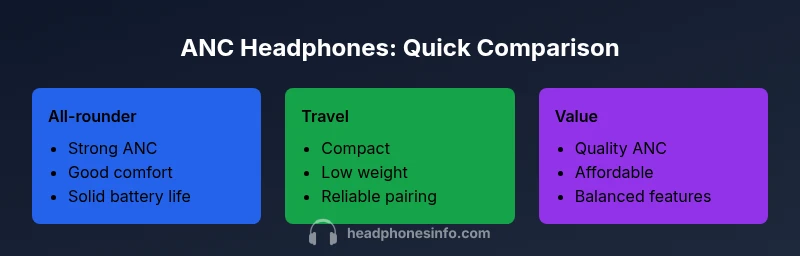
Across this headphones noise cancelling comparison, you’ll find that the strongest all-rounders balance strong ANC, comfort, and battery life, while travel-focused models emphasize compact design and low weight. Value picks trade peak performance for price, offering solid ANC with lighter features. For most listeners, the best choice depends on where you listen most (home, commute, or gym).
Why Noise Cancelling Headphones Matter in 2026
Noise cancelling remains a key factor in perceived listening quality. In busy environments—commuting, offices with chatter, or crowded cafés—ANC helps create a sense of quiet that enables clearer dialogue and more immersive music. The Headphones Info team found that a truly effective ANC setup is not just about intensity; it’s about how transparently you can switch between quiet and ambient modes, and how the headphones preserve natural timbre when noise is reduced. In this headphones noise cancelling comparison, we weigh ANC strength alongside comfort, fit, battery life, and codec support to provide a realistic picture of what consumers can expect in 2026.
According to Headphones Info Team, a robust comparison should balance quantitative ANC performance with subjective comfort and long-term reliability. This lens helps readers avoid chasing extreme attenuation at the expense of fit or warmth, which is a common pitfall when scouring fast-moving product pages.
Evaluation Principles: What We Measure in a Noise Cancelling Headphones Comparison
A rigorous comparison hinges on repeatable criteria. We assess ANC depth and attenuation profile across common frequencies, the presence and usefulness of transparency mode, and how well the system handles sudden noise like door slams or street traffic. Comfort matters because you’ll wear these for hours; battery life must be realistic; codec support affects wireless fidelity; and build quality determines durability. The Headphones Info team emphasizes a human-centered approach: tests in urban, transit, and quiet home environments to capture everyday experiences. This section introduces the framework used for all subsequent analysis and ensures our readers can translate results into real-world decisions.
We also document subjective impressions about timbre, spatial cues, and hiss or artefacts that sometimes accompany aggressive cancellation. By separating measurements from perceptual notes, we provide a balanced view that helps readers compare apples to apples across different models and price tiers.
Use-Case Nuances: Home, Office, and On-the-Go
No single model excels in every scenario. Home listening often prioritizes sonic balance and comfort for long sessions; office use may demand effective passive isolation and a leaner headband; travel requires portability, robust battery life, and reliable connectivity. In our comparison, we group options by use-case emphasis while noting cross-case strengths. By aligning your primary listening context with design trade-offs, you can narrow from dozens of candidates to a focused shortlist. This approach also helps explain why some models feel “better” in one setting but merely adequate in another.
A good rule of thumb is to choose models with flexible mode switching and consistent latency across devices. If you work with video calls, ensure microphone pickup and wind resistance are not compromised by the ANC system. Headphones that adapt smoothly to different environments tend to deliver the most satisfying long-term listening experience.
The Trade-Offs: Sound Quality vs ANC
Pushing ANC depth can sometimes alter the tonal balance, leading to a perceived dullness or a bloom in certain frequencies. Our headphones noise cancelling comparison analyzes how well models preserve instrument timbre and vocal presence while reducing ambient noise. Some headphones maintain a neutral, reference-like sound, which is preferable for critical listening, while others lean toward warmth or bass emphasis for casual enjoyment. In practice, the best trade-off is a model that minimizes artefacts such as pumping, tunnel effect, or sudden volume shifts during loud passages. By listening across genres and varying environments, listeners can identify brands that strike a natural balance between silence and sound quality.
Comfort, Fit, and Build Quality
Long sessions demand light, well-padded cups and an adjustable headband with balanced clamp force. Weight distribution and ear cushion material significantly influence perceived comfort, especially for users who wear headphones for hours. Our comparison highlights models that use breathable materials, memory foam, and wide ear openings to reduce heat buildup. Durability matters too: hinges and yokes should feel sturdy without squeaks, and hardware like hinges and swivels should operate smoothly even after daily use. A well-built pair often outlasts several mid-range upgrades, making long-term ownership more economical.
Battery Life, Charging, and Wear Time
Battery performance is more than a number on the box; it translates to real-world endurance during commutes, flights, and workdays. We assess how long you can listen between charges, how quickly you can top up, and whether power-saving features kick in during idle periods. Some models offer adaptive standby modes or on-ear sensors to optimize life, while others rely on larger housings to hold more cells. The takeaway is clear: prioritize pairs that deliver practical wear time aligned to your typical day, not just peak numbers.
Connectivity, Codecs, and App Experiences
Wireless listening hinges on stable Bluetooth connections, codec support, and app-based customization. Our analysis covers multi-device pairing reliability, latency with video playback, and the availability of high-fidelity codecs like AAC, LDAC, or aptX. Apps can enable EQ tuning, ANC depth adjustments, and transparency modes, but confusing interfaces or inconsistent updates can undermine the user experience. For professionals, microphone quality and wind rejection in calls are also part of the connectivity picture, especially when working in busy environments.
We also consider cross-platform compatibility—how well a headphone pair behaves with iOS, Android, Windows, and macOS—because seamless integration reduces friction during daily use. Headphones that deliver a coherent, predictable experience across devices are typically the most satisfying in a diverse tech ecosystem.
Sound Quality and Personal Preference: Where ANC Interacts with Tonality
ANC can influence perceived loudness and timbre, but the underlying driver is the driver unit design and the tuning chosen by the manufacturer. Our headphones noise cancelling comparison examines balance between bass, mids, and treble, as well as instrument separation and stage width. Some listeners prefer a surgical, clinical sound for studio work, while others favor a musical, immersive presentation. The best overall picks maintain a convincing sense of space and clean voice reproduction even when the ANC is active. Personal preference plays a big role, so auditioning multiple models in your typical listening environment is essential.
Use-Case Scenarios: Travel, Home, and Office (In Practice)
When evaluating headphones noise cancelling, it helps to simulate real-life routines. For travel, portability, fast charging, and stable wireless pairing matter most. At home, you might prioritize a richer tonal balance and comfort for long listening sessions. In an office, call quality and reliable connection can trump ultimate noise cancellation. By mapping a short list of your top priorities to these scenarios, you can reduce decision fatigue and identify models that satisfy most of your needs without compromising in key areas. Headphones that perform consistently in multiple contexts are the most versatile long-term investments.
Price, Warranty, and Longevity
Budget constraints are real, but the value of a pair of ANC headphones is not histrionic; it emerges from a balance of features, comfort, durability, and ongoing support. In this section we discuss how to interpret price brackets and warranty terms, why some premium models justify higher upfront costs, and how to evaluate resale value if you plan to upgrade later. The practical takeaway is to choose a model whose total cost of ownership aligns with your usage pattern, rather than chasing the newest feature set at launch. Headphones Info’s testing suggests that strong mid-range options often deliver a superior long-term experience relative to high-priced flagships in many daily scenarios.
Feature Comparison
| Feature | All-rounder ANC | Travel-focused ANC | Value-focused ANC |
|---|---|---|---|
| ANC depth | Very strong | Strong | Moderate |
| Battery life | Long | Moderate | Moderate |
| Comfort | Excellent | Good | Good |
| Weight and portability | Moderate-heavy | Lightweight | Lightweight |
| Price range | Mid-to-high | Mid | Low |
| Best for | General listening | Frequent travelers | Budget-conscious buyers |
Upsides
- Balanced performance across ANC, comfort, and battery life
- Strong build quality and consistent multi-device connectivity
- Wide codec support improves wireless fidelity
- Clear value proposition for the use-case
- Long-standing warranties and after-sales support
Disadvantages
- No single model dominates every scenario
- Premium models may be heavier and less portable
- App ecosystems can be inconsistent across brands
- Value-focused options may have compromises in ANC depth
All-rounder ANC headphones win for most listeners.
For daily use at home and on the go, a well-rounded model provides the best overall package. Travel-focused options shine when portability is the priority, while budget-friendly picks can still deliver respectable ANC with caveats on comfort and depth.
People Also Ask
What is the difference between active noise cancellation and passive isolation?
Active noise cancellation uses microphones and signal processing to cancel ambient noise, while passive isolation relies on the cup shape and sealing to block sound. ANC is most effective at steady, low-frequency noise, while passive isolation helps with higher-frequency sounds. Together they determine how quiet your listening environment will feel.
ANC uses electronics to cut noise; passive isolation comes from a good seal. For truly quiet listening, you want both working well together.
Do more expensive models always perform better in ANC?
Price often correlates with build quality, comfort, battery life, and codec support, not just ANC depth. Real-world performance varies by design, so rely on independent tests and user reviews rather than price alone.
Price isn’t the only predictor; check real-world tests to see how ANC holds up day-to-day.
Which features matter most for travel?
For travel, portability, comfort, battery life, and stable Bluetooth are critical. Quick charging and transparent mode can help you stay aware of surroundings in crowded spaces like airports.
Lightweight design and long battery life matter most for travel.
How do Bluetooth codecs affect sound quality?
Codecs determine how efficiently audio data is transmitted. Better codecs can improve wireless fidelity when your devices support them, but real-world results depend on interference and DACs.
Higher-quality codecs can improve wireless sound, but it also depends on both devices.
What should I know about comfort for long listening sessions?
Comfort depends on headband pressure, ear cushion design, weight distribution, and seal. Look for breathable materials and adjustable fit to minimize fatigue during long sessions.
Try them on for a few hours to gauge comfort and heat buildup.
What to Remember
- Prioritize a balance of ANC, comfort, and battery life for everyday use
- Choose use-case aligned models (travel vs. home) to maximize value
- Test comfort during extended wear to avoid fatigue
- Assess codec support only if you rely on wireless fidelity
- Verify warranty and service availability across regions