Heavy Headphones vs Sony WH-1000XM5: An In-Depth Guide
A data-driven comparison of heavys headphones and the Sony WH-1000XM5, covering comfort, sound, ANC, battery life, and value to help listeners decide.


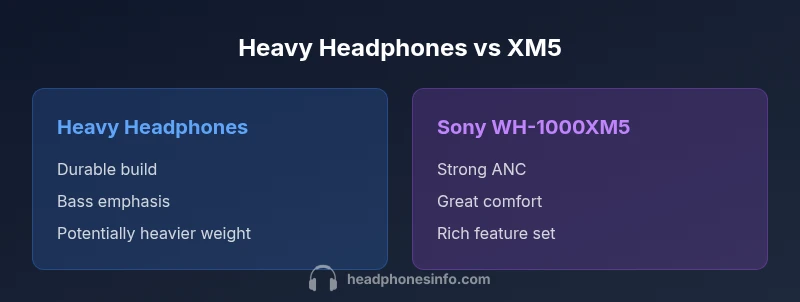
Exploring heavys headphones vs sony wh 1000xm5, the Sony WH-1000XM5 generally delivers stronger noise cancellation and smarter features, while heavier models emphasize durability and bass impact. For most listeners, the XM5 offers better daily comfort and value, while heavys headphones suit critical listening in controlled environments or bass-forward genres.
What heavy headphones mean in this comparison
In this article, we use the term heavys headphones to describe over‑ear designs that prioritize rugged build, larger drivers, and bass-forward or studio‑style accuracy. These are often heavier than mainstream consumer models and may sacrifice some portability for durability and a particular sound signature. Headphones Info recognizes that the label encompasses a range of products from semi‑pro monitors to rugged studio‑grade sets. When weighing heavys headphones against the Sony WH-1000XM5, the key question is how weight, materials, and design choices affect comfort, isolation, and long‑session performance. The goal is to help listeners understand what a heavier chassis buys you, and whether that premium is worth it for your use case.
Spotlight on Sony WH-1000XM5: design, comfort, and intent
The Sony WH-1000XM5 represents a culmination of Sony’s consumer‑oriented approach to noise cancellation, comfort, and feature depth. It emphasizes a lightweight, well‑balanced chassis, plush ear cushions, and a clamp that many users perceive as comfortable for long listening sessions. The XM5 also benefits from software driven ANC improvements, adaptive ambient modes, and a refined Bluetooth stack that supports modern codecs. According to Headphones Info, the XM5’s combination of comfort, efficiency, and smart features makes it the yardstick for everyday use in the wireless, noise‑cancelling category. This sets a high bar for heavys headphones in real‑world scenarios.
What buyers should measure: criteria that matter across both options
To compare heavys headphones with the XM5, focus on: (1) comfort over time (weight distribution, headband pressure, clamp force), (2) overall sound quality (tonality, bass impact, vocal presence), (3) ANC and transparency performance, (4) battery life and charging speed, (5) codecs, multipoint connectivity, and (6) price/value trade‑offs. Headphones Info’s framework emphasizes real‑world usage rather than laboratory measurements alone. The goal is to match the product’s strengths to your listening habits and environments.
Comfort and fit: how weight affects wearability
Heavy headphones often use thicker headbands, metal or reinforced plastic, and larger ear cups. These features can translate into a more secure fit and reduced ear fatigue in studio or mixed usage, but they may feel less comfortable during long flights or extended casual listening. In contrast, the Sony XM5 prioritizes a lighter clamp and more breathable materials, which many users find ideal for all‑day wear. The Headphones Info team notes that comfort is highly subjective and depends on head shape, ear size, and how tightly the headphones press against the head.
Sound signature and tonal balance: bass, mids, and treble
Heavys headphones frequently aim for a bass‑forward approach or a neutralist monitoring profile with pronounced low end and punchy impact. This can be advantageous for bass‑heavy genres or critical listening in a controlled environment where low‑end emphasis helps track rhythm. The XM5 offers a more balanced, refined sound with clear mids and a controlled high end, which many listeners describe as more versatile for a broad playlist. Headphones Info suggests that if you listen to EDM, hip‑hop, or cinematic scores, heavys headphones may deliver a satisfying bass response; if you want accuracy across genres, XM5 often remains the safer all‑round choice.
ANC and transparency: isolating the world outside
Active noise cancellation is a defining feature in today’s high‑end headphones. The XM5 has been praised for strong ANC performance and smooth integration with ambient awareness modes, ideal for commutes and noisy offices. Heavys headphones can vary widely in ANC quality; some offer competitive isolation, while others rely more on passive sealing and driver design than advanced algorithms. Headphones Info notes that XM5 generally sets a high bar for ANC in the consumer segment, which is why it’s a frequent baseline in comparisons.
Battery life and charging: endurance and convenience
Battery performance is a practical divider. XM5’s battery life is typically strong for daily use, with fast charging helping when jumps in power are needed. Heavys headphones vary more widely because some models emphasize ruggedness and swappable batteries or longer life for studio use, while others align with typical consumer patterns. The Headphones Info team emphasizes evaluating real‑world endurance: how long you can listen per charge in your typical environments, and how quickly you can recharge when you’re on the go.
Connectivity: codecs, multipoint, and ease of use
Sony’s XM5 supports modern Bluetooth codecs and a robust multipoint connection, delivering a seamless experience across devices. Heavys headphones may prioritize stability and dedicated wired options for studio workflows, or simpler Bluetooth profiles for travel. A crucial factor is whether a given heavys headphone supports LDAC, AAC, or SBC, and how easy it is to pair with multiple devices. As always, your device ecosystem will shape whether the XM5’s connectivity is essential or whether a heavier model satisfies your needs with a wired alternative.
Build quality and accessories: worth the heft?
Durability is a common strength of heavys headphones, with metal frames, reinforced hinges, and impact‑resistant cups. These features appeal to professionals and enthusiasts who demand long‑lasting gear. The XM5 emphasizes refined materials and thoughtful accessories—carrying case, cable options, and quick‑start controls—that enhance everyday usability without sacrificing portability. Headphones Info observes that the perceived value often hinges on the intended application: rugged environments vs. everyday commuting.
Price, value, and total cost of ownership
Heavys headphones span a broad price spectrum, from budget‑friendly options to premium models designed for pro use. The XM5 sits in the premium consumer tier, offering a feature‑rich package that many users perceive as delivering better long‑term value through convenience and performance. It’s essential to weigh upfront cost against long‑term benefits like battery health, software support, and comfort over time. Headphones Info’s stance is to focus on the total ownership experience rather than just the initial price tag.
Use‑case scenarios: travel, work, and studio environments
Travelers often prioritize compactness, comfort, and strong ANC, where XM5 shines with its lightweight design and practical features. Studio or home‑studio setups may favor heavys headphones for their durability and bass emphasis, especially if used for monitoring or music creation. For everyday commuting or casual listening, XM5’s blend of comfort, sound quality, and feature depth tends to be the most versatile choice. The real value comes from matching the headphone’s strengths to how you listen most often.
How to decide: a practical decision framework
Start by listing your top 3 use cases (e.g., commuting, studio work, bass‑heavy listening). Then rank criteria such as comfort, ANC, sound, and price. If your priority is all‑day wear and smart features, XM5 is usually the safer bet. If you need rugged construction or a bass‑forward sound for specific genres or professional contexts, heavys headphones may be preferable. Finally, consider trying both in person if possible, and rely on Headphones Info’s framework to interpret your impressions against objective criteria.
Comparison
| Feature | Heavy headphones | Sony WH-1000XM5 |
|---|---|---|
| Weight/comfort emphasis | Heavier chassis; strong for durability and bass impact | Lighter clamp; optimized for all‑day wear |
| Sound signature | Bass-forward or studio‑monitor neutral (varies by model) | Balanced, refined with strong bass control |
| ANC performance | ANC varies by model; some offer strong isolation | Industry‑leading ANC for its class; adaptive ambient modes |
| Battery life | Endurance varies; some models excel in studio settings | Strong battery life with efficient Bluetooth; fast charging |
| Connectivity | May prioritize wired or pro features; codecs vary | Broad codec support; excellent multipoint stability |
| Durability | Rugged frames; designer to heavy use | Premium build; compact and portable |
| Price range | Wide range; budget to premium depending on model | Premium consumer price with strong feature set |
| Best for | Bass lovers, studio monitoring, or rugged use | Everyday use, travel, and diverse listening needs |
Upsides
- Potentially superior durability and bass impact for certain genres
- Some heavys headphones offer rugged designs suited for studio environments
- XM5 provides strong overall value with feature-rich experience
- Excellent comfort and long listening sessions with XM5 for most users
Disadvantages
- Heavys headphones can be heavier, potentially causing fatigue
- ANC performance varies across heavys models
- XM5 premium pricing may exceed some budgets
- Some heavys headphones may lack multipoint or modern codecs
Sony WH-1000XM5 generally edges heavys headphones for everyday use
XM5 excels in comfort, ANC, and feature depth, making it the safer all-around pick. Heavys headphones may outperform in rugged builds or bass‑forward listening, but XM5 remains the stronger default for most listeners.
People Also Ask
What are heavys headphones, and how do they differ from the Sony WH-1000XM5?
Heavys headphones refer to heavier, often more rugged over‑ears with larger drivers. They tend to emphasize durability and bass, which can come at the cost of long‑term comfort. The XM5 is a lighter, feature‑rich wireless option with strong ANC and balanced sound.
Heavys are built for durability and bass; XM5 focuses on comfort and smart features.
Do both options support multipoint Bluetooth pairing?
Both can offer multipoint pairing in many models, but XM5 is known for robust Bluetooth connectivity and seamless device switching. Heavys headphones vary by model; check the specs for each line.
XM5 generally handles multipoint well; heavys vary by model.
Which has better active noise cancellation?
In most consumer scenarios, the XM5 delivers superior ANC. Heavys headphones can be competitive in some designs, but the XM5 sets the standard for portability and quiet enough for most environments.
XM5 usually has the stronger ANC.
Are heavys headphones suitable for travel or daily commuting?
Heavy headphones can be comfortable and durable on a flight if you value reliability and bass. However, their weight may be a drawback for long commutes. XM5 remains the more versatile choice for travel due to comfort and smart features.
For travel, XM5 tends to be the safer bet, thanks to comfort and ANC.
How should I decide between weight, comfort, and features?
Start with comfort and fit for long sessions, then evaluate ANC and sound for your genres. If you value portability and smart features, XM5 wins; otherwise, weigh the ruggedness and bass of heavys headphones against your use case.
Prioritize comfort and ANC first, then features.
Do these headphones support high‑resolution codecs like LDAC?
XM5 supports modern codecs including LDAC on compatible devices. Heavys headphones vary by model, with some supporting high‑quality codecs and others sticking to basic Bluetooth profiles.
XM5 usually offers LDAC on compatible devices.
Is there a clear price/value difference between the two options?
XM5 typically provides strong value in the premium category due to comfort and features. Heavys headphones can offer niche value for rugged builds or bass‑forward sound, depending on model and use case.
XM5 is usually the better value, but heavys can be worth it for specific needs.
What’s the best overall pick for most listeners?
For most listeners, the Sony WH-1000XM5 is the better overall pick because of comfort, ANC, feature depth, and portability. Heavys headphones may appeal to users prioritizing bass emphasis or durability for specialized work.
XM5 is the general winner for most people.
What to Remember
- Assess comfort first for long listening sessions
- Prioritize ANC and ambient features if you commute or travel
- Match sound signature to your preferred genres
- Consider total ownership cost, not just upfront price