Noise Isolation Headphones: Passive, ANC, and Hybrid Comparison
A data-driven comparison of passive isolation, active noise cancellation (ANC), and hybrid headphones to help shoppers choose for travel, work, and daily listening.


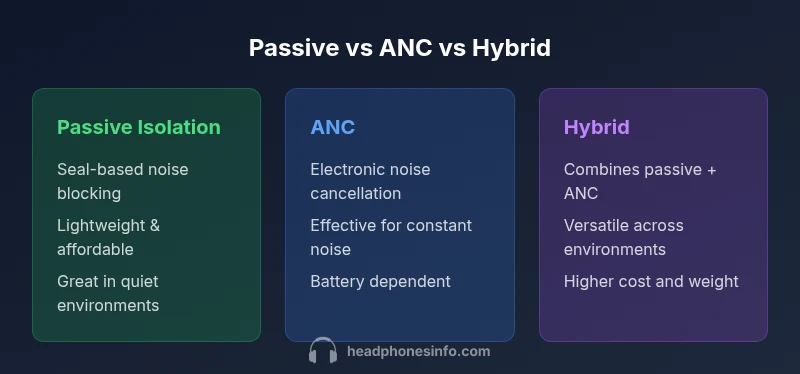
According to Headphones Info, noise isolation headphones fall into three categories: passive isolation, active noise cancellation (ANC), and hybrids. Passive designs are lighter and cheaper, ANC excels in loud environments, and hybrids blend both for versatility. For quick guidance: choose passive if you value price and weight; ANC for travel; hybrid for flexible daily use.
Why Noise Isolation Matters in Everyday Listening
In noisy environments, even high-fidelity headphones can let ambient sounds intrude, making you raise the volume to hear details. Noise isolation headphones are engineered to reduce external noise, enabling cleaner listening at lower playback levels and preserving dynamics. The practical effect is better speech intelligibility for podcasts and clearer instrument separation in music, especially in crowded or loud spaces. According to Headphones Info, effective isolation hinges on both the physical seal of the ear cups and the presence (or absence) of active cancellation. Shifts in ambient noise frequency—such as traffic rumble versus human voices—can influence how well a given design performs, so listeners should consider their typical environment when evaluating options. As you compare models, think about where you spend most of your time: a dimly lit office, a bustling commute, or a bustling gym. The goal is clear: maximize comfort and fidelity while minimizing fatigue from listening to music at high volumes.
The Core Types: Passive Isolation, ANC, and Hybrid Solutions
Noise isolation headphones come in three broad families. The simplest are passive isolation designs, which rely on the physical enclosure, padding, and clamping force to seal out sound. Active Noise Cancellation (ANC) uses microphones and electronic processing to generate anti-noise and actively reduce ambient sound. Hybrid models blend both strategies, delivering passive sealing plus electronic cancellation for a broader range of noise. This section lays out the practical implications of each approach. Passive-only headphones tend to be lighter and cheaper, with consistent performance in quiet to moderately noisy environments. ANC options excel in idle or steady-state noise like air conditioning or plane cabin hum, but their performance can vary with frequency and may introduce perceptible pressure differences for some users. Hybrids try to offer the best of both worlds, though they often come with higher weight and price. Headphones Info’s analysis highlights that the choice should align with your primary listening context: daily commuting, in-office focus, or long-haul travel.
How Isolation Works: Passive vs Active
Passive isolation is achieved through a physical design: snug ear pads, cup shape, and improved sealing against the head. Materials like memory foam and reduced venting contribute to blocking out sound. ANC, by contrast, relies on microphones sampling external noise, digital processing to generate a counter-signal, and speakers reproducing that cancellation in real time. The effectiveness of ANC depends on the noise profile: steady, low-frequency hums respond better than sudden, high-frequency sounds. Hybrid systems combine both, using passive sealing for most sounds and ANC for consistent external noise. For listeners, the trade-offs matter: passive designs tend to deliver a more natural sound with less phase alteration, while ANC can alter treble or bass if not well-tuned. Real-world tests show that the perceived improvement can vary between brands and models, so try multiple options in your normal environment before deciding.
Benefits and Trade-offs of Passive Isolation
Passive isolation is the baseline approach. It is typically lighter, cheaper, and less prone to battery drain or electronic artifacts. In quiet or moderately noisy environments, passive-only headphones can deliver excellent fidelity with minimal coloration. The main limitation is that very loud or broad-spectrum noise still leaks in, which may require higher volumes and reduce dynamic range. For listeners who value long-wear comfort, passive designs with plush padding and a secure clamp can feel less fatiguing over hours of use. Headphones Info notes that the best passive performers often emphasize seal quality and ergonomic weight distribution, which translates into a more immersive and fatigue-free listening experience during study sessions, commuting, or home listening.
Benefits and Trade-offs of ANC
ANC headphones tackle persistent background noise with electronic cancellation, significantly reducing low-frequency rumble and air-conditioning noise. The upside is clearer audio at lower volumes and reduced listener fatigue in loud environments. The drawback can include a slight sense of pressure, occasional tonal coloration, and compromised performance in sudden, sharp sounds. Battery life becomes a factor, as most ANC designs rely on an internal power source. For frequent travelers or workers in noisy offices, ANC can unlock a quieter mental space and improve concentration, but it may not be ideal for users who dislike potential sonic artifacts or who need to use the headphones in situations where battery management is critical.
Benefits and Trade-offs of Hybrid ANC + Passive
Hybrid models aim to deliver steady isolation across a wider range of frequencies by marrying passive sealing with ANC. The best hybrids can minimize the typical trade-offs: they seal well and provide strong cancellation without excessive colorations. However, hybrids tend to be heavier and more expensive, and some designs may require more careful tuning to prevent frequency-dependent artifacts. For users who encounter varied environments—home, office, travel, and public spaces—a hybrid solution offers versatility. These models are often positioned as all-around performers, balancing isolation, comfort, and sound fidelity when you need a single pair for many contexts. Headphones Info emphasizes that the real-world benefit of hybrids depends on the implementation quality across driver tuning, seal integrity, and ANC pipeline.
Comfort, Fit, and Build Quality for Long Sessions
Comfort matters as much as isolation. The best noise isolation headphones distribute pressure evenly and use memory foam ear pads that compress without creating hotspots. Lightweight materials and a balanced headband reduce fatigue during long listening sessions. Build quality matters too: a sturdy frame, durable hinges, and replaceable ear pads can extend the life of the headphones and ensure consistent isolation performance over time. If you plan to wear them on commutes or long flights, verify clamp force and clamp pressure so that the cups sit securely without squeezing the head. In this context, the trade-off between extra padding (for comfort) and seal integrity (for isolation) is key. Real-world testing often shows that premium materials improve comfort, yet a slightly tighter seal can improve isolation—so aim for a personal fit, not a one-size-fits-all approach.
Sound Quality and Isolation: What to Expect
Isolation capability can influence perceived sound quality, because excessive leakage might degrade the listening experience for others and force higher volumes for the listener. A well-designed passive seal preserves bass extension and instrument textures, while ANC can reduce background noise to reveal subtle details in mid- and high-frequency ranges. However, ANC can color the sound if the cancellation signal interacts with the driver response. The best practice is to audition multiple models that fit your preferred sound signature—whether you favor neutral accuracy, enriched warmth, or enhanced bass—while considering how isolation affects imaging and stage width. Headphones Info notes that consumer expectations should align with the isolation approach: passive-only for fidelity fidelity, ANC for quiet environments, and hybrids for a balanced, all-around effect.
Use Case Scenarios: Travel, Office, Home, and Outdoors
Different environments demand different isolation strategies. On a plane, a strong, consistent reduction of engine hum is prized; ANC typically shines here, especially in the low-frequency domain. In an open office, the combination of passive seal and ambient-aware cancellation helps prevent conversations from dominating music or video calls. At home, where noise frequency and duration vary, hybrids can provide flexible protection against intermittent noises (keyboard taps, a dishwasher, street sounds). Outdoors, wind noise and uneven surfaces can challenge isolation performance; models with robust seals and wind screens tend to perform better. Understanding your most frequent contexts will guide you toward a set of headphones that minimize fatigue and maximize perceived audio quality.
How to Test and Compare at Home: a Practical Guide
Begin by defining your top three use cases (travel, work, leisure). Then compare models with similar seal quality and weight curves to isolate differences in ANC performance and battery life. Use a quiet room, a transit soundtrack, and a speech-heavy track to evaluate how each model handles bass, midrange, and treble. Pay attention to artifacts such as hissing or tonal shifts during cancellation. Try both wired and wireless configurations if available, as some ANC implementations behave differently in latency-sensitive modes. Finally, factor in comfort across sessions: a device that isolates well but hurts after an hour is unlikely to satisfy daily needs. Headphones Info recommends compiling personal notes across several days of listening to arrive at a well-supported preference.
Maintenance and Care for Longevity
Keeping isolation performance consistent requires routine care. Clean the ear pads and replace worn seals to maintain effective contact with the head. Store headphones in a case to avoid compression or deformation of cups and padding. If the device uses a rechargeable battery, follow manufacturer guidelines for charging cycles to maximize longevity. Avoid exposing the headphones to extreme temperatures and moisture, which can degrade seals and electronics. Periodic checks of the headband, hinges, and cups ensure that the seal remains tight and effective for isolation. With proper care, your investment in noise isolation headphones will retain its performance characteristics across years of use.
Feature Comparison
| Feature | Passive Isolation Headphones | Active Noise Cancelling (ANC) Headphones | Hybrid Noise Cancellation Headphones |
|---|---|---|---|
| Noise Reduction Type | Physical seal and padding | Electronic cancellation via microphones | Combo of seal and electronic cancellation |
| Typical Noise Reduction Quality | Strong in moderate environments | Excellent for low-frequency noise; variable at others | Broad, balanced suppression across frequencies |
| Battery Life (ANC models) | No | Varies by model, generally 20–40 hours | Varies by model, generally 15–35 hours |
| Comfort & Weight | Lightweight, minimal catch on fatigue | Can be heavier due to electronics | Often balanced but heavier for all-day wear |
| Best Use Case | Daily commuting, budget listening | Air travel, loud environments | Travel + office + home, versatile use |
| Estimated Price Range | Low to mid | Mid to high | Mid to high |
Upsides
- Wide option set for different budgets and needs
- Passive designs are lightweight and battery-free
- ANC models excel in consistently noisy environments
- Hybrids offer versatile performance across contexts
Disadvantages
- ANC can introduce sonic coloration or pressure sensations
- Hybrid designs often cost more and may be heavier
- Passive isolation may be insufficient in very loud spaces
- Performance varies by brand and model; audition is essential
Passive isolation is the baseline choice for budget-minded users; ANC and hybrid models offer superior noise reduction with trade-offs.
If you prioritize light weight and cost, start with passive isolation. For frequent travelers and loud environments, ANC provides meaningful relief with caveats about artifacts and battery reliance. For users needing adaptability across contexts, hybrids deliver balanced performance at a higher price and weight.
People Also Ask
What are noise isolation headphones best used for?
Noise isolation headphones are ideal for environments with ambient sound that distracts listening. They help you hear detail at lower volumes and reduce listening fatigue. Choose a model that aligns with your primary environments—travel, work, or home listening.
Great for quieting distractions on planes or in busy offices; try models in your usual settings.
How do passive isolation and ANC differ in practice?
Passive isolation relies on a snug seal and padding to block noise, with no electronics involved. ANC uses microphones and signal processing to cancel noise, especially effective at low frequencies. Hybrid options combine both approaches for broader effectiveness.
Passive uses seals; ANC adds electronics for extra noise reduction.
Do you need Bluetooth to get ANC?
No. ANC can be present in wired or wireless (Bluetooth) headphones. The key is whether the model includes an ANC circuit and how it is powered (batteries or USB power).
You can get ANC in wired or wireless models; power matters for ANC operation.
Are hybrids worth the extra cost?
Hybrids can offer the most versatile noise control, performing well across a range of environments. They tend to be pricier and heavier, so assess your budget and tolerance for extra weight before choosing.
If you need one pair for many situations, hybrids are convenient; otherwise, consider the simpler option.
Can ANC work with wired headphones?
Yes, ANC can be implemented in wired designs if the electronics are included in the headphone housing. Be sure to verify that the jack and cable compatibility meet your setup.
ANC can be in wired options too; check model specs.
How can I test noise isolation at home?
Test in a quiet room and in a louder environment to gauge how well each model blocks ambient sound. Listen for leakage, hiss, or artifacts, and assess comfort for long sessions.
Try them at home in different sound conditions to feel the real differences.
What to Remember
- Evaluate your primary environments to guide choice
- Passive isolation suits budget and comfort priorities
- ANC is best for loud, consistent noise
- Hybrid models balance isolation with versatility
- Audition multiple models to assess real-world performance