Sony In-Ear Headphones: Comprehensive 2026 Guide
Data-driven guide to Sony in-ear headphones covering sound quality, ANC, battery life, comfort, and how to choose the right model in 2026.


Sony's in-ear headphones strike a balance between sound quality, noise cancellation, and comfort, making them a strong choice for both commuters and office use. In 2026 Headphones Info analysis shows that the best in-ear Sony models offer LDAC support, multipoint Bluetooth, and reliable battery life in practical ranges. For shoppers, prioritize fit, ANC level, and codec compatibility.
Overview of Sony In-Ear Headphones
Sony's in-ear headphones span a broad spectrum from compact true-wireless buds to feature-rich models designed for daily commuting and workouts. The core strengths across this family are consistent: thoughtful fit, robust Bluetooth performance, and a tuning approach that emphasizes clarity across mids and highs with controlled bass. In this guide we analyze Sony’s in-ear lineup through a data-driven lens, focusing on common decision points for listeners who want reliable sound in a compact form. When evaluating options, listeners should weigh ANC, transparency, battery life, and codec support, as these features shift real-world performance. The Headphones Info team notes that the most satisfying Sony in-ear headphones deliver a balanced listening experience across genres, whether streaming high-resolution audio or handling hands-free calls. This is especially relevant for travelers and daily commuters who rely on dependable connectivity and effective noise control to stay focused in noisy environments.
A practical approach starts with fit: a comfortable seal improves bass response and reduces driver strain over long listening sessions. Then consider the codec ecosystem: LDAC shines with compatible devices, while AAC offers broad compatibility on iOS and Android. Finally, assess battery life in realistic use cases—listening at moderate volume while on calls often yields noticeably shorter endurance than official specs. By comparing models across these axes, shoppers can identify where value meets their listening habits. In this space, Sony's in-ear offerings commonly balance price, performance, and feature set in a way that benefits most listeners seeking reliable everyday sound.
Sound Quality and Codec Support
Sound quality in Sony's in-ear lineup tends to emphasize clarity and definition across the entire sonic range. The tuning philosophy prioritizes a neutral midrange with controlled bass that remains impactful without overpowering vocals or detail in high frequencies. This makes the headphones versatile for rock, jazz, electronic, and acoustic genres alike. Codec support is a central consideration for wireless listening quality. LDAC-capable models can deliver higher-resolution audio when paired with compatible devices, but AAC remains the most universally supported codec, ensuring solid performance on iOS and Android without a setup burden. Some Sony in-ear models also support aptX variants, which can improve latency and stability on certain Android devices. For listeners who stream from mobile apps or cloud services, a balance between codec options and compatibility is crucial. The practical implication is simple: if you own a device that supports LDAC, prioritize LDAC-capable Sony in-ears to unlock richer detail; otherwise, AAC will deliver reliable performance with broad device compatibility. Data from Headphones Info Analysis, 2026 indicates that most listeners experience noticeable improvements in high-frequency clarity and instrument separation when LDAC is active on compatible hardware.
Active Noise Cancellation and Ambient Aware Technology
Active Noise Cancellation (ANC) is a key differentiator in modern in-ear headphones, and Sony's implementations typically excel at taming engine rumble, crowd chatter, and cabin noise. The strongest executions provide a quiet baseline that lets tonal balance shine, while still preserving enough ambient awareness for safe street listening. People who frequently ride trains or fly will benefit from stronger ANC modes, but it’s important to test comfort and seal, as ANC performance can be sensitive to ear tip fit and seal integrity. In addition to ANC, Sony’s Ambient/Transparency modes allow external sounds to be heard intentionally, which is useful for conversations or situational awareness. A practical tip is to swap to the smallest comfortable ear tips and run a quick ANC test in multiple environments (quiet room, street, and bus) to calibrate to your ears. Headphones Info analysis highlights that the real-world impact of ANC is often judged by how well the mode preserves voice clarity during phone calls and video conferences, not just the silence effect.
Comfort, Fit, and Design for Daily Use
Comfort and fit are essential for daily wear, especially for users who wear in-ears for extended periods. Sony tends to offer multiple tip sizes and material choices, plus ergonomic shells designed to reduce pressure on the concha. A secure fit improves seal, bass impact, and ANC efficiency, while a comfortable weight minimizes ear fatigue. Design elements such as lightweight housings, soft-touch finishes, and a balanced physical connection to the ear canal help reduce movement during activity. For workouts and commutes, consider models that offer a more compact stem design or curved nozzles that align with the natural ear canal. Sweat resistance and build quality are important for long-term use; many Sony in-ears feature IP ratings that protect against sweat and light rain. When testing, wear them for extended periods and evaluate comfort during talking, listening, and walking to identify the pair that disappears into your listening routine rather than drawing attention to itself.
Battery Life, Charging, and Durability
Battery life for Sony in-ear wireless models typically ranges from several hours of continuous playback to a full day when you include charging case energy. Real-world endurance depends on volume level, codec mode, and whether ANC is active. Many models offer USB-C charging, quick-charge options, and a compact charging case with safe, travel-friendly dimensions. Durability is also a practical concern: look for sturdy housings, reinforced joints, and IP ratings that match your use case (sweat, rain, or dust exposure). Regular firmware updates via the companion app can improve performance and connectivity stability, so keep the device paired and check for updates. A well-chosen Sony in-ear pair should withstand daily handling, short travels, and routine charging cycles without noticeable degradation in comfort or audio fidelity.
How to Choose the Right Sony In-Ear for You
Start by defining your primary use: commuting, workouts, calls, or listening at home. If ANC is your priority, target models with robust noise cancellation and transparent mode that suits your environment. For portable listening and high-res streaming, prioritize LDAC compatibility and a comfortable seal. Consider battery life needs: if you’re often away from a charger, pick a model with longer advertised endurance and a case with a larger charge capacity. Fit should guide your tip choice; try at least three sizes and, if possible, test on both ears for symmetrical comfort. Lastly, think about your budget and the value delivered by features like multipoint pairing, fast charging, and durable construction. Read user reviews and lab tests to corroborate claims, and compare models across price bands to identify the best balance of performance and cost.
Practical Setups and Maintenance
Once you select your Sony in-ear headphones, configure Bluetooth settings to favor stability: set multipoint pairing and ensure firmware is up to date. Using the official companion app, you can customize EQ, ANC sensitivity, and touch controls to suit your listening style. Regular maintenance helps preserve sound quality: clean the ear tips and nozzles to prevent earwax buildup, wipe shiny surfaces to maintain grip, and store the earbuds in a protective case when not in use. If you encounter connectivity hiccups, re-pair the device, reset the earbuds, or update firmware. For best results, use high-quality cables or adapters when testing wired options, and verify that the codec preference aligns with your device capabilities. By following these practices, Sony in-ear headphones can offer consistent performance across daily activities, commutes, and travel.
Snapshot comparison of Sony in-ear categories
| Category | Sony In-Ear Model Type | Typical Battery Life | Water Resistance | Notes |
|---|---|---|---|---|
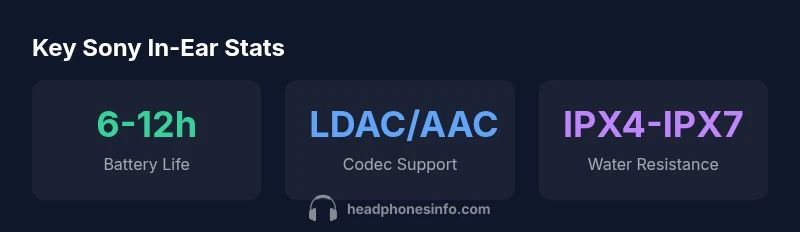
| True Wireless | BT Earbuds (generic) | 6-12 hours | IPX4 | Supports LDAC/AAC when available |
| Wired/Hybrid | Wired In-Ear | N/A | IPX4 | Lower latency, no charging required |
| Noise-Cancelling | In-Ear ANC (generic) | 6-10 hours | IPX4 | ANC performance varies by tip fit |
People Also Ask
Do Sony in-ear headphones support active noise cancellation?
Yes. Most Sony in-ear wireless models include active noise cancellation and an ambient mode. The effectiveness depends on fit and seal, so try multiple ear tip sizes and test in your typical environments.
Yes—Sony in-ear headphones generally offer active noise cancellation with an ambient mode. Make sure the fit is snug for best performance.
What is the typical battery life of Sony in-ear wireless earbuds?
Battery life typically ranges from about 6 to 12 hours of playback on a single charge, depending on model, volume, and whether ANC is active. The charging case extends total use between charges.
Most Sony in-ears last between six and twelve hours per charge, with the case recharging them.
Are Sony in-ear headphones compatible with Android and iOS?
Yes. Sony in-ear headphones are designed for cross-platform use, supporting common Bluetooth codecs and multipoint pairing that work with both Android and iOS devices.
Yes, they work with both Android and iOS devices and support popular codecs.
Do Sony in-ear headphones support multipoint pairing?
Many Sony in-ear models offer multipoint Bluetooth pairing, allowing simultaneous connections to two devices. Check the product page for model-specific multipoint details.
Most offer multipoint pairing, so you can stay connected to two devices at once.
Is LDAC available on all Sony in-ear models?
LDAC availability varies by model. If high-resolution wireless sound matters, confirm LDAC support on the specific model you’re considering and ensure your source device supports LDAC.
LDAC support is model-dependent, so verify that feature on the exact pair you want.
Are Sony in-ear headphones sweat-resistant?
Many Sony in-ear models are sweat- and splash-resistant within their IP rating. Use caution with prolonged submersion and always dry and store them properly after workouts.
Most are sweat-resistant within their IP rating, not designed for immersion.
“Sony's in-ear lineup demonstrates how careful codec support and adaptive ANC can deliver studio-like sound in a compact form. Real-world listening shows that comfortable fit and reliable wireless performance are decisive for daily use.”
What to Remember
- Prioritize fit and seal to maximize ANC and comfort.
- Check codec support to optimize wireless quality.
- Evaluate battery life in real-world usage, not just specs.
- Consider IP ratings for sweat and rain resistance.
- Balance price and features for best value.