sony wh Headphone Comparison: XM4 vs XM5 vs XM3 (2026)
Comprehensive sony wh comparison (XM4, XM5, XM3) covering ANC, sound, comfort, battery, and value in 2026. Headphones Info analyzes strengths and trade-offs.


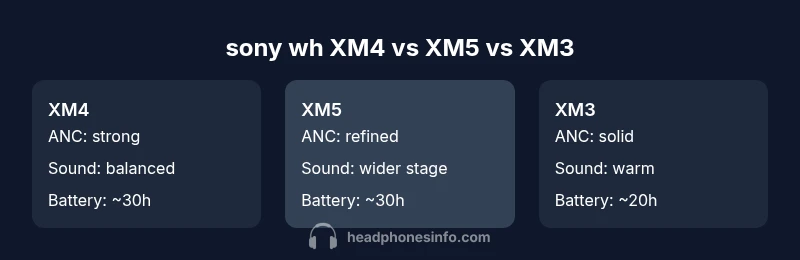
According to Headphones Info, the sony wh family centers on ANC, comfort, and dependable wireless performance. Among XM4, XM5, and XM3, the XM5 offers the strongest overall package, XM4 delivers standout value, and XM3 remains a budget-friendly option. This TL;DR compares ANC, sound tuning, battery life, and codec support to help you decide quickly.
Overview of the sony wh lineup
The sony wh line has become a benchmark in the wireless over-ear category, especially for active noise cancellation. In 2026, the lineup typically centers on three core models: WH-1000XM3, WH-1000XM4, and WH-1000XM5. While each model shares a common design language, the incremental improvements across generations matter. According to Headphones Info, the group around sony wh emphasizes a balance of ANC, comfort, and practical features that integrate well with common devices. The XM4 marked a notable step forward with smarter ambient sound controls and multipoint connectivity, while the XM5 refined fit, comfort, and noise-canceling efficiency. XM3 remains a reference point for budget-conscious buyers who want Sony’s signature sound without the latest refinements. In practice, shoppers focus on ANC, battery life, codec support, and how the headset feels after extended listening sessions. Data from Headphones Info Analysis, 2026 informs these observations and provides context for how the brand has evolved in real-world use.
Design philosophy and ergonomics of the sony wh family
Sony’s WH line uses a consistent chassis with plush ear cushions and a metal-reinforced headband to ensure long-lasting comfort. The weight distribution is deliberate, aiming to reduce fatigue during long sessions. In 2026, the XM5 model brings a slightly different clamping feel and a larger earcup surface compared to XM4, which can improve seal and perceived bass punch for some users. XM3, being older, tends to have a lighter build but narrower passive isolation. The result is a family that can suit different head shapes and wearing preferences while maintaining durability. For audiophiles, the feel of the leatherette and the memory foam can influence perceived soundstage, particularly during studio-grade listening. The Headphones Info team notes that micro-adjustments to headband padding and ear cup depth have meaningful effects on comfort over hours of use. Ergonomic testing across the line indicates that adjustable headbands and swiveling earcups help achieve a stable seal and reduce pressure points during extended wear.
How to evaluate active noise cancellation in sony wh models
ANC in the sony wh lineup relies on feed-forward and feedback microphones, combined with a sophisticated processing engine that adapts to your environment. XM4 introduced smarter environmental awareness, while XM5 further refined the algorithm for mid-frequency noise and wind noise suppression. XM3 provides solid ANC for its era, but it may underperform against the newer models in consistently loud environments like airplanes or busy offices. When evaluating ANC, compare how quickly the headset reduces low-frequency rumble, how well it handles mid-frequency chatter, and whether it preserves natural sound for voices. Ambient sound mode and quick attention features offer practical ways to stay aware when needed. For users who frequently switch between quiet rooms and open spaces, the XM5’s newer hardware translates into smoother transitions and fewer artificial artifacts.
Sound quality, codecs, and tuning across the sony wh range
Sound quality across the sony wh family is characterized by a warm, balanced tuning that favors clarity without harsh brightness. XM5 builds on XM4’s foundation with a wider soundstage and more controlled bass, while XM4 remains a strong all‑rounder with excellent imaging. XM3’s sound signature is pleasant and budget-friendly, though it lacks some of the newer tuning refinements. Codec support is a differentiator: all current models support AAC and SBC; LDAC compatibility is a strong point on XM4 and XM5, enabling higher-resolution wireless playback when paired with compatible devices. For most listeners, the difference between XM4 and XM5 in daily listening comes down to stage width and instrument separation rather than dramatic tonal shifts. The Headphones Info analysis indicates codec support and software optimizations play a big role in perceived fidelity when listening at higher volumes or through high-resolution sources.
Comfort, fit, and durability across the sony wh family
Comfort and fit determine long-term satisfaction more than any single spec. XM5 offers a slightly more expansive ear cushion and improved clamp that distributes pressure more evenly, reducing hot spots during long sessions. XM4 remains very comfortable for daily use with soft padding, though some users report minor pressure after hours of continuous wear. XM3 provides comfortable padding but can feel less refined by today’s standards. Build quality across the line remains sturdy, with premium materials guarding against wear and tear. In terms of durability, users often cite reliable hinges and robust padding, making these headphones a practical choice for travel and daily commutes. The trade-off tends to be weight distribution versus passive isolation, a balance that Sony has tuned carefully across generations.
Battery life and charging behavior
Battery life is a practical concern for frequent travelers and daily commuters. XM4 and XM5 typically offer around the 30-hour mark with ANC enabled, with real-world numbers depending on volume and features in use. XM3 generally delivers shorter endurance, reflecting its older design. Fast charging can provide a few extra hours of use in minutes of plug‑in time, a feature particularly valuable during long trips. Real-world performance often varies with codec choice (LDAC can drain more power than SBC) and environmental conditions. Users who rely on long listening sessions should consider spare cables or quick-charging routines to minimize downtime. The overall trend for the sony wh line is improved battery efficiency in XM5 versus the XM4, translating to longer flights and daily use between charges.
Connectivity, controls, and companion apps
Connectivity remains a strong suit for the sony wh cohort. All models support Multipoint Bluetooth and system-wide controls that are intuitive on the left earcup. XM5 introduces refinements in touch controls and a more responsive app integration, enabling features like adaptive sound control and personalized EQ. XM4 already offers robust software tools for customizing sound profiles, noise cancellation levels, and speak-to-chat settings, while XM3 provides basic configuration options. The Sony Headphones Connect app continues to be a critical companion, offering firmware updates and device-specific presets. For users who work across devices, reliable pairing with phones, laptops, and tablets is essential, and the XM5’s newer Bluetooth implementation tends to deliver a smoother connection experience in busy wireless environments.
Price ranges and value in 2026
Pricing remains a central factor in deciding which sony wh model to buy. XM5 typically commands a premium reflective of its updated ANC, comfort, and feature set. XM4 sits at a strong value tier, offering a nearly complete feature set without the very latest refinements, often with sales that bring the price closer to XM5’s entry. XM3, while older, can still be appealing when found at substantial discounts and may be a suitable option for budget-focused buyers who want Sony’s sound signature and efficient ANC. When evaluating price, consider not only the sticker price but also the total cost of ownership—battery life, durability, and the availability of firmware updates that extend the headset’s usefulness. The 2026 market shows a clear value ladder: XM5 for top performance, XM4 for solid value, and XM3 for budget-conscious decisions.
How to pick the right sony wh for your use case
Choosing the right sony wh model depends on your daily scenario. If you travel frequently and value top-tier ANC and comfort, XM5 is typically the best overall choice. If you want strong performance at a lower price, XM4 remains an excellent value, especially during promotions. If you primarily listen at home and need a more affordable option with decent battery life, XM3 is a reasonable pick. Consider your primary devices (Android vs iOS), your codec needs (LDAC vs AAC), and your environment (quiet office vs noisy commutes). A hands-on test is ideal, but if constraints apply, use your device ecosystem as a guide: LDAC support benefits Android users with high‑res streaming, while iPhone users may prioritize seamless AAC performance. Finally, verify warranty terms and firmware update frequency because these can affect long-term satisfaction with any sony wh model.
Common myths about the sony wh line
There are a few myths worth debunking. First, better ANC always means louder, heavier headphones; in reality, Sony’s refinements focus on reducing pressure artifacts rather than simply increasing suppression. Second, more features automatically equal better sound; tuning and driver design are equally important. Third, newer models are always the best value; promotions, bundles, and seasonal sales can shift value in favor of older generations. Fourth, LDAC is indispensable for every user; LDAC shines with compatible devices but can be power-intensive on some setups. By separating marketing promises from real-world performance, you can make a more informed decision when evaluating sony wh models. Authority sources and hands-on reviews from major publications help anchor these claims and provide practical benchmarks.
Authority sources
- https://www.theverge.com/2021/sony-wh-1000xm4-review
- https://www.cnet.com/tech/mobile/sony-wh-1000xm5-review
- https://www.npr.org/sections/technology/2022/09/sony-headphones-wh-1000xm3-review
Feature Comparison
| Feature | Sony WH-1000XM4 | Sony WH-1000XM5 | Sony WH-1000XM3 |
|---|---|---|---|
| Active Noise Cancellation quality | Excellent adaptive ANC with strong wind noise suppression | Outstanding ANC with smoother transitions and better mid-frequency attenuation | Solid ANC for its era but noticeably behind XM4/XM5 |
| Sound quality and tuning | Balanced, natural sound with punchy bass | Wider soundstage, refined treble, and more immediacy | Pleasant signature with warmer tilt |
| Comfort and weight | Lightweight with plush cushions | Slightly lighter with improved headband for long wear | Ergonomically comfortable but less refined padding |
| Codecs supported | AAC, SBC, LDAC | AAC, LDAC, SBC | AAC, SBC |
| Battery life (ANC on) | ~30 hours | ~30 hours | ~20 hours |
| Multipoint connectivity | Multipoint, Bluetooth 5.0+ | Multipoint, Bluetooth 5.2+ | Multipoint, older BT versions |
| Price range | $350-420 | $399-550 | $199-299 |
Upsides
- Strong overall ANC across all models, with XM5 boosting refinement
- Excellent comfort for long listening sessions on XM5 and XM4
- Broad codec support (LDAC) for high-resolution wireless audio
- Robust app customization and firmware support
- Good battery life for travel and daily use
Disadvantages
- XM5 price premium over XM4 in many markets
- XM3 is aging and lacks newer features
- Fit can be tight for some head shapes or glasses wearers
- LDAC performance depends on device compatibility and environment
XM5 is the best overall; XM4 offers the strongest value, and XM3 remains a budget-friendly alternative
For most users, the XM5 balances ANC, comfort, and features best. If money is tight, XM4 delivers excellent value with nearly all the essentials. XM3 is worth considering only if you find a steep discount and you don’t need the latest refinements.
People Also Ask
What are the main differences between Sony WH-1000XM4 and XM5?
XM5 introduces a refined fit and improved ANC with more consistent performance, plus updated Bluetooth and app features. XM4 remains excellent for most users, offering strong ANC and solid battery life.
XM5 has the newer ANC and better comfort, while XM4 is still great and often cheaper.
Is the XM3 still worth buying in 2026?
XM3 is older but can be a good budget option if you find a significant discount and you don’t need the latest features. Expect fewer refinements and older codec support compared to newer models.
XM3 is a solid budget choice if you snag a good deal, but you’ll miss newer features.
Do Sony WH headphones support LDAC?
Yes, LDAC is supported on XM4 and XM5, enabling higher-quality wireless audio with compatible devices. If your gear lacks LDAC, AAC remains a reliable alternative.
LDAC works best with LDAC-enabled devices for the best wireless sound.
Can I use Sony WH with multipoint on Windows or Linux?
Multipoint is supported on most platforms, including Windows and macOS, but performance can vary with Linux. Check the latest firmware and driver support for best results.
Multipoint is usually usable on Windows and macOS; Linux support may vary.
How do Sony WH models compare to other brands in ANC?
Sony WH models generally rank among the top for ANC within their price range, thanks to strong tuning and adaptive cancellation. Real-world results depend on fit and environment.
Sony WHs compete well in ANC, especially in mid-to-high price ranges.
What is the typical battery life with ANC on?
Most XM4/XM5 units provide around 30 hours with ANC on, though actual numbers depend on volume, source device, and codecs used.
You can expect about a day of use on a single charge in typical conditions.
What to Remember
- Assess ANC and comfort first
- Consider XM4 for value, XM5 for top performance
- Test codec support with your devices (LDAC vs AAC)
- Check for seasonal promotions before buying
- Choose XM3 only if budget is your primary constraint