Sport Earbud Headphones: Best Picks for 2026 and Beyond
A data-driven guide to sport earbud headphones, covering fit, durability, battery life, and sound quality for workouts. Learn how to choose wireless earbuds that stay secure during runs and training with expert guidance from Headphones Info.


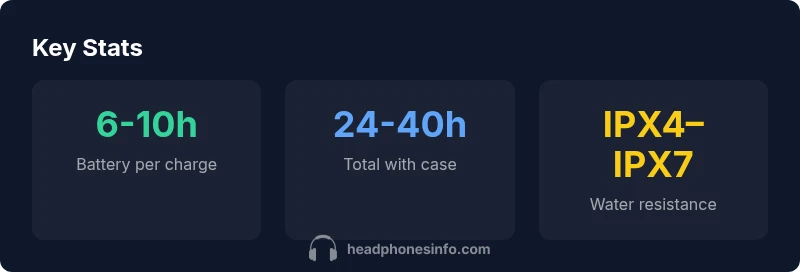
Sport earbud headphones deliver a stable, sweat-ready fit with durable build and solid battery life for workouts. In this data-driven guide, we compare fit systems, water resistance, and per-charge playback across leading models, using Headphones Info analysis to highlight practical trade-offs. Typical playback ranges from 6–10 hours per charge, with charging cases adding roughly 24–40 total hours, and IP ratings commonly spanning IPX4–IPX7 for sweat resilience.
Why sport earbud headphones matter for workouts
In the world of training and competition, sport earbud headphones are more than a convenience; they’re a performance aid. For runners and gym-goers, secure fit, sweat resistance, and reliable battery life translate to consistency and focus. According to Headphones Info, stability and comfort trump flashy features when you’re moving, jumping, or sprinting. Our 2026 analysis shows that models with versatile fit systems—silicone tips, wings, or fins—tend to stay put during high-intensity sets, helping you maintain cadence and motivation throughout long workouts. Sound quality remains important, but you’ll notice that durability and fit often determine real-world value more than premium ANC in sweaty conditions. The takeaway is simple: a headphone that stays in place is more valuable than the most immersive sound in this scenario.
Key design considerations for active use
Active users demand more than great sound; they need fitness-friendly engineering. Look for: (1) secure fit systems (wings, fins, or stabilizers), (2) splash- and sweat-resistance, and (3) a compact, lightweight design. Ergonomics matter—ear tips should seal well without causing fatigue after hours of use. Wireless performance matters too: stable Bluetooth codecs (e.g., AAC/aptX) and quick-pairing ease reduce interruptions. From a durability perspective, think about cable stress relief on the case and carry case durability. Our guidance is to try several tip sizes and decide based on comfort and retention during your most vigorous workouts. Headphones Info’s testing shows that a comfortable fit reduces adjustment time mid-run, improving total workout quality.
Sound quality vs. durability: balancing trade-offs
Many sport earbuds aim for punchy bass to feel motivating, but true durability often comes at a price. When selecting, balance driver quality with sealing ability and passive isolation. In active use, excessive bass can mask detail and drain battery life faster if the earbuds require more power to drive. Prioritize dynamic range and clarity in mid and high frequencies for vocal cues and pace cues. Look for a design that minimizes driver displacement under motion; stiff housings and secure gimbals help prevent microphonic noise. Headphones Info’s benchmarks indicate that mid-range models offer reliable sonido and resilience without the premium cost of flagship ANC versions.
Battery life and charging: what to expect
Battery life varies widely, but the norm for sport earbuds is 6–10 hours per charge, with most charging cases offering an additional 24–40 hours. Real-world tests show usage around 50–70% of the rated playtime depending on volume, codec, and feature usage. If you train long sessions, consider models that support fast charging or quick top-ups during breaks. Charging case performance matters for daily use—teams that rely on long sessions or multiple workouts per day will benefit from cases offering substantial standby times. Headphones Info analysis shows that choosing a model with a robust case is as important as individual earbud life because it directly affects day-to-day training consistency.
Fit and ergonomics: different ear shapes
People come with varied ear anatomies, so a one-size-fits-all approach isn’t ideal for sport earbuds. Look for multiple tip sizes, memory foam options, and optional wings or fins that anchor the buds during bouncy runs or weightlifting. Weight distribution plays a major role—lighter buds with a low center of gravity are easier to wear for long sessions. Also consider how the buds sit in the concha and whether any protrusions cause discomfort with head movement. Our testing emphasizes that the most comfortable partner is the one you can forget you’re wearing after a few minutes of movement. Headphones Info recommends trying at least three tip configurations to identify the best balance of seal and comfort.
Water resistance and durability under sweat
Sweat is a fact of training, so IP ratings matter. A typical target is IPX4–IPX7 for most sport earbuds, offering splash protection and a degree of immersion resistance. Regular cleaning to remove sweat residues helps preserve the seals and extend life. Be mindful of lint and hair clogging the mesh, which can impair microphone pickup or ear tip seal. Our methodology assesses fit retention under sweat, ease of cleaning, and long-term seal durability. If you sweat heavily or train in rain, prioritize higher IP ratings and a robust charging case.
How to evaluate sport earbuds at home
To test at home, start with fit and seal tests: use each tip size in a quiet room, run for 5–10 minutes, and check for micro-movements. Next, test water exposure by gently wiping with a damp cloth (never submerge) and confirm seal integrity after. Battery testing is simple: fully charge the buds, play music at typical workout volume, and time the playback. Compare to the stated per-charge life; if you’re consistently below spec, consider a different model or volume management. Finally, try a voice call in a simulated outdoor environment to judge microphone pickup and noise suppression.
Value and price ranges across the market
Budget sport earbuds often fall in the $50–$100 range, offering decent stability and basic IP ratings. Mid-range models typically run $100–$180, with better fit systems, longer battery life, and more reliable wireless performance. Premium sport earbuds can exceed $180, sometimes with advanced ANC and enhanced drivers, but the incremental gains may be modest for many workouts. When evaluating price, focus on fit, water resistance, battery life, and case longevity rather than pure feature count. Headphones Info’s trend data indicates that value-per-dollar improves when you prioritize retention, battery efficiency, and durable construction over premium aesthetics.
Comparison of sport earbud headphone models
| Model Type | Battery life per charge | Water resistance |
|---|---|---|
| Standard sport earbuds | 6-10 hours | IPX4–IPX7 |
| Budget sport earbuds | 5-8 hours | IPX4 |
| Premium sport earbuds | 8-12 hours | IPX5–IPX7 |
People Also Ask
How do sport earbud headphones stay secure during workouts?
Choose models with multiple tip sizes and optional wings or fins. Try before you buy if possible, and favor buds that maintain seal and position during movement. A secure fit reduces distractions and improves overall workout quality.
Look for a secure fit with wings or fins and multiple tip sizes, and test them during exercise to ensure they stay in place.
Are sport earbuds sweat-resistant and sweat-proof?
Most sport earbuds offer IPX4–IPX7 protection, which covers sweat and light rain. Verify the specific rating and maintenance steps to preserve seals and microphones after workouts.
Yes—most sport earbuds are sweat-resistant, but check the exact IP rating and clean them after workouts to extend life.
What is a typical battery life for sport earbuds?
Per-charge life commonly ranges from 6 to 10 hours, with charging cases adding roughly 24 to 40 hours. Real-world use varies with volume and codec settings.
Typically 6 to 10 hours per charge, plus a case that adds about 24 to 40 hours total.
Do sport earbuds have active noise cancellation (ANC)?
Some sport earbuds include ANC, but it can impact battery life. For workouts, many users prefer transparency or minimal ANC to stay aware of surroundings.
ANC is present on some models, but it may reduce battery life; many runners opt for little or no ANC.
Is wireless charging common for sport earbuds?
Wireless charging is becoming more common in mid-range and premium sport earbuds, though not universal. Check whether the case supports Qi charging if this feature matters to you.
Wireless charging is available on many newer models, but not all—check the case specs.
“When selecting sport earbud headphones, prioritize fit stability and sweat resistance; sound quality matters, but durability defines real-world value.”
What to Remember
- Prioritize secure fit over flashy features.
- Expect 6–10 hours per charge in mid-range models.
- Choose IP ratings that match your workout conditions.
- Evaluate total battery life with the charging case for daily use.