iPhone Earphones vs Headphones: A Side-by-Side Guide
Compare iPhone earphones and headphones with a data-driven guide. Explore wired, wireless, and USB-C options to determine the best fit for compatibility, sound, mic quality, and price.


For iPhone earphones and headphones, wired options deliver the lowest latency and most reliable compatibility, while wireless models offer convenience and portability. This comparison covers three common categories, focusing on compatibility, sound quality, microphone performance, and price to help you choose the best option for your iPhone. Whether you prioritize latency, battery life, or overall value, this guide gives practical criteria and context for real-world use.
Why iPhone Earphones Headphones Matter for Your Audio Setup
Selecting iphone earphones headphones is more than choosing a brand or some features; it’s about how your chosen option integrates with iPhone hardware, software, and your daily listening habits. The landscape has shifted as newer iPhone models adopt USB-C, while older devices still rely on Lightning or adapter-based pathways. The right pair can reduce latency during gaming or watching videos, improve voice capture during calls, and preserve battery life for wireless models. The Headphones Info team has found that many users underestimate the importance of connector compatibility and DAC support when comparing options. A balanced choice—one that aligns with your primary listening contexts (commuting, office work, workouts)—tends to deliver the most satisfaction over time. In this context, iPhone users should assess how often they value simplicity (wired) versus freedom (wireless) and whether future-proofing (USB-C) matters for their device ecosystem.
Core Categories: Wired Lightning Earphones, Wireless Bluetooth Earphones, USB-C Earphones
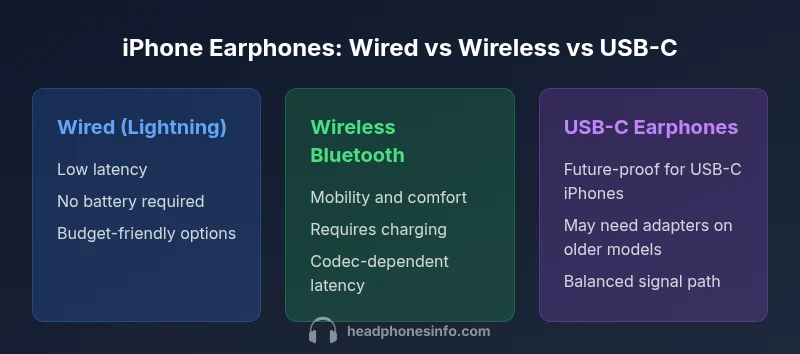
Three main pathways define the landscape for iphone earphones headphones. Wired Lightning earphones leverage the native connector for direct signaling with minimal latency and no battery requirement, making them highly dependable for calls and media playback. Wireless Bluetooth earphones give you complete mobility, with trade-offs in battery management and potential codec limitations depending on the device and environment. USB-C earphones, increasingly common on newer iPhone models, aim to blend the best of both worlds by offering a wired-like signal path with modern connector versatility. Each category has distinct advantages, and many users end up adopting a hybrid approach—one wired option for critical tasks and a wireless pair for commuting or workouts. For audiophiles and creators, the choice often hinges on codec support, latency tolerance, and micro/macro detail retrieval across genres.
Compatibility, Connectors, and Adapters: Lightning, USB-C, and 3.5mm
Compatibility is the linchpin of user satisfaction. Lightning-based earphones work seamlessly with many iPhone models but may require adapters on devices that shift toward USB-C. USB-C earphones promise broader cross-platform compatibility and future-proofing, yet may demand a USB-C-to-Lightning adapter for older iPhones. 3.5mm adapters remain common for legacy devices, though they add a small impedance to the signal path. When evaluating options, consider whether your ecosystem (Mac, iPad, Apple Watch) shares the same connector. The Headphones Info guidance emphasizes testing with your primary apps (calls, music, games) to confirm mic clarity and latency in real-world usage. Also, assess build quality and cable stress points—these often determine long-term durability more than MSRP.
Latency, Battery Life, and Real-World Scenarios
Latency matters most in gaming, sync-heavy video production, and live performances. Wired options typically deliver near-zero latency, which keeps lip-sync and frame timing tight. Wireless models introduce some delay that varies with codecs (e.g., SBC vs. AAC or LC/AptX), environmental interference, and device power. Battery life becomes a critical factor for prolonged sessions; many wireless earphones advertise 4–8 hours of playback on a charge, with cases offering additional cycles. In everyday tasks like podcasts or commuting, you might prefer the convenience and isolation of wireless headphones, while for critical audio work you may revert to wired. Understanding your typical use case helps narrow the field without overemphasizing one trait at the expense of others.
Sound Quality, Fit, and Comfort Across Brands
Sound quality is influenced by driver size, tuning, and enclosure design, but comfort and fit can be just as important. In-ear tips that seal well contribute to bass response and noise isolation, yet they must suit your ear shape to avoid fatigue. Apple’s wired options tend to emphasize neutral tuning suitable for general listening, while third-party models vary widely—from bright to warm voicings. For headphones that travel, weight and clamp force matter, especially during long listening sessions. Micro-adjustable tips, memory foam variants, and balanced armature drivers are common approaches to improve comfort and sustain a consistent seal. When evaluating comfort, also consider cable handling, detachable cords, and headband padding in over-ear designs if you lean toward larger models.
Microphone Quality and Call Performance on iPhone
Call quality hinges on microphone pickup patterns, wind suppression, and the phone’s native noise reduction. Wired earphones generally provide the most consistent mic performance since there is less signal processing complexity, whereas wireless options rely on digital processing that can introduce artifacts in noisy environments. USB-C earphones with integrated DACs may offer slightly improved mic behavior when paired with compatible iPhone models. For frequent video calls and voice memos, prioritize models with multiple microphones or dual-array configurations, plus reliable beamforming to reject ambient noise. Real-world testing—like jump-cuts during a subway ride or a windy outdoor scene—helps you quantify mic performance beyond marketing claims.
Durability, Cable Quality, and Longevity Considerations
Durability varies by build quality, connector design, and cable strain relief. Flat cables and braided jackets tend to resist tangling better, while standard round cables may kink over time if bent sharply near the connector. Inline remotes and microphones add mechanical interfaces that can become failure points; seek reinforced strain relief and detachable cables for longevity. Lightning and USB-C connectors should feel solid with a positive click when seated. If you anticipate heavy daily use, prioritize models with rugged coatings, reinforced connectors, and serviceable parts. In the long run, durability often determines total cost of ownership more than the initial price.
Price Ranges, Value, and Buying Scenarios
Price bands for iphone earphones headphones span broad ranges to accommodate different budgets and needs. Budget wired options frequently offer good value for everyday listening and calls, with prices commonly falling in the under-$40 range. Mid-range wireless models can deliver better codec support, mic quality, and comfort for $40–$150. Premium wired and wireless options push higher, often entering the $150–$300 territory, where advanced DACs, premium drivers, and durable builds become differentiators. When assessing value, consider total cost of ownership, including potential adapters, replacement cables, and battery life maintenance. A prudent approach is to map your listening priorities to a price band that aligns with your expected usage pattern and device compatibility.
How to Choose: A Step-by-Step Decision Framework
Step 1: List your top priorities (latency, battery life, comfort, mic quality). Step 2: Check compatibility with your iPhone model and ecosystem (Lightning vs USB-C). Step 3: Decide which category best fits your routine (wired for reliability, wireless for mobility, USB-C for future-proofing). Step 4: Evaluate fit and comfort with return policies that allow try-before-you-buy. Step 5: Read independent reviews that emphasize real-world test scenarios rather than spec sheets alone. Following this framework helps you avoid buyer’s remorse and select a pair that remains satisfactory after weeks of use.
Feature Comparison
| Feature | Apple EarPods (Lightning) | Wireless Bluetooth Earphones | USB-C Earphones |
|---|---|---|---|
| Connector/Compatibility | Lightning | Bluetooth (iPhone-compatible) | USB-C |
| Latency/Delay | Very low (wired) | Variable (wireless) | Low to moderate (via USB-C adapters) |
| Battery Required | None | Yes | None |
| Sound Quality (subjective) | Balanced, suitable for most listeners | Codec-dependent; can be excellent with quality codecs | Solid with proper DAC in adapters |
| Microphone Quality | Adequate for calls | Good with clear calls in quiet environments | Depends on model; test with calls |
| Durability/Build | Inline remote can wear over time | Varies by brand; premium often durable | Cable and connector build impact longevity |
| Best For | Budget, travel, simple setup | Mobility and workouts | Newer iPhone models and future-proofing |
Upsides
- Low latency and reliable signaling with wired options
- No need to charge wired units, simple maintenance
- Broad price range across budgets
- Potential for higher call quality with better wired mics
- USB-C options offer future-proofing for newer iPhone models
Disadvantages
- Wireless models require battery management and charging
- Adapters add small signal loss or inconvenience
- Wired Lightning options may be less future-proof
- Sound quality varies significantly across brands and models
Wired options offer the best baseline reliability and value for most iPhone users; wireless models win on convenience for daily mobility.
If latency, simplicity, and cost are your priorities, start with wired Lightning earphones. For workouts, travel, or hands-free use, wireless options add value, while USB-C earphones provide a forward-looking balance for newer iPhone devices.
People Also Ask
What should I consider when choosing iphone earphones headphones?
Think about latency, compatibility, and comfort. Wired options minimize latency and avoid battery management, while wireless models maximize freedom but need charging. USB-C earphones are a future-proof option for newer iPhone models.
Consider latency, compatibility, and comfort. Wired means low latency; wireless brings freedom; USB-C is future-proof for newer iPhones.
Do I need adapters for USB-C iPhones to use older Lightning earphones?
Yes, some older Lightning earphones require a USB-C to Lightning adapter to work with USB-C iPhones. Always verify whether your specific model supports direct USB-C or requires an adapter.
Some older Lightning earphones need an adapter to work with USB-C iPhones. Check your model's compatibility.
Are Apple EarPods still good for calls and daily use?
Apple EarPods offer reliable, plug-and-play performance with decent microphone quality for everyday calls. They are a budget-friendly option, though newer models may outperform them in noise handling and codec diversity.
EarPods are solid for daily use and calls, especially if you're on a budget, but newer models can do better in noisy environments.
Which option is best for gaming on an iPhone?
For gaming, wired options minimize latency and ensure consistent audio timing, while high-quality wireless options work well if latency is well-managed by the codec and devices.
If you want lowest latency for gaming, go wired; good wireless options can also work if they have low latency codecs.
How much should I expect to spend to get good iphone earphones headphones?
A solid setup spans roughly three tiers: budget under $40, mid-range $40–$150, and premium $150–$300. Your choice should align with your priorities like latency, mic quality, and durability.
Expect under $40 for basics, $40–$150 for better mics and comfort, or $150–$300 for premium builds and DACs.
What to Remember
- Prioritize your primary use-case when choosing.
- Check connector compatibility with your iPhone model.
- Balance price across budget, mid-range, and premium tiers.
- Test mic quality for calls in real environments.