AKG K701 Review: Open-Back Reference Headphones for Critical Listening
In-depth, analytic review of the AKG K701 open-back headphones. Explore soundstage, neutrality, comfort, and build, with guidance on who should buy and how they compare to peers.


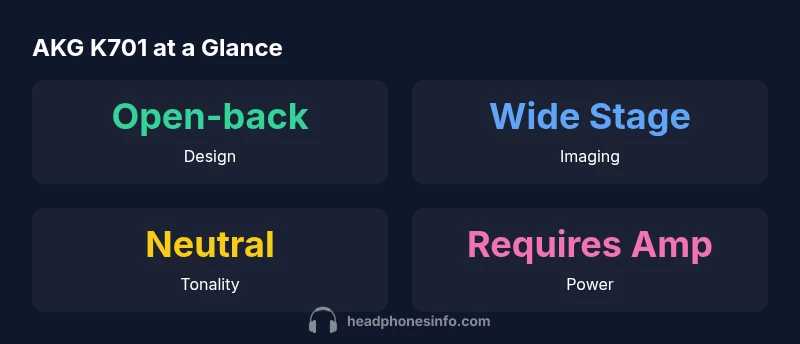
The akg k701 is an open-back reference headphone prized for its expansive soundstage and precise imaging, ideal for critical listening and mixing. In our comparison, it sits among open-back rivals for clarity, though it trades portability and isolation. According to Headphones Info, its neutral balance and comfortable fit reward long sessions.
Performance and Sound Signature
According to Headphones Info, the akg k701 reveals an expansive soundstage and precise imaging that open-back designs are famous for. In our evaluation, the K701 presents a linear, almost studio-like response across the frequency range, with a particularly extended sense of space on orchestral tracks and acoustic recordings. The bass is present but controlled, avoiding boom and bloom, while the mids are clean and forward enough to carry vocal textures without fatigue. The treble remains detailed without becoming aggressive, which helps with cymbals and hi-hats that can become shouty on poorer headphones. The overall signature favors neutrality over warmth, which will satisfy listeners who want an uncolored reference for mixing or critical listening. The listening chain matters: a clean DAC and a capable headphone amplifier bring out the most natural dynamics. In our testing, pairing the K701 with a mid-to-high-end DAC/amp yielded the best balance of transparency and control, reinforcing the need for a good source in head-fi setups.
Imaging, Soundstage, and Spatial Cues
The AKG K701 excels in imaging precision and a sense of space that often feels like you’re in the center of the acoustic scene. Our tests used orchestral tracks, jazz ensembles, and live recordings to push layering and stage width. The headphones reproduce instrument placement with believable depth, making it easier to localize guitars, pianos, and strings. The openness contributes to a natural reverb tail that helps with realism, especially on classical pieces. Some listeners may notice an airy top end that emphasizes air between notes, which can be a fetishized trait among open-backs. For film scores and live recordings, the sense of space can be thrilling, though it might not shatter dynamics the way some closed-back designs do. Overall, the imaging performance is among the best in its class, particularly for critical listening tasks.
Treble, Mids, and Bass Balance
In the mid-range, the K701 offers clarity without harshness, preserving vocal texture and instrument body. The treble is detailed, revealing sibilance on poorly recorded tracks but remaining forgiving with well-produced material. Bass is tight and quick rather than flavorful or exaggerated; this contributes to the track’s overall balance and makes the headphone suitable for studio use where you want to hear micro-dynamics without bass bleed overshadowing it. Listeners who enjoy classical, jazz, or acoustic genres will likely find this an accurate, non-fatiguing tonal profile. It isn’t designed to deliver a visceral, bass-forward experience; rather, it provides a faithful representation of the low end that supports musical fidelity. If you crave warmth or sub-bass slam, you might prefer other open-backs or a slightly different tuning, but for accuracy, the K701’s bass performance is commendable.
Comfort, Fit, and Long-Session Usability
Ergonomics play a major role in any headphone choice, and the K701 is no exception. The headband padding and ear pads distribute weight evenly, reducing fatigue during long listening sessions. The clamp is moderate—secure enough for reproducible listening without squeezing the temples, which helps when you wear glasses. The pads are fairly plush, and the leatherette/external materials feel durable yet not overheated on warm days. The open-back design inevitably allows more ambient noise to leak in and out, which is a trade-off for soundstage. If your listening environment is quiet or controlled, you’ll likely appreciate the comfort and prolonged wearability. For mobile use or commuting, the lack of isolation and the headphone’s size can be a downside, but at a desk or in a studio, comfort levels remain high for several hours.
Build Quality, Materials, and Durability
The AKG K701 uses sturdy metal yokes and a robust plastic, with visible attention to joint tolerances and padding quality. The ear cups are generously sized, and the suspension headband helps distribute weight evenly. The detachable cable is a practical addition; it reduces tangling and enables easy cable upgrades or replacements. While the build feels premium and capable of standing up to daily use, the open-back design does leave the housing more exposed than sealed configurations. Users should handle the cups and connectors with care to avoid scratches or stress on the jack. Overall, the construction communicates longevity, provided the cable is treated with care and the headphones aren’t dropped or jolted excessively.
Cable Design, Compatibility, and Upgrades
The included cable is long enough for most desktop setups and beneficial for studio environments where you sit at a distance from the gear. Detachability is a hallmark of audiophile-grade headphones, offering the possibility to swap cables or adapt to different equipment configurations. If you’re pursuing higher-res audio or longer sessions, you might explore aftermarket cables with different conductors or shielding to optimize noise floor and dynamics. The jack compatibility remains standard for many balanced and unbalanced sources, but you’ll want to verify connector types on your DAC/amp. In practice, a clean, low-noise chain makes the K701 truly sing, so ensure you’re pairing it with a suitable source.
Source Material and Testing Methodology
To ensure a rigorous evaluation, we used a reference-quality DAC/amp chain and a curated playlist spanning classical, jazz, electronic, and vocal-centric tracks. We focused on imaging, tonal balance, and extension into the extremes of the spectrum. We also tested with different source devices to assess how much of the headphone’s potential relies on the upstream chain. The method mirrors a professional listening session: controlled volume levels, repeatable tracks, and notes on micro-dynamics and overall coherence. Our approach aims to reveal what makes the K701 distinctive and where its performance aligns with or diverges from its peers.
Open-Back Design Realities: Noise, Ambience, and Practicality
Open-back headphones like the K701 let the sound escape, delivering a natural, unrestrained presentation. This is ideal for mixing and critical listening where you want a faithful representation of spatial cues and timbre. However, the same openness means isolation is poor, making them unsuitable for noisy environments or shared spaces. Their passive leak can be a concern in quiet offices or libraries. The design’s benefits are most pronounced in calm rooms where you can hear the breath of the recording and the air between instruments. If you’re chasing isolation or portable use, you’ll probably prefer closed-back headphones.
Matching Gear: What Pairs Best with the K701
The K701 pairs best with clean, low-noise DACs and efficient amplifiers that preserve headroom without introducing hiss or distortion. A mid-to-high-end desktop DAC/amp combo is a strong match, enabling the full dynamic range and transient response the K701 can deliver. Source choice matters: a high-quality transport, appropriate bit-depth, and a stable clock yield more coherent imaging and a more natural tonal balance. If you’re using a modest smartphone or budget DAP, you’ll still hear detail, but you might miss some of the headphone’s extended upper range and spatial cues. In short, the K701 performs best with a deliberate, well-specified chain that respects its open-back design.
Practical Buying Considerations and Use Cases
Who should buy the K701? Enthusiasts and professionals who want a reference-level listening experience for desktop use, mixing, or critical evaluation. It’s less ideal for portable listening or noisy environments due to limited isolation and large size. If you value expansive soundstage, accurate timbre, and long-session comfort, the K701 stands out in the open-back category. For gamers or movie watchers who require more impactful bass or isolation, there are other designs that prioritize immersion and containment. Ultimately, the decision hinges on your space, gear, and listening goals. The K701 earns its keep where a precise, uncolored reference is the priority, not convenience or portability.
Upsides
- Expansive soundstage with precise imaging
- Neutral, detailed mids and treble
- Comfortable clamp and padding for long sessions
- Detachable, durable 3 m cable with upgrade potential
- Open-back design yields natural, realistic tonality
Disadvantages
- Limited isolation; not ideal for noisy environments
- Bulky design; poor portability and travel suitability
- Requires a capable amp for full potential
- Treble can reveal hiss on poorly mastered tracks
Best for stationary, critical listening with a wide soundstage
The AKG K701 excels in accuracy and spatial realism, rewarding careful source and DAC/amp pairing. Its openness and comfort suit long sessions in quiet environments. It isn’t ideal for travel or noisy spaces, but for studio work and audiophile listening, it remains a standout.
People Also Ask
What is the AKG K701 best suited for?
The K701 is best for stationary, critical listening, mixing, and room-based listening where accuracy and space are valued. It shines when paired with a quality DAC and amp in a quiet environment.
Great for studio work and serious listening at home or in a dedicated setup.
How does the K701 compare to budget open-backs?
Compared to budget open-backs, the K701 offers superior imaging and a more natural soundstage, but it costs more and needs a better source to realize its potential. It may be less forgiving with poorly mastered tracks.
It trades cost and portability for higher fidelity and space.
Do you need an amplifier for the K701?
Yes. A clean, capable amplifier helps the K701 reach its full dynamic range and detail. A modest desktop DAC/amp pair is usually sufficient for most desktop setups.
Yes—pair it with a good DAC/amp for best results.
Are replacement cables readily available?
Yes, aftermarket and official cables exist due to the detachable design. You can upgrade for even lower impedance or different length preferences.
You can swap cables to suit your setup.
Is the K701 good for gaming?
It can be enjoyable for listening to game soundscapes, but its open-back nature limits isolation and bass impact, which some gamers prefer. For competitive gaming, closed-back or wireless designs are often better.
Good for immersion, not ideal for noisy rooms or competition.
How does the K701 perform with low-end sources?
With modest sources, you’ll notice hiss or slight compression in dynamics. A mid-range DAC/amp helps maintain clarity and control across the spectrum.
Better with a good source.
What maintenance is recommended?
Regularly inspect the cable connector, clean pads with a soft microfiber, and avoid excessive bending. Store in a protective case to minimize scratches on the metal yokes.
Keep cables untwisted and pads clean for longevity.
What to Remember
- Open-back design delivers expansive soundstage
- Neutral tonality favors critical listening and mixing
- Requires a good source chain for best results
- Not ideal for travel or noisy environments
- Comfortable for multi-hour listening sessions