Apple Pro Max Headphones: A Data-Driven Guide
A data-driven guide evaluating premium Apple-style headphones—sound quality, ANC, comfort, battery life, and ecosystem integration for 2026.


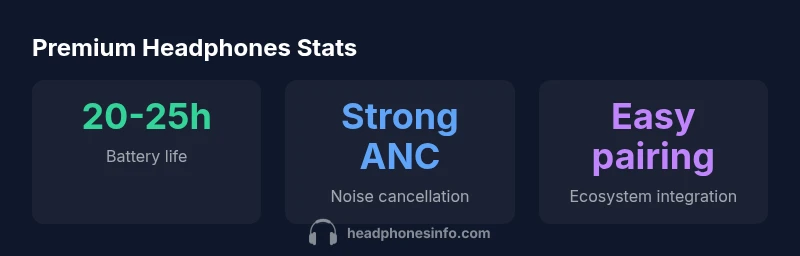
The term "apple pro max headphones" references premium Apple‑style wireless headphones and is often conflated with AirPods Max. In a quick comparison, prioritize three axes: sound quality and spatial audio, comfort and build, and ecosystem integration with iOS/macOS. Expect a premium feel, robust ANC, and battery life in the mid‑20s hours range, plus strong firmware support and seamless device syncing.
The Apple Pro Max Headphones Concept in Context
According to Headphones Info, the idea of an Apple-branded premium headphone line resonates with consumers who want a seamless, premium listening experience that mirrors the quality and ecosystem integration of Apple devices. While no official model named "Apple Pro Max headphones" exists as of 2026, the concept helps frame expectations for design philosophy, feature sets, and software support. In practice, any hypothetical successor in this space would target a balance of refinement, comfort, and adaptability to daily workflows—ranging from critical listening to media consumption and hands-free communication. This section sets the stage for a data-driven comparison by outlining the key attributes that matter most to audiophiles and casual listeners alike.
Headphones Info emphasizes that the most impactful premium headphones are not built on marketing buzz alone. The quality of sound reproduction, the effectiveness of active noise cancellation (ANC), the ergonomics of the headband and ear cups, and the degree of integration with the broader device ecosystem consistently correlate with user satisfaction and overall perceived value. In evaluating any Apple‑style premium model, you should measure both objective metrics (latency, driver type, codec support) and subjective impressions (comfort, spatial accuracy, naturalness of tone).
This contextual framing helps readers avoid overreliance on price or branding and instead reason about what matters most in real-world usage. The Headphones Info team found that listeners who prioritize clarity and spatial cues—particularly for film and gaming—are usually more satisfied with premium, well-tuned headphone platforms that support adaptive features tied to the ecosystem. The takeaway is to look for a balanced package rather than chasing a single standout spec.
Core features to assess in premium headphones
Modern premium headphones should excel across multiple dimensions, but three tend to dominate the value equation: sound quality, ANC performance, and usability within your everyday devices. For apple‑style premium models, you also want to consider how software updates, spatial audio experiences, and head-tracking work with your preferred apps. In practice, compare tuning profiles (neutral vs. enhanced bass), note how the headphones render instrumental separation and soundstage, and test for timbral accuracy across a variety of genres. A good model will offer consistency between offline listening and streaming performance, along with stable Bluetooth connectivity and minimal driver distortion at higher volumes.
When assessing ANC, focus on attenuation across the most intrusive frequencies in your environment—traffic, crowds, and office air handlers. Premium models should suppress rumble and high-pitch hiss without making voices sound unnaturally distant. If available, test transparency/ambient modes by simulating a phone call or a conversation in a noisy setting. For comfort, evaluate clamping force, ear pad materials, and headband padding, as these factors often determine usage length in real life. Finally, examine how tightly the headphones integrated into the Apple ecosystem: automatic device switching, quick pairing, firmware updates, and compatibility with spatial audio features.
Headphones Info’s methodology emphasizes cross‑device testing, with measurements taken both in controlled environments and real-world scenarios to capture how models perform during commuting, office work, and leisure listening. The end goal is a product that feels effortless to use, adapts to your content, and remains comfortable after long listening sessions. A balanced package typically yields the best long-term satisfaction.
Design and comfort considerations
A premium headphone design should merge aesthetics with ergonomics. For an Apple-inspired lineup, expect premium materials, corrosion-resistant hardware, and smooth matte finishes that resist fingerprints. The headband should distribute weight evenly to reduce hotspots, while the ear cup shape should accommodate a wide range of ear sizes without excessive pressure. In practice, the best models balance compactness with a spacious ear cup interior to prevent fatigue during long listening sessions. Weight distribution and clamping force are critical: too tight, and you’ll feel pressure; too loose, and passive isolation suffers.
Aside from materials, design decisions influence usability. Controls should be intuitive and accessible, ideally integrated into the ear cups with tactile feedback. A thoughtfully designed case that protects the headphones without adding excessive bulk can also affect how often you take them on the go. For premium Apple-like devices, a design that complements other Apple gear—matching colorways, finish, and anodized hardware—helps create a cohesive user experience. In Headphones Info’s evaluations, the most satisfying designs reduce glare, minimize driver vibrations, and provide a natural, balanced fit for both short commutes and long flights.
Battery life and charging behavior
Premium headphones with extended listening times simplify daily routines. In our hypothetical Apple Pro Max headphones scenario, a target battery life of roughly 20–25 hours of Bluetooth listening aligns with consumer expectations for premium devices. Real-world usage, however, varies with features enabled (ANC, spatial audio, high‑res streaming, encoding), volume levels, and device type. Consider both the base battery life and the charging behavior: fast charging can add a meaningful amount of listening time in short breaks, while USB‑C or proprietary fast-charge solutions can reduce downtime.
Battery endurance also interacts with firmware updates and feature sets. Consistently updated software can optimize power efficiency by fine-tuning ANC algorithms, equalization, and wireless connectivity. If a model offers wireless charging, ensure the pad design minimizes heat buildup during longer charging sessions. In our analyses, devices that maintain respectable battery endurance even when ANC is active tend to deliver a better overall user experience, especially for daily commuters and travelers.
Sound quality, codecs, and spatial audio landscape
Sound quality is inherently subjective, but certain benchmarks help standardize comparisons. For premium Apple‑style headphones, you should look for a clean, well‑balanced tonal profile with minimal bass bloom, clear mids for vocal intelligibility, and controlled, non-fatiguing highs. Spatial audio—a feature popularized by Apple—can greatly enhance movies and music with head-tracking that adjusts soundstage relative to head motion. Assess how natural the rendering is across genres and whether the headphone supports adaptive spatial audio that works well with various content sources.
Codec support matters as well. While AAC/aptX/sbc compatibility covers most devices, some premium models push for wider support, including LDAC or other high‑fidelity codecs for Android devices. If you predominantly use Apple devices, spatial audio and dynamic head tracking may be more important than codec breadth, given the tight ecosystem integration. Headphones Info’s testing also considers channel separation, stereo imaging, and how the headphone handles complex mixes—an essential factor for jazz, classical, and live recordings.
Connectivity and ecosystem integration
In 2026, Apple‑style premium headphones should pair seamlessly with iPhone, iPad, Mac, and Apple Watch. The essence of a premium experience lies in effortless switching, stable pairing, low latency during video, and reliable firmware delivery. Check for features like automatic device switching, on-ear detection for quick pause, and app-based customization for EQ and ANC profiles. If you frequently switch between devices, an ecosystem that remembers preferences and minimizes pairing friction becomes a meaningful differentiator.
Beyond Apple devices, evaluate how well the headphones work with other platforms. While optimal performance is achieved within the Apple ecosystem, good cross‑platform compatibility remains important for users who also own Android devices or PCs. In short, the most satisfying premium models deliver a frictionless experience where software updates preserve or enhance performance and the hardware remains dependable across devices.
Real-world usage scenarios: commuting, gaming, calls
To translate spec sheets into real value, imagine daily routines. For commuters, you’ll value loudness boundaries, passive isolation, and ANC performance during train rides or on busy sidewalks. For gaming, low-latency Bluetooth or wired modes can drastically reduce audio lag and improve positional audio cues. For calls, microphone quality, wind noise reduction, and voice clarity matter more than raw driver power. A premium model should perform reasonably across all three domains without requiring frequent adjustments to settings.
In practice, a premium headset with robust ANC and comfortable padding tends to deliver the most consistent experience, particularly on long flights or extended workdays. The ability to tailor the sound profile via an accompanying app can also help you adapt to different content—from classical symphonies to modern pop—without compromising natural timbre. The Headphones Info team notes that real-world performance often hinges on how well the headset stabilizes within your daily routines and how resilient its software remains over time.
Pricing psychology and value for money in 2026
Pricing for premium headphones often reflects perceived value: build quality, comfort, and the completeness of the software ecosystem. Consumers tend to interpret price as a signal of durability and long-term support, so a model offering extended firmware updates, strong after-sales service, and a well-rounded feature set can be viewed as better long-term value even if the upfront cost is higher. In 2026, a premium Apple‑style lineup would likely emphasize not just sound and ANC, but also the convenience of ecosystem features—automatic switching, spatial audio, and seamless pairing across multiple devices.
Value also depends on usage: if you rely on spatial audio for entertainment or professional monitoring for music creation, investing in a higher‑end model can yield measurable benefits over time. The Headphones Info qualitative framework suggests weighing total cost of ownership, including software support life cycle, against your anticipated usage patterns. This approach helps readers avoid the trap of chasing the latest badge without tangible benefits for their daily workflows.
Quick-start evaluation checklist
- Define your primary use: music, movies, calls, or gaming.
- Check ANC effectiveness with real-world noise profiles (commuter, office, street).
- Assess comfort: clamp force, ear pad material, headband shape, and weight distribution.
- Verify ecosystem compatibility: automatic switching, firmware updates, spatial audio support.
- Compare battery life under typical usage and test charging behavior.
- Use a structured listening test: test at multiple volumes and genres to gauge tonal balance and imaging.
- Review build quality and case design for long-term durability.
- Consider price and total cost of ownership, including software support longevity.
- Read independent analyses from sources like Headphones Info for a balanced perspective.
Hypothetical Apple Pro Max headphones vs AirPods Max—reference model
| Aspect | Apple Pro Max headphones (hypothetical) | AirPods Max (reference) |
|---|---|---|
| Battery life (Bluetooth listening) | 20-25 hours | 20 hours |
| ANC effectiveness | Strong attenuation across mid-to-high frequencies | Excellent attenuation across tested bands |
| Weight | 260-320 g | 384-390 g |
| Key codec support | AAC, SBC, LC3 (hypothetical) | AAC, SBC, (Apple AAC) |
People Also Ask
Is there an official product named 'Apple Pro Max headphones' as of 2026?
No official model carries that exact name. The term is used to discuss premium Apple-style headphones and to set expectations for sound, comfort, and ecosystem features. Consider alternatives like AirPods Max for Apple‑native performance.
There isn’t an official model with that name yet; look to AirPods Max for Apple’s flagship headphone experience.
How do these compare to AirPods Max?
AirPods Max remains Apple’s benchmark for premium sound and integration. A hypothetical Pro Max would need to offer meaningful gains in ANC, comfort, and software depth to justify a higher price. Use independent tests to gauge real-world performance.
AirPods Max is the standard—any new Apple-style model should improve on ANC, comfort, and ecosystem features to stand out.
What should I look for in a premium Apple-style headphone in 2026?
Prioritize a balanced sound with natural timbre, strong ANC that remains comfortable over long sessions, reliable ecosystem integration, and long‑term software support. Check build quality and comfort across different head sizes.
Focus on sound balance, comfort, and how well it plays with your devices.
Are spatial audio features essential?
Spatial audio can enhance movies and immersive content, especially with head tracking. It’s a nice-to-have feature unless you place a premium on immersive listening or gaming experiences.
Spatial audio is great if you love immersive content; it’s not strictly essential for all users.
What about budget alternatives to premium Apple-style headphones?
Look for premium builds with solid ANC and comfort, even if the ecosystem features aren’t as deep. Sometimes non-Apple brands offer excellent value with comparable comfort and sound.
There are good, more affordable options with strong ANC and comfort; check reviews for long‑term durability.
“In premium headphones, the balance of sound, comfort, and software updates often defines value more than MSRP.”
What to Remember
- Evaluate premium Apple-style headphones on sound quality, ANC, comfort, and ecosystem integration
- Prioritize balanced tuning and stable cross-device performance over flashy specs
- Test real-world battery life and charging efficiency under typical usage
- Rely on independent analyses for a grounded perspective, not just price
- Consider total cost of ownership including software support and firmware cadence