How to Choose Headphones: A Practical Guide for 2026
Discover a structured, step-by-step method to pick headphones that fit your uses, ensure comfort, and maximize value with clear criteria, tests, and budget guidance from Headphones Info.


Choosing headphones that fit your needs starts with clear goals and a reliable comparison process. This guide walks you through identifying listening goals, selecting the right type, evaluating core specs, and testing options—equipping you to buy confidently. Follow the step-by-step method to balance sound quality, comfort, features, and price.
Understanding Your Listening Goals
Before you start comparing headphones, define what you actually want to accomplish with your next pair. Are you preparing for long daily listening sessions at a desk, commuting, working out, or critical listening for mixing and mastering? Your use-case drives important choices like impedance, openness, and isolation. The Headphones Info team emphasizes that a well-scoped goal helps you separate must-have features from nice-to-haves. Start by listing three scenarios where you’ll use the headphones most: travel, gaming, and casual listening, then assign a priority score to each. This clarity will guide your budget and test plan, ensuring you don’t get dazzled by flashy specs alone. Also consider environment and source quality; a high-end headphone will only sound as good as the device driving it. According to Headphones Info, many buyers overlook how streaming quality, dongle adapters, and DAC/amp compatibility influence perceived performance. Keep your test playlist simple but representative: a mix of bass-heavy tracks, mids-rich vocals, acoustic guitar, and ambient soundscapes. Finally, set your budget ceiling and a fair test window to compare at least two strong contenders side by side.
Key Headphone Types: Over-Ear, On-Ear, In-Ear
Headphones come in three broad formats, each with distinct strengths for different environments and preferences. Over-ear models enclose the ears in a large, cup-shaped enclosure, often delivering the most immersive sound and passive isolation. They’re typically comfortable for long sessions but can feel bulky for commuting. On-ear designs sit on the ears rather than around them; they’re lighter and more portable, yet may leak more sound and fatigue the temples with pressure over time. In-ear monitors (IEMs) are compact and deeply portable, excelling for travel and workouts, but fit and seal determine sound quality and comfort. Your choice should align with use-case, comfort, and how much you value isolation versus openness. For daily listening at a desk or during commutes, many listeners prefer a well-fitted over-ear or a quality IEM with a stable seal. Brand and model variety means you should test multiple shapes to understand tonal balance, bass texture, and vocal clarity. Remember that the best type is the one you’ll wear consistently, not the one with the best marketing.
Core Specs That Matter
Audio quality isn’t defined by a single spec. Core parameters to understand include impedance, sensitivity, driver type, and frequency response, plus open-back vs closed-back design. Impedance indicates how much electrical pressure the headphones require to achieve a given volume; higher impedance headphones often need a more capable source but can offer lower distortion and more controlled dynamics when paired with a quality amp. Sensitivity predicts loudness at a given power; higher sensitivity means you’ll reach comfortable listening levels with less power. Driver type (dynamic, planar magnetic, electrostatic) shapes timbre, transient response, and efficiency. Frequency response hints at the range of audible tones but not guaranteed accuracy; look for flatness around the midrange if you want a faithful representation. Open-back headphones release sound into the room and feel more natural but leak sound; closed-back isolates better and is ideal for noisy environments. If you’re buying wireless, consider codecs (AAC, LDAC, aptX) and latency, which affect synchronization with video and games. Finally, ANC (active noise cancellation) can dramatically improve perceived bass and quietness in travel and work settings. Interpret specs as a guide to fit your priorities, not as a guarantee of “best.”
How to Fit Your Budget and Priorities
Budgeting for headphones means balancing price against the features you truly need. At a low budget (roughly $50-$100), you’ll typically find well-made wired models with decent comfort and tonal balance suitable for casual listening or student use. Mid-range options ($100-$250) often deliver better build quality, more consistent sound, and features like detachable cables or foldable design. If you’re ready to invest ($250-$400+), you can expect premium materials, advanced drivers, robust wireless performance, stronger ANC, and longer warranties; however, the gains may plateau if the source quality isn’t up to par. Always map your priorities to your budget: if wireless freedom and ANC matter most, allocate more toward practical features rather than chasing a marginal tonal shift. For travelers, consider compact, foldable designs with long battery life and reliable Bluetooth performance. Headphones Info analysis shows that comfort and fit can overshadow minor tonal differences for many listeners over long listening sessions; test for clamp force, clamp pressure, clamping balance, and ear-pad softness. If you plan to use headphones with a high-end DAC or amp, factor that into your buying decision as it can unlock higher fidelity in mid-to-high price ranges.
Wireless vs Wired: When to Choose Each
Wired headphones deliver natural, latency-free signal paths ideal for critical listening, studio work, and certain gaming setups where timing matters. They’re typically lighter and free from battery constraints, but the cable adds tangling and potential wear. Wireless headphones offer portability and convenience, with the trade-offs of potential compression, codec considerations, and battery life. If you travel, commute, or exercise, wireless with a stable battery and robust ANC can be worth the premium. When evaluating wireless options, examine battery life with ANC on, charging speed, footprint, and the reliability of Bluetooth connections in your typical environments. If you value sound quality above all, you may start with a wired model; if you value flexibility and mobility, a quality wireless option with dependable ANC is compelling. ANC performance varies by model and often reduces bass fullness or creates a perceived “hollow” feel on certain tracks; test with a variety of genres to assess the trade-off. Remember that you can always upgrade the source or DAC later to improve wireless fidelity.
How to Test Headphones Before You Buy
Testing is crucial. If you can visit a store, bring your own tracks and listen at a comfortable volume. Compare at least two to three contenders across the same set of songs to isolate tonal differences. Check for fit: seal on IEMs, clamp comfort on over-ears, and weight distribution. Use a few reference tracks you know well, including a bass-heavy piece, a vocal-centric track, and a dynamic cinematic score to evaluate bass response, vocal clarity, and soundstage. For wireless models, test real-world use: latency with video, quick pairing, and stable reconnection after brief interruptions. If you test at home, use the same audio source and volume for each model to reduce variables. Finally, factor in practical wear: sleeve length, headband adjustability, ear-pad material, and overall comfort for sessions longer than an hour. With a structured test, you’ll see how each model handles tonal balance, resonance, and transient response in your real-world listening.
Step-by-Step Buying Process (Checklist)
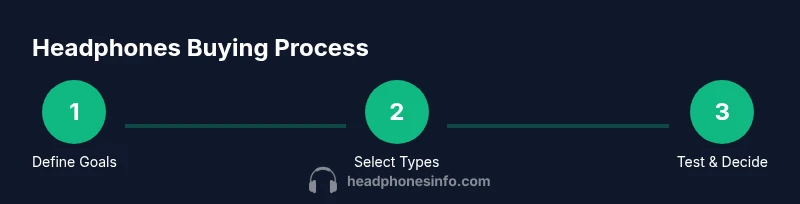
This section complements the hands-on testing by providing a repeatable buying workflow you can follow for any headphone purchase. It’s designed to take you from goal-setting to final choice with clear, discrete steps and a timeline.
How to Optimize Your Setup for Headphones
Pairing headphones with a compatible source, e.g., a quality phone, DAC/amp, or PC, can unlock the full potential of your purchase. Use a clean, neutral source to hear tonal balance without added coloration. If you test high-impedance models, you’ll want a stable, capable amplifier so you can reach intended loudness without distortion. Consider cables: replaceable cables with robust strain relief extend life and maintain signal quality. For wireless setups, keep firmware updated and test the Bluetooth range in your primary listening areas.
Tools & Materials
- Quiet testing environment(Reduces external noise for accurate listening.)
- Source device (phone/laptop/desktop)(Prefer a neutral, clean output for testing.)
- Two or more headphone samples(Have at least two options to compare tonal balance.)
- DAC/AMP (optional)(Helpful for high-impedance or premium models.)
- Test tracks (reference library)(Include bass-heavy, midrange vocals, and acoustic material.)
Steps
Estimated time: 60-120 minutes
- 1
Define your listening goals
Articulate primary use cases, environments, and listening duration. This guides your type and feature choices and prevents overpaying for features you won’t use.
Tip: Write down three scenarios and rank their importance. - 2
Gather candidate models
Select two to four headphone options across price points and types that seem to fit your goals. Use retailer specs and third-party reviews as initial filters.
Tip: Choose models with return policies to test at home. - 3
Check core specs against goals
Match impedance, sensitivity, driver type, and closed/open-back design to your needs. Passive comfort and build quality should align with your usage.
Tip: Prioritize comfort and reliability over minor tonal shifts. - 4
Assess fit and comfort
Try to wear the headphones for 15-20 minutes and evaluate clamp force, pressure on the temples, and ear-cup padding. Fit affects perceived sound and fatigue.
Tip: Take short breaks to avoid ear fatigue during extended tests. - 5
Test sound with reference tracks
Play a set of tracks you know well across genres. Note bass articulation, vocal clarity, and instrument separation.
Tip: Use the same volume for all models to keep comparisons fair. - 6
Evaluate wireless performance (if applicable)
Check latency with video, stability of pairing, and battery life in typical use. ANC effectiveness should be measured in your environment.
Tip: Test with multiple devices to gauge cross-compatibility. - 7
Compare value and warranty
Weigh features against price, check warranty terms, and consider accessory quality like detachable cables or memory foam pads.
Tip: A longer warranty often signals better build quality. - 8
Make your decision and plan a real test
Choose the best candidate, place an order if satisfied or request a longer test window for a final decision.
Tip: Keep a brief log of impressions for each model.
People Also Ask
What is the most important spec when choosing headphones?
There isn’t a single universal spec. For many listeners, comfort and fit drive long-term satisfaction, followed by how accurately the headphones reproduce music within your preferred genre. For critical listening, impedance, sensitivity, and driver type matter more.
The most important spec depends on your use. Comfort and fit often trump minor tonal differences, especially for long listening sessions.
Should I buy wired or wireless headphones?
If you value latency and studio accuracy, wired headphones are usually best. For mobility and convenience, wireless with reliable battery life and ANC can be a great choice, especially for travel or commuting.
Wired is best for accuracy; wireless is best for convenience, depending on your environment.
Do expensive headphones always sound better?
Not necessarily. Higher price often correlates with better build quality, comfort, and features, but the best sound is what fits your preferences and source. Test across two or more options in your budget to find the best overall value.
Price doesn’t guarantee sound quality; test for comfort and how the sound aligns with your preferences.
How do impedance and sensitivity affect loudness?
Impedance indicates how much power is required to reach a given volume; sensitivity estimates loudness at a fixed power. A mismatch between headphone impedance and your source can reduce volume or increase distortion.
Impedance and sensitivity determine how easily headphones play loud; match them to your device for best results.
How long should I test headphones before buying?
Aim for at least 15-30 minutes per model across several tracks to assess comfort, tonal balance, and fit. If possible, extend this to 1-2 hours to observe fatigue and real-world usability.
Test each model for at least 15-30 minutes, ideally longer to gauge comfort and accuracy.
Can online reviews be trusted for headphones?
Reviews can be helpful for common experiences, but they vary in quality and bias. Rely on tests with your own ears whenever possible and look for sources that disclose test conditions and sources.
Use reviews as a guide, but verify with your own listening tests when you can.
Watch Video
What to Remember
- Define listening goals before shopping.
- Choose headphone type that fits your use case.
- Balance comfort with sound quality and build.
- Test with real tracks across genres and sources.
- Consider price-to-value, warranty, and future-proofing.