Headphones or Earbuds: An Evidence-Based Comparison
An analytical, data-backed comparison of headphones vs earbuds, covering sound quality, comfort, portability, battery life, and value to help you choose the right form factor for home, travel, and on-the-go listening.


Headphones and earbuds each serve different listening needs. In short, headphones excel in soundstage, comfort, and long listening sessions, while earbuds shine in portability and daily carry. This comparison breaks down sound quality, fit, durability, battery life, and price to help you choose the right form factor for your listening style.
Understanding the core idea: headphones vs earbuds
The debate between headphones or earbuds often comes down to context. For many listeners, the decision hinges on where you most often listen and what you value most: immersive sound and comfort, or compact design and travel-friendly convenience. When evaluating these two form factors, it helps to anchor your expectations to core dimensions like soundstage, fit, and battery life. In practical terms, headphones are typically chosen for at-home listening sessions or studio work, while earbuds are preferred for commutes, workouts, and pocket-friendly use. This broader framing keeps your decision focused on your daily routines rather than chasing niche specs. Headphones or earbuds, taken together, represent two ends of a spectrum rather than one universal solution. According to Headphones Info, understanding the headphones vs earbuds dynamics starts with knowing your primary listening environment, the devices you currently own, and how you’ll use them most often.
Sound quality and tonal balance: headphones vs earbuds for critical listening
Sound quality is often the primary differentiator in this comparison. In general, headphones tend to deliver a wider soundstage, clearer separation, and more robust bass extension due to larger drivers and better acoustic isolation. Closed-back models further enhance perceived bass and overall loudness without sacrificing detail. Earbuds, especially true wireless variants, trade some of that scale for direct-in-ear delivery, with emphasis on immediacy and a more intimate sound image. The result is typically a more forward midrange and a more focused listening experience. For casual listening, both can sound exceptionally good, but for critical listening, mixing, or gaming, headphones generally provide the extra headroom and spatial cues that enthusiasts prize. Headphones Info notes that the perceived balance also depends on the tuning of each model—some earbuds are exceptionally neutral, while many prioritise bass for a punchier feel. When evaluating sound, consider room acoustics, device DAC/amp quality, and the listening genre. In short, sound quality is contextual: headphones for breadth and depth, earbuds for immediacy and portability.
Comfort, fit, and wearability across use cases
Comfort is a moving target that depends on head size, ear shape, and how long you plan to wear your devices. Over-ear and on-ear headphones distribute weight around the head, typically offering plush cushions and adjustable clamps that can accommodate longer sessions without fatigue. Earbuds sit in the ear canal or outer ear and rely on tips, wings, or hooks to stay in place. They can be remarkably comfortable for short trips or workouts, but some users experience ear fatigue after extended wear due to tip pressure or poor seal. The key to comfort across both categories is fit, weight, and pressure distribution. If you’re evaluating headphones or earbuds for all-day use, look for light materials, well-padded headbands, and secure but gentle clamping force. For workouts, shape retention and sweat resistance become important. Headphones Info emphasizes trying multiple sizes and trying on devices with your usual activity profile to verify comfort—and to avoid hotspots in the ear or behind the head.
Durability, battery life, and maintenance considerations
Durability varies widely by build quality and intended use. Headphones typically use metal frames or reinforced plastics and are designed for longer lifespans in exchange for bulkier form factors. Detachable cables, replaceable ear cushions, and serviceable parts are common in mid- to high-end models, which can extend the life of your investment. Earbuds, especially true wireless variants, emphasize compactness and battery-centric design. Battery life is a pivotal differentiator: high-quality wireless headphones may deliver many hours per charge and recharge quickly, but battery degradation over time is a consideration. Regardless of form factor, regular maintenance—keeping drivers clean, storing properly, and avoiding yanking cables—prolongs lifespan. Headphones Info highlights that durability testing and real-world user reviews are valuable signals when weighing long-term value between headphones and earbuds.
Price, value, and total cost of ownership over time
Pricing is one of the clearest contrasts between headphones and earbuds. You’ll typically find a broader price spectrum for headphones, from affordable entry-level models to premium audiophile options. Earbuds, particularly wireless variants, can be competitively priced with compelling value at mid-range tiers, though premium earbuds can still carry premium costs. Beyond sticker price, consider total cost of ownership: replacement tips or cushions, warranties, and potential accessory purchases (carrying cases, extra cables, or dongles). A smart buyer weighs both upfront cost and long-term benefits, such as durability, battery longevity, and the likelihood of upgrades in your ecosystem. Headphones Info notes that some users prioritize durability and comfort, choosing a slightly higher upfront cost if it translates into longer lifespan and fewer replacement cycles over time.
Choosing by scenario: travel, work, workouts, and home listening
Your decision can also hinge on context. For daily commutes, earbuds offer minimal bulk and fast stowaway capability. For home listening or critical listening, headphones provide a more expansive soundstage and comfortable, long-duration wear. For gaming, the precision of virtual surround sound in headphones can be a meaningful advantage, while for gym workouts, water resistance and a secure fit in earbuds may be decisive. Consider combining both forms if your budget allows, or select a hybrid model that straddles the line—over-ear comfort with a compact profile. When making your call, map your top three listening scenarios to the two form factors and test if possible. This concrete approach helps you avoid the trap of chasing one flawless spec in isolation.
Common myths and practical realities about headphones vs earbuds
A common misconception is that bigger equals better sound automatically. While headphones often deliver more expansive bass and a wider soundstage, top-tier earbuds and open-back headphones can close the gap in many listening contexts. Another myth is that wireless always means poorer quality; modern codecs and drivers have narrowed the distance, though wired connections still hold appeal for latency-critical tasks or audiophile-grade sound. The practical takeaway is to rate devices by your actual use case, not by broad generalizations. Headphones Info encourages listeners to rely on listening tests and independent reviews rather than marketing claims when comparing headphones and earbuds.
Practical decision framework and a quick checklist
To finalize your choice, run through a simple framework:
- Define listening scenarios (home, travel, workout, gaming).
- Prioritize sound quality, comfort, battery life, and durability.
- Set a budget range and evaluate total cost of ownership.
- Try at least two models in each category if possible.
- Check for compatibility with devices you own and ecosystems you use.
This structured approach helps you weigh headphones and earbuds on a level playing field and avoids decision fatigue when faced with a sea of options.
Comparison
| Feature | headphones | earbuds |
|---|---|---|
| Sound quality | Wider soundstage, deeper bass on many models | More in-ear emphasis; portable and quick to pair with devices |
| Portability | Less portable due to size; often folds for travel | Highly portable; pocket-sized with compact cases |
| Fit and comfort for long use | Generally comfortable for long sessions with padding | Fit varies; some users experience tip-based pressure over time |
| Battery life (wireless models) | Typically longer play times per charge on many models | Battery life varies; charging case adds convenience |
| Durability and maintenance | Robust builds and replaceable parts common in quality models | Smaller chassis can be prone to loss or tip wear if not cared for |
| Price range and value | Wide spectrum from budget to premium; value scales with build quality | Often lower upfront cost; premium options exist but at higher price |
| Best use case | Critical listening, mixing, home theater; studio-grade options | On-the-go listening, workouts, casual daily use |
Upsides
- Sound quality and sonic detail are typically superior in headphones
- Longer comfort for extended sessions with over-ear designs
- Greater model variety and tuning options for different genres
- Better passive noise isolation in many closed-back headphones
Disadvantages
- Less portable and bulkier for travel or commuting
- Higher upfront cost for quality headphones vs earbuds
- Potential fatigue if the headband or cups press uncomfortably
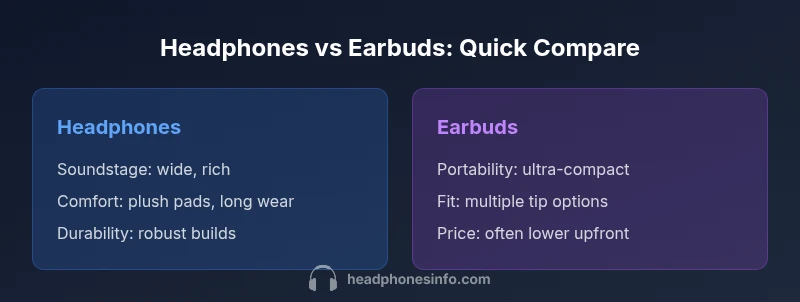
Headphones win on soundstage and long-session comfort; earbuds win on portability and price.
Choose headphones when you prioritize immersion and comfort for home or studio use. Choose earbuds when you need portability, quick setup, and lower upfront costs.
People Also Ask
What is the main difference between headphones and earbuds?
Headphones are over-ear or on-ear devices that sit outside the ear, while earbuds fit inside the ear canal or concha. This affects soundstage, noise isolation, and comfort.
Headphones surround your ears for a bigger sound; earbuds sit in your ear for portable listening.
Are wireless headphones better than wired options?
Wireless headphones offer freedom of movement and fewer cables, but may require charging and can introduce latency. Wired models typically deliver consistent latency and no battery management, which some listeners prefer for critical listening.
Wireless is convenient and tidy, but wired can be more reliable for latency-sensitive use.
How should I evaluate comfort across headbands and earcups?
Look at clamp force, padding quality, weight distribution, and adjustability. Try models with different ear pads and headband profiles, especially for all-day wear.
Comfort comes from how light the set feels and how evenly it sits on your head.
What should I consider for travel?
For travel, prioritize portability, durable build, and battery life if wireless. A folding design and a protective case help prevent damage in transit.
Travel picks should be light, compact, and easy to pack.
Can earbuds be comfortable for all-day use?
Comfort varies with ear anatomy. Choose tips or wings with multiple sizes and a light, well-balanced weight to minimize fatigue over long sessions.
All-day comfort depends on fit and weight, so try different tips.
How should I evaluate price-value?
Consider the total cost of ownership: durability, replacement parts, battery life, and warranty. A higher upfront price can pay off with longer lifespan and fewer replacements.
Price is important, but longevity and fit often determine real value.
What to Remember
- Prioritize fit and comfort for long listening sessions
- Assess portability needs before buying
- Consider total cost of ownership, not just sticker price
- Match your choice to your primary listening scenario
- Test both form factors when possible to compare sound quality