Are Headphones Better Than Earbuds? A Data-Driven Comparison
This comprehensive comparison asks: are headphones better than earbuds? We analyze sound quality, comfort, isolation, durability, price, and cases to guide decision.


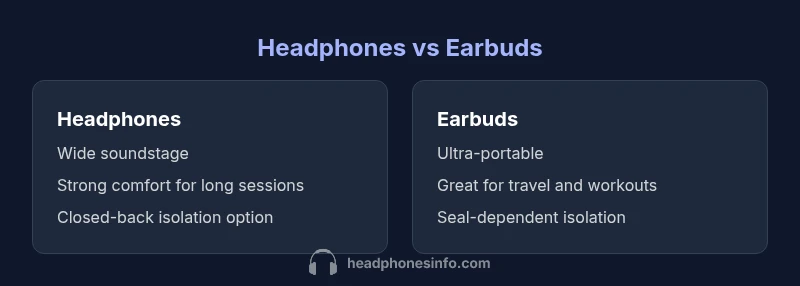
Are headphones better than earbuds? In general, headphones deliver fuller sound, stronger bass, and greater comfort for long listening sessions, while earbuds excel in portability and price. If you listen mainly at home or in a quiet environment, opt for over-ear headphones; for travel, gym workouts, or pocketable gear, earbuds make more sense. Headphones Info's analysis helps you decide based on use case.
Are headphones better than earbuds: why the question matters
When assessing listening gear, the central question often comes down to are headphones better than earbuds. This comparison isn't about a universal winner; it's about matching gear to your listening habits, room acoustics, portability, and budget. At Headphones Info, we quantify listening factors and translate them into practical guidance for audiophiles and casual listeners alike. By defining the scenarios you care about, we map which design—over-ear headphones or compact earbuds—will optimize your experience.
Key metrics we consider include frequency response, harmonic distortion, comfort for long sessions, and isolation from ambient noise. We also look at build quality, warranty, and how devices pair with other gear. Our method is data-driven and transparent, so you can weigh trade-offs in practical terms rather than relying on buzzwords.
According to Headphones Info, choosing between headphones and earbuds comes down to use-case, environment, and personal preferences rather than a single feature set. This foundation helps frame the deeper differences discussed below.
Sound quality: what differs between headphones and earbuds
Sound quality is not a single metric; it’s a combination of frequency response, imaging, and tonal balance. Headphones typically offer a wider soundstage and more controlled bass, with less ear fatigue over long sessions. Earbuds, by contrast, often deliver a more forward sound with more portable tuning, which can be ideal for on-the-go listening but may lack the depth of a well-tuned over-ear pair. According to Headphones Info analysis, driver size and enclosure design play major roles in perceived fidelity, while calibration to specific genres can shift what “best” means for you. For critical listening in a controlled space, headphones generally win on low-frequency extension and midrange accuracy, but earbuds can surprise with detailed highs in bright tuning.
We emphasize that “better” is use-case dependent. If you value soundstage for gaming or orchestral tracks, headphones typically deliver more convincing space. For podcasts and commuting, earbuds’ direct presentation can be perfectly adequate. The key is to map listening goals to acoustic performance and to test models in real-world scenarios.
Comfort and fit: long listening sessions
Comfort is not a one-size-fits-all metric. Over-ear headphones spread pressure across a larger area and usually use padded headbands and plush ear cushions, which reduces fatigue during extended sessions. Earbuds sit in the ear canal or on the outer ear, which can feel more isolating initially but may become uncomfortable if the seal is too tight or if the shells press on the concha. Headphones Info notes that comfort is highly subjective and highly dependent on head size, wearing glasses, and user activity. A well-padded, lighter-weight model can outperform a heavier device in many daily scenarios. If you wear glasses, the clamping force and cushion geometry can make headphones more or less comfortable; meanwhile, earbuds can avoid some of that pressure entirely but may cause ear fatigue due to longer insertion times.
In practice, try on multiple options with your typical glasses, hats, or hair styling. The most comfortable models often have adjustable clamps, memory foam pads, and breathable materials. Consider break-in periods and adjustability when evaluating comfort as part of your decision.
Isolation and leakage: how much sound stays in and outside?
Isolation, or how well a device blocks ambient noise, is influenced by seal quality, enclosure design, and material. Closed-back headphones with snug padding generally provide strong passive isolation, making them suitable for noisy environments like gyms or commuting. Earbuds rely heavily on the in-ear seal, which can offer excellent isolation if designed properly, but poor seals lead to significant acoustic bleed and reduced bass response. Leakage matters in shared spaces; headphones tend to leak more at higher volumes due to larger drivers, while high-quality earbuds with good seal can be quite discreet. Headphones Info emphasizes testing isolation by simulating typical environments—train cars, offices, and quiet rooms—to understand real-world performance rather than relying solely on laboratory specs.
Durability, build quality, and value over time
Durability is often tied to construction quality, materials, and cable design in wired models, as well as the battery life and charging mechanisms in wireless variants. Over-ear headphones frequently feature robust hinges and replaceable cables, which can translate to longer lifespans with proper care. Earbuds are more compact and portable, but their small drivers and micro components can be more vulnerable to wear, loss, or damage in daily travel. Value over time depends on usage patterns, warranty, and the ability to replace parts. Headphones Info recommends weighing the total cost of ownership—initial price plus maintenance and potential replacements—against how often you use each type in your life.
Use-case mapping: when to wear headphones vs earbuds
Your primary use case should drive the decision. If you spend hours at a desk editing audio, gaming, or watching films, directed listening with headphones typically yields a richer and more immersive experience. If you travel frequently, exercise, or want something that disappears in a pocket, earbuds win on convenience and discretion. For mixed-use households or multi-room setups, some listeners prefer wireless headphones or a premium wireless earbuds that balance portability with sound quality. Our approach is to match the gear to the scene: home studio, office, gym, or commute, with attention to comfort, battery life (for wireless models), and budget constraints.
We also discuss brand ecosystems and accessory backwards compatibility, which can influence your long-term satisfaction. In practice, a modular approach—pairing a high-quality pair of headphones for at-home listening with noise-isolating earbuds for travel—often offers the best of both worlds.
Wireless considerations: battery life, latency, and connectivity
Wireless models introduce new variables, including Bluetooth codecs, latency, and battery management. Headphones often deliver longer battery life per charge and more stable connections in interference-heavy environments. Earbuds excel at minimal weight and compact form, with modern implementations delivering reliable latency suitable for casual gaming or media consumption, though competitive gaming may demand specialized gear with lower latency. When evaluating wireless options, assess codec support (e.g.,
Price-to-performance and decision framework
Price-to-performance is not a simple ratio; it reflects your willingness to trade convenience, comfort, and fidelity for cost. In many markets, premium headphones deliver high fidelity and comfort at a price premium, while consumer earbuds offer competitive sound with a lower upfront cost. The decision framework emphasizes aligning price brackets with use-case frequency, maintenance expectations, and the desire for portability. Headphones Info suggests establishing a short-list of models that meet your core criteria—sound signature, isolation, fit, and durability—and then testing them in real-world scenarios before deciding. This practical approach helps reduce buyer’s remorse and ensures you buy gear that complements your daily routines.
Authority sources and methodology
To ensure robust guidance, we reference external sources that provide independent evaluations of headphone and earbud performance. See the linked authority sources for broader context: NIDCD (National Institute on Deafness and Other Communication Disorders), Consumer Reports, and major tech outlets such as CNET. These sources help validate the general principles we apply in our data-driven comparisons. Throughout, Headphones Info maintains a transparent methodology, citing our own analyses and user testing where applicable.
Practical testing checklist and how to test at home
Before making a final decision, replicate a home testing routine for both headphones and earbuds. Listen to a variety of genres, test for comfort with and without glasses, check for fatigue after sessions, and evaluate how each design handles ambient noise and bleed. Bring along a trusted reference track that you know well and perform a blind test if possible. Finally, verify warranty terms and service options, as these can significantly affect long-term satisfaction. Our goal is to empower you with a practical, real-world evaluation rather than relying solely on specs or marketing language.
Real-world decision snapshot
In real-world terms, most listeners will benefit from headphones for home listening and earbuds for travel or workouts, with many users adopting a hybrid approach. The choice hinges on comfort, use-case, and budget, not a single measure of audio quality. If you want maximum fidelity in a stationary setting, pick headphones; if you need portability and discretion on the move, pick earbuds. This pragmatic perspective aligns with Headphones Info’s overall guidance to choose equipment that supports your everyday listening rituals.
items
rows
Comparison
| Feature | Headphones | Earbuds |
|---|---|---|
| Sound quality | Wider soundstage and richer bass | More compact, with punchy highs and tight bass depending on tuning |
| Comfort | Cushioned, adjustable fit for long sessions | Lightweight, minimal pressure but can fatigue ears with prolonged wear |
| Isolation | Strong passive isolation when closed-back | Seal-dependent; can be excellent with proper fit |
| Portability | Bulkier; less convenient on-the-go | Ultra-portable and pocketable |
| Battery life (wireless) | Often longer per charge | Typically shorter; charging case helps |
| Durability | Robust hinges and replaceable cables common | Smaller components can be more delicate |
| Best for | Home, studio, critical listening | Travel, workouts, casual use |
| Price range | Higher upfront cost typical | Lower upfront cost typical |
Upsides
- Superior sound fidelity for most genres
- Greater comfort for long listening sessions
- Versatile use across home, work, and studio
- Longer durability potential with replaceable parts
Disadvantages
- Higher upfront cost and bulkier form factor
- Less portable for travel or quick commutes
- Wired models may require cable management or replacement
Headphones are generally the better choice for sound quality and comfort in stationary use; earbuds excel in portability and value for on-the-go listening
If you prioritize depth, accuracy, and long sessions, choose headphones. If portability and budget are your main concerns, earbuds are the sensible pick. For mixed-use lifestyles, consider a hybrid approach or premium wireless options.
People Also Ask
Are headphones better for music quality?
In most cases, headphones offer richer bass and wider soundstage, which benefits music listening across genres. However, high-quality earbuds can approach similar clarity in the mids and highs when tuned well. The best choice depends on your preferred listening environment and genre.
Headphones usually deliver fuller sound, but the best fit depends on your music style and where you listen.
Do wired options beat wireless for latency?
Wired connections typically provide lower latency than wireless, which can matter for gaming and synchronized video. Modern wireless codecs reduce delay substantially, but a wired setup remains the most reliable for timing-sensitive tasks.
Wired often has less delay than wireless, but good wireless options can be very close today.
What should beginners look for when buying?
Beginners should focus on fit, comfort, and intended use first. Then consider sound signature, isolation, and warranty. Avoid chasing the highest spec if the model isn’t comfortable or suits your listening style.
Start with fit and use-case, then check sound and warranty.
Are earbuds suitable for studio work?
Earbuds can be adequate for casual monitoring, but true studio work often benefits from headphones with flatter response and better stereo imaging. For critical mixing or mastering, headphones are generally preferred.
Earbuds can work for casual checking, but headphones are better for studio work.
How do I compare sound quality across models?
Compare sound by listening to the same reference track across models, noting bass presence, detail in the mids, and treble clarity. Check for distortion at high volumes and pay attention to how quickly the sound feels balanced after a few minutes of listening.
Use a reference track and listen for balance and distortion.
Which lasts longer, headphones or earbuds?
Durability depends on build quality and usage. Headphones often survive longer due to sturdier construction, but a well-made pair of earbuds with a good warranty can outlast cheaper headphones. Always review warranty terms.
Durability depends on build and use; check warranty before buying.
What to Remember
- Define your primary use case before choosing
- Headphones win on sound and comfort for at-home listening
- Earbuds win on portability and price for travel/workouts
- Test models in real-world scenarios before buying
- Check warranty and replacement parts for longevity