High Quality Headphones: A Data-Driven Guide to Superior Sound
Explore how to identify high quality headphones with data-backed metrics, practical testing steps, and a buyer's framework for choosing the best sound, comfort, and build in 2026.


High quality headphones deliver an authentic, balanced listening experience with minimal distortion, wide dynamic range, and lasting comfort. In practice, quality is defined by a linear frequency response, low total harmonic distortion, durable build, and predictable impedance across common listening environments. Wired headphones typically offer the most sonic fidelity when paired with a capable source, while premium wireless models emphasize convenience and stable Bluetooth codecs without sacrificing core accuracy. This article dives into the data-driven criteria to help you choose confidently.
What defines high quality headphones in 2026
High quality headphones are not defined by loudness alone; they are defined by how faithfully they reproduce music, how comfortable they are during long listening sessions, and how durable their construction feels under daily use. According to Headphones Info, quality headphones deliver a neutral or pleasantly balanced tonal profile, with controlled bass that doesn’t overpower mids and highs, and with low distortion at typical listening levels. The Headphones Info team found that listeners evaluate quality based on three practical pillars: accurate tonal balance, a wide dynamic range, and long-term comfort. Beyond sound, the sense of build quality—cables, headband, padding, and the overall fit—matters just as much as measurements. This means the pursuit of high quality headphone listening should combine objective specs with subjective comfort and real-world usage.
Core metrics that determine sound quality
To understand why some headphones sound better to you, it helps to know the core metrics manufacturers and reviewers discuss. Frequency response measures how much a headphone emphasizes or de-emphasizes certain frequencies. A flat or gently rising response across the audible range generally indicates accuracy, while obvious peaks color the sound. Total harmonic distortion (THD) indicates how faithfully a driver converts electrical energy to sound without adding extra harmonics. A lower THD is typically preferred for clean, transparent playback. Impedance and sensitivity influence how loud the headphones get with a given source. Open questions like signal-to-noise ratio (SNR) and channel balance also matter for quiet passages and stereo imaging. Real-world listening adds another layer: driver type (dynamic, planar magnetic), enclosure (open-back vs closed-back), and cable quality all affect perceived fidelity. Headphones Info analysis shows that the combination of consistent driver behavior and ergonomic design yields the most satisfying listening experience.
Wired vs wireless: does quality suffer?
A common concern is whether wireless headphones can match the sonic fidelity of wired models. In practice, premium wireless headphones can deliver excellent sound by utilizing high-resolution codecs (such as aptX HD or LDAC) and robust DACs within the headphones themselves. However, the wire connection still has the potential to minimize latency and preserve the purest signal path. If you are an audiophile who values absolute accuracy, a high-quality wired setup with a clean, low-impedance source will generally reveal more room for nuance and dynamic range. For everyday use, premium wireless designs paired with the right codec can come very close while offering convenience, noise isolation, and long battery life. The Headphones Info team notes that evaluating trade-offs based on listening context—studio work, gaming, commuting—helps you pick the right balance.
Sound signatures and use-cases: tailoring to your needs
Not all “high quality” headphones share the same sound character. Some listeners prefer a neutral, uncolored sound that lets the music breathe; others enjoy a touch of warmth or a bass-leaning emphasis for immersive experiences. For studio work, a balanced, accurate signature is critical for mixing and mastering decisions. For gaming, a precise soundscape with clear positional cues can improve spatial awareness. For travel or casual listening, comfort and noise isolation may take precedence over ultra-rare tonal perfection. When selecting, compare a few tracks you know well—across genres—while evaluating bass control, vocal intelligibility, and treble smoothness. Headphones Info analysis shows that real-world listening satisfaction hinges on a combination of signature suitability and physical comfort during long playback sessions.
Build quality, comfort, and durability
High-quality headphones should feel solid, with a well-padded headband, sturdy hinges, and a cable that resists tangling and strain. Materials matter: metal or reinforced plastic joints, quality padding with breathable fabrics, and a soft headband reduce fatigue. Clamp force should be firm enough to stay in place without squeezing the skull. Weight distribution matters to prevent hotspots on the top of the head or behind the ears. A good build also includes detachable cables, replaceable ear pads, and robust connectors. The practical upshot is that you’ll experience fewer interruptions and longer lifespans from a thoughtfully engineered pair. In short, build quality is a proxy for consistent, long-term listening satisfaction.
How to test headphones at home: a practical protocol
Testing headphones at home can be surprisingly informative if you follow a structured approach. Start with a familiar, well-recorded track that you know intimately. Listen for tonal balance, then switch to a few tracks with strong transients (drums, pianos, percussive sounds) to assess attack and decay. Check for bass control and how quickly it responds to dynamic changes. Use a controlled source with clean amplification, and adjust for your listening volume to prevent ear fatigue. A quick burn-in can be useful, but focus on the immediate listening differences between models. Finally, test comfort by wearing them for 30–60 minutes, noting clamp, heat buildup, and overall fit. This disciplined approach reveals differences that casual listening often misses.
A practical decision framework for buyers
Choosing high quality headphones involves a structured decision process that aligns with your goals and budget. Step 1: define primary use cases (studio work, gaming, commuting, travel) and required features (open-back vs closed-back, wireless vs wired, portability). Step 2: set a realistic budget and map it to expected build quality and driver technology. Step 3: audition multiple models with your own reference tracks, focusing on tonal balance and comfort. Step 4: verify compatibility with your equipment (amplification needs, source impedance, Bluetooth codecs). Step 5: consider serviceability and warranty. This framework helps avoid overpaying for features you won’t use and ensures you pick headphones that remain satisfying over time, not just in a showroom demo. Headphones Info emphasizes validating the fit with your ears and music choice as a key component of decision quality.
Common myths and misperceptions about high quality headphones
There are many myths about premium listening gear. A common one is that higher price guarantees superior sound; while price often correlates with build quality and components, it doesn’t guarantee sweetness for every listener. Another myth is that more drivers or larger cups automatically produce better sound; sometimes the opposite is true if the design colors the signal or changes imaging unfavorably. Finally, some people believe burn-in changes a headphone’s fundamental properties; while some listeners report perceived changes, scientific evidence remains mixed. The reality is a combination of measured performance, ergonomic design, and personal listening preferences that determines perceived quality.
Quick-start checklist to find your ideal pair
- Define use-case and environment (studio, travel, gaming).
- Set a realistic budget and map it to build quality expectations.
- Prioritize frequency response and distortion metrics in specs.
- Test with familiar tracks for tonal balance and imaging.
- Assess comfort, fit, and clamp force during a 20–30 minute session.
- Verify source compatibility and desired connectivity (wired vs wireless).
- Read reviews that include objective measurements and real-world tests.
Conclusion: a data-driven path to better listening
Finding high quality headphones is not about chasing ever-bigger specs; it’s about matching sound, comfort, and durability to how you listen most often. The Headphones Info team recommends using a structured, data-informed approach to separate meaningful differences from marketing hype. By focusing on core metrics,-realistic usage scenarios, and personal comfort, you can select a pair that remains satisfying over years of listening.
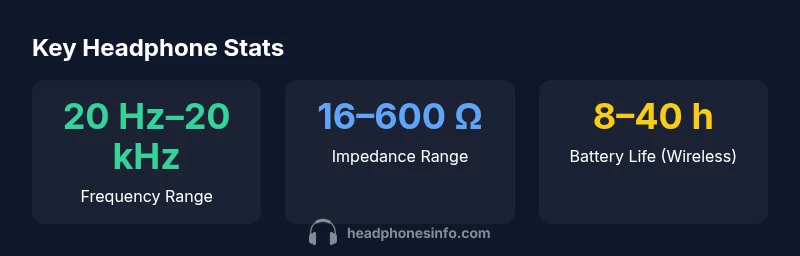
Overview of key headphone specs
| Aspect | Common Metrics | Notes |
|---|---|---|
| Frequency Response | 20 Hz - 20 kHz | Standard audiophile range |
| Impedance | 16–600 ohms | Affects source compatibility |
| Battery Life | 8–40 hours | Depends on codec and usage |
| THD (Distortion) | 0.01% – 0.5% | Lower is typically better |
| Weight | 180–380 g | Comfort and durability balance |
People Also Ask
Are expensive headphones always better?
Not always. Price often correlates with build quality, materials, and brand, but sonic merit depends on your use-case and the pair’s ability to reproduce music faithfully. Focus on measurements and comfort relative to your needs rather than price alone.
Not always. Higher cost can mean better materials or features, but the sound depends on how the headphones fit your music and your gear.
What is the difference between open-back and closed-back headphones?
Open-back headphones tend to sound more natural and wider, at the cost of sound leakage and less isolation. Closed-back headphones offer better isolation and bass control, but can sound more colored due to enclosure effects. Your choice should reflect your listening environment and goals.
Open-backs feel more natural but leak sound; closed-backs isolate better and often feel punchier in the bass.
Do wireless headphones compromise on sound quality?
Premium wireless headphones can approach wired fidelity when using high-quality codecs and DACs integrated in the headset. For absolute reference-level accuracy, a wired connection is typically preferred, especially in critical listening scenarios.
They can be nearly as good if they use strong codecs, but wired usually has the edge for accuracy.
Can I improve sound quality with a better DAC/amp?
Yes, a higher-quality DAC/amp can reveal more detail and dynamic range, especially with high-impedance headphones. Ensure the amp can comfortably drive the target impedance to avoid volume limitations and distortion.
A good DAC/amp can unlock more detail, especially with demanding headphones.
How do I choose headphones for travel?
Prioritize comfort, compactness, and passive or active noise isolation. Look for a balance of sound quality, battery life (if wireless), and a snug, portable design that fits your luggage.
For travel, comfort and noise isolation often trump absolute suite of specs.
“High quality headphones reproduce music authentically, with dynamic range and low distortion, provided you pair them with a suitable source. The improvement is measurable, not magical.”
What to Remember
- Define true quality by balance, not loudness
- Prioritize low distortion and flat response
- Choose wired for pure fidelity; wireless for convenience
- Test with familiar tracks to gauge real-world sound
- Prioritize comfort and build for long-term use