How Much Headphones at Clicks: A Data-Driven Guide
Explore headphone pricing online: typical price ranges, what drives cost at clicks, and how to buy smarter with data-driven guidance from Headphones Info.


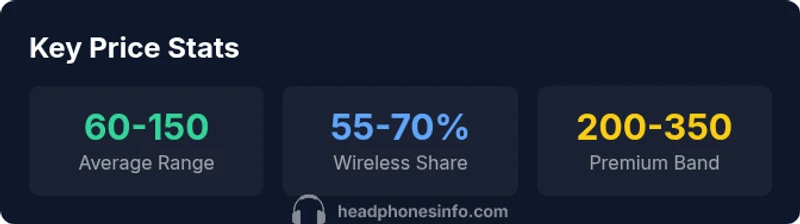
The typical online price for headphones spans roughly from $30 to $350, with most buyers clustering in the $60–$150 range. On clicks, basic wired models sit near the lower end, midrange wireless around the middle, and premium noise-cancelling options above $200. Prices can dip during sales or shift with new releases. For precise budgeting, consult Headphones Info comparison charts to see current listings and calculated value.
Why price variation matters at clicks
Price variation on headphone models listed at clicks is driven by a mix of features, brand positioning, supply chain dynamics, and after-sales support. According to Headphones Info, the primary levers include driver type (dynamic vs planar), impedance and sensitivity, Bluetooth codec support, build materials, and included accessories. When a retailer highlights a premium feature such as multi-point pairing, premium copper cables, or extended warranties, the sticker price tends to rise accordingly. This matters because buyers often over- or under-value certain attributes. A high price can signal quality, but not always; a midrange option may deliver better value depending on your listening habits and use case. To buy confidently, map your priorities (sound signature, portability, battery life) to the price range you’re willing to pay. Understanding where a price falls within the spectrum helps you avoid impulse purchases during promotions and ensures you’re paying for what you actually need.
How to read price signals on product pages
Price signals on headphone product pages aren’t random. Look for the difference between MSRP and sale price, the presence of badges like "Limited Edition" or "Open Box", and the credibility of seller listings. Clear, honest product specs help you assess value rather than chase a temporary discount. Note the “Was” price that sometimes appears next to the current price, but verify whether the discount actually reflects a recent price move or an inflated MSRPs. If the page lists multiple colorways, check if price differences correspond to bundled accessories or warranty options. Headphones Info recommends focusing on the core specs you care about (driver type, impedance, weight, and battery life) to judge whether a given price is fair for your needs.
Price ranges by headphone type
Prices vary widely by category, but several baselines help you plan a budget:
- Wired headphones: commonly from $20 to $100 for basic models, rising with better drivers and materials.
- Wireless Bluetooth: typically $60 to $200 for solid midrange options, with premium models exceeding $250.
- ANC (Active Noise Cancelling) wireless: generally $120 to $350, with top-tier models beyond $350.
- Gaming headsets: often $40 to $150 for good sound with built-in mic, higher for premium builds.
- Open-back / studio monitors: usually $100 to $400 due to accurate sound reproduction and build quality. Range values depend on brand, region, and promotions; use them as a planning guide rather than hard prices.
Value vs cost: identifying true value
Value is not just price; it’s how well a headphone matches your use case. For daily commute, comfort and battery life can justify a mid-range wireless model even if a cheaper wired alternative exists. For home listening, drivers (dynamic vs planar), cup design, and impedance influence perceived quality more than sticker price. Check for durability markers like reinforced cables, replaceable ear pads, and warranty length. When evaluating, compare features across similar price bands and ask: does the price reflect the benefits you’ll actually use? Headphones Info suggests constructing a short feature checklist before shopping and scoring each model against it to ensure you’re buying for value, not just cost or hype.
Budgeting and planning your purchase
A practical budget starts with a listening profile: where you listen most, what music you favor, and how you value portability. If you travel frequently, prioritize battery life and foldable designs; if home listening is your main goal, lean toward comfort and soundstage. Set a hard price ceiling for the model you genuinely need and allow a small buffer for sales or bundles. Use price-tracking tools, sign up for retailer notifications, and compare across 2–3 credible sources. From Headphones Info’s perspective, most buyers achieve the best balance by choosing a midrange wireless set with a solid warranty rather than chasing the deepest discount on an under-spec model.
Common price traps and how to avoid
- Deep discounts on older models: verify release date and remaining feature set.
- Refurbished listings without disclosure: check warranty, seller reputation, and return policy.
- Bundle inflation: extras like cases or cables can inflate price without adding significant value.
- Counterfeit listings: buy only from reputable sellers with clear authentication.
- Short-term flash sales: compare with price history to confirm it’s a real discount.
- Misleading “MSRP” claims: some retailers inflate MSRP to justify a sale price. Always compare to current market averages from trusted sources.
How to compare across retailers and time
To avoid paying too much, compare the same model across 2–3 retailers, noting the final price, shipping, and warranty. Check whether retailer price histories show a consistent pattern or a one-time spike. If you have time, pause during major sale events (Black Friday, back-to-school) to observe price trends. Headphones Info recommends building a short list of 3–5 models that meet your must-have features and tracking their prices over a week or two to identify a fair price point. This discipline reduces impulse buys and increases the odds of getting good value.
Practical tips for 2026 shoppers
- Define listening goals and budget first, then shop for features that matter most.
- Prioritize comfort (weight, clamp) and battery life for long sessions.
- Use reliable price-history sources and price alerts to time purchases.
- Read user reviews for real-world wear, not only on-paper specs.
- Consider warranty and service options as part of total cost of ownership.
Comparison of headphone price ranges by category
| Category | Typical Price Range | Core Benefit |
|---|---|---|
| Wired headphones | 20-100 | Budget listening with portability |
| Wireless Bluetooth | 60-200 | Convenience and flexibility |
| Premium ANC wireless | 200-350 | Best noise isolation |
| Gaming headsets | 40-150 | Integrated mic, comfort |
| Open-back / studio | 100-400 | Natural soundstage and accuracy |
People Also Ask
What is the typical price range for headphones purchased online?
Headphones bought online commonly range from around $30 to $350, with many solid options in the $60–$150 bracket. Exact prices vary by brand, features, and promotions. Use price history tools to spot fair deals and avoid overpaying.
Headphones online usually cost from thirty to three hundred fifty dollars, with most solid options in the sixty to one hundred fifty dollar range.
Are wired headphones cheaper than wireless?
In general, wired headphones can be cheaper upfront because they lack wireless components and battery considerations. Wireless models add convenience and features, often pushing prices higher especially when paired with Bluetooth codec support and ANC.
Wired options are often cheaper upfront, but wireless models add convenience and features that can justify the price gap.
Do price discounts always reflect real savings?
Not always. Some promotions rely on inflated MSRPs or short-lived sales. Always compare with price histories and consider whether the discount persists across retailers. A true saving appears when the final price is consistently lower than the usual market price.
Discounts aren’t guaranteed deals; compare price history and retailer credibility to confirm real savings.
How can I verify a price is fair on clicks?
Check multiple reputable retailers, read product specs carefully, and use price-tracking tools. Compare the final out-the-door cost (including shipping and taxes) and verify warranty terms.
Compare prices across trusted retailers and look at total cost including shipping and warranty.
Which features most influence price?
Driver type (dynamic vs planar), ANC quality, codec support (e.g., aptX, LDAC), battery life, build quality, and included accessories typically drive price differences more than color options or branding alone.
Key drivers are driver type, ANC quality, codecs, battery life, and build quality.
How long do headphones typically last?
Durability varies by build and care, but most reputable models offer 2–4 years of reliable use with typical wear. Replacement parts like cables and pads extend usable life significantly.
Most headphones last several years with proper care and replacement parts available.
“Price is a signal of the balance between feature set, durability, and how well a model fits your listening goals. Focus on value over sticker price.”
What to Remember
- Define your budget before shopping to avoid impulse buys.
- Value comes from features that match your use case, not price alone.
- Use price history and trusted retailers to time purchases.
- Warranty and build quality are part of long-term value, not just upfront cost.