Sennheiser HD 700 Headphones Review: Soundstage, Detail, and Amp Needs
In-depth, analytical review of the Sennheiser HD 700 headphones: soundstage, amplification needs, comfort, and who should buy.


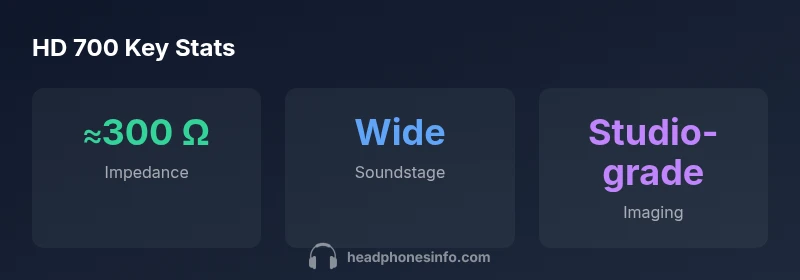
According to Headphones Info, the Sennheiser HD 700 headphones deliver a wide, airy soundstage with precise detail and a neutral-to-warm tonal balance. They reward high-quality DAC/amp pairing and studio-grade sources, offering an engaging, analytical listen. Because they are open-back and high impedance, they excel in quiet rooms but aren’t ideal for portable use or noisy environments.
Design and Build Quality
The HD 700 demonstrates Sennheiser's meticulous engineering with a lightweight, rigid frame and a carefully engineered open-back grille that minimizes resonance while maximizing air-flow. The headband uses a combination of metal and composite materials for a balance of stiffness and comfort, and the cups are mounted on a suspension system to reduce pressure hotspots during long sessions. Detachable, high-quality cables enable easy replacement and reduce wear on the jack and cup connectors. Padding on the ear cups uses soft velour that remains comfortable even after hours of listening, while the overall weight is distributed to avoid fatigue. The choice of materials conveys a premium feel, and the build should hold up well to everyday home-studio use. According to Headphones Info, build quality aligns with premium desktop-oriented headphones and benefits from careful maintenance and occasional pad replacement.
Sound Signature and Imaging
The HD 700's sound signature centers on a wide, spacious stage and precise imaging that lets listeners pinpoint instrument placements with clarity. The tonal balance is largely neutral to slightly warm, which helps uplift vocal presence and acoustic instruments without harsh treble peaks. The low end is present but not bass-boosted; it remains natural and controlled, which supports mixing and critical listening without overpowering midrange detail. The midrange is exceptionally articulate, revealing vocal textures and instrumental harmonics with realism. Treble is extended and airy but remains smooth, avoiding sibilance even on brighter recordings. Overall, the headphones reward careful source material and well-matched amplification to unlock their full resolution and micro-detail.
Driving the HD 700: Amplification and Source
Given the HD 700's impedance and sensitivity characteristics, pairing them with a capable DAC/amp chain is essential for maximum performance. They perform best with clean power and ample headroom; lower-end portable devices will usually struggle to reach their full sonic potential, resulting in audible compression and limited dynamics. A quality desktop DAC/amp combo or a dedicated headphone amplifier can reveal the HD 700's true spatial cues and resolution. Tubes vs. solid-state can influence the sense of warmth and liquidity, but the goal is to maintain low noise and adequate voltage to the drivers. In real-world listening, a well-matched setup provides the most natural decay, improved imaging, and a more convincing stage.
Comfort and Ergonomics
Comfort is a strong suit for the HD 700, thanks to soft velour pads, a relatively light clamping force, and a headset shape that distributes weight evenly. The open-back design promotes cooling and prevents driver reflections that can stress listening comfort on longer sessions. The ear cups are large enough to accommodate most ears without excessive contact, though individuals with larger ears may notice pressure on the jawline after several hours. The headband padding remains supportive without creating hot spots, and the detachable cable minimizes micro-movements that can cause cable wear. For extended monitoring work, the overall fit remains stable, with a natural balance between seal and comfort.
Practicality: Open-Back Characteristics and Use Environments
Open-back headphones like the HD 700 excel in controlled environments such as quiet home studios, mastering rooms, or critical listening setups where sound leakage is not a concern. The trade-off is acoustic openness: you’ll hear surrounding room sounds, and others nearby will hear the audio clearly, which makes them unsuitable for commuting or shared spaces. The benefit is a more natural decay, broader soundstage, and better articulation of spatial cues. If you frequently listen at lower volumes, the open design helps maintain a sense of air and space even when playback levels are modest. For casual listening in a busy environment, consider closed-back alternatives to preserve privacy and reduce noise bleed.
Value Proposition and How They Compare to Alternatives
Compared with contemporary open-back competitors, the HD 700 offers an exceptionally clean, detailed presentation with a pristine midrange. It may not deliver the deepest bass slam or the most forward bass texture, especially when compared to some modern closed-back models, but its overall fidelity, soundstage, and imaging wins favor with engineers, analysts, and audiophiles seeking a reference-like experience. The main value lies in its precision and stability across genres, assuming you pair it with a high-quality DAC/amp. When evaluating alternatives, consider the HD 700 against other premium open-backs and studio-oriented headphones to understand how much you value stage width, resolution, and neutrality versus bass emphasis and portability.
Setup, Cables, and Accessories
Out of the box, the HD 700 includes a high-quality detachable cable with a reliable locking mechanism at the plug, alongside comfortable earpads and a sturdy case. Proper setup involves ensuring secure connections to a DAC/amp with low noise and sufficient power delivery. The detachable cable makes swaps to longer or higher-purity cables straightforward for enthusiasts who want to experiment with different cable options. Accessories such as replacement pads and a clean storage pouch can extend the life of the headphones, while careful handling will reduce wear on the headphone connectors and ear cup padding.
Care, Maintenance, and Longevity
Maintenance is straightforward: wipe the pads with a mild cleaner, avoid moisture, and store the headphones in a protective case when not in use. Open-back grills should be kept free of dust using a soft brush, and drivers should be protected from accidental impact. Pads will gradually soften and may need replacement to preserve comfort and seal integrity. With proper care and a clean amplification chain, the HD 700 can remain relevant for many years as a reference-grade listening tool.
Upsides
- Extremely wide soundstage and precise imaging
- Neutral-to-warm tonal balance suitable for critical listening
- Detachable cable and premium build.
- Low listener fatigue for long sessions
Disadvantages
- High impedance requires a capable amplifier; not portable
- Open-back design leaks sound and lacks isolation
- Non-folding form factor reduces travel convenience
Best for stationary, critical listening with high-fidelity gear
The HD 700 excels in resolution and stage with a natural balance. The trade-offs are portability and amp requirements; with a capable setup, they reward discerning listeners and studio evaluators.
People Also Ask
Do the Sennheiser HD 700 headphones require a dedicated amplifier?
Yes. The HD 700 benefits from a capable DAC/amp to reach its full dynamics and detail. A weak source can limit bass impact and overall headroom, making the listening experience less engaging. If you plan to use them primarily with a laptop or portable device, you may want to budget for a desktop amp or a higher-quality DAC.
Yes. You’ll get the most out of them with a decent DAC and amp; otherwise, you’ll miss some dynamics and detail.
What is the sound signature of the HD 700?
The HD 700 presents a wide, airy soundstage with a neutral-to-warm balance. Mids are detailed and natural, while treble extends smoothly. Bass is present but restrained, favoring transparency and accuracy over slam.
It sounds open and precise, with a natural midrange and a balanced treble.
Are the HD 700 good for mixing and critical listening?
Yes. The combination of spacious imaging and accurate midrange makes them well-suited for mixing and critical listening in a quiet room. They reveal subtle harmonic details that help balance tracks during mastering.
They’re a solid choice for careful listening and mixing, especially when partnered with good gear.
Can I use the HD 700 on the go?
Not ideal. Their high impedance and open-back design are optimized for a controlled environment. They require a stable listening setup and don’t travel well in terms of isolation or portability.
They’re best left at home or in a studio—not great for commuting.
How do the HD 700 compare to Sennheiser HD 600?
Both are high-fidelity open-back headphones, but the HD 700 aims for a more expansive stage and improved detail retrieval. The HD 600 remains a more budget-friendly and universally adaptable option with a different, somewhat warmer presentation.
HD 700s offer a bigger soundstage and finer detail; HD 600s are a great value with a slightly different warmth.
What to Remember
- Pair with a high-quality DAC/amp for best results
- Open-back design yields a wide soundstage and natural decay
- Not ideal for portable use or noisy environments
- Comfort remains strong for long sessions
- Carefully match pads and cables to maintain longevity