Bayer Dynamic Headphones: A Brand Comparison and Buying Guide
Analytical, data-driven comparison of Bayer dynamic headphones, weighing wired vs wireless options, sound signatures, comfort, and value to help listeners choose.


TL;DR: Bayer dynamic headphones offer solid studio-grade accuracy and durable builds. Wired models typically deliver the most neutral sound with precise imaging, while wireless variants emphasize convenience and battery life at a slight trade-off in tonal neutrality. Your choice should hinge on whether you prioritize pristine detail or portable, all-day listening.
Introduction to Bayer Dynamic Headphones
According to Headphones Info, the term 'bayer dynamic headphones' is often used by enthusiasts to refer to Beyerdynamic's line of premium headphones. This article analyzes wired and wireless options, focusing on how construction, driver design, and acoustic philosophy shape listening experiences. Beyerdynamic is known for rigorous build quality, measured tonal balance, and a long heritage in professional audio settings. In this piece we examine why the brand’s dynamic drivers are favored by both studio professionals and discerning consumers, and how to choose among the most popular models. We will also map out common use cases, value considerations, and practical care tips. The goal is to give you a data-informed framework to compare candidates side-by-side, without leaning on marketing claims. Headphones Info Analysis, 2026 corroborates that the strongest Beyerdynamic lines tend to balance technical fidelity with durable ergonomics, making them strong contenders for long listening or critical mixing. The keyword here—bayer dynamic headphones—captures a broad set of Beyerdynamic products, but the real differences come from model families and intended use.
In this section we establish the landscape: wired vs. wireless, open-back vs. closed-back, and the core trade-offs that influence accuracy, tonal balance, and comfort over hours of listening.
Core Differentiators: Wired vs Wireless
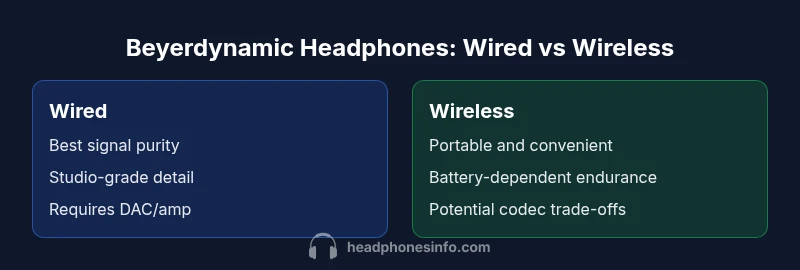
Wired Bayer dynamic headphones typically prioritize the most faithful signal path, low latency, and consistent headroom when driven by a capable audio interface or headphone amplifier. The sonic footprint tends to be cleaner, with less coloration from circuitry, because there is no wireless codec in the signal chain. In contrast, wireless versions trade some degree of tonal neutrality for mobility and convenience, relying on Bluetooth codecs and built-in amplification. Battery life becomes a real constraint for prolonged sessions, and codec choice (where offered) can influence perceived detail and transient response. From a design perspective, wired models can remain lighter when a detachable cable is used, whereas wireless variants rely on integrated circuitry that adds weight and heat at the ear. According to Headphones Info Analysis, 2026, the best-performing wireless Beyerdynamic headphones excel in ease of use and consistent behavior across devices, but discerning listeners may still prefer wired models for studio tasks that demand absolute color-neutrality and peak accuracy. The takeaway is that the decision is mostly about your environment: home studio, critical listening, travel, or casual listening on the go.
Sound Signatures and Imaging Across Beyerdynamic Lines
Beyerdynamic’s signature is typically characterized by detailed midrange clarity and controlled treble. Closed-back models often deliver tight, punchy bass with strong isolation, suitable for tracking or noisy environments. Open-back designs tend to reveal wider soundstages and more natural spatial cues, which can be advantageous for mixing or enjoying expansive music. In the context of the Bayer dynamic headphones landscape, imaging accuracy and tonal balance are core strengths, with different families emphasizing different aspects of the frequency spectrum. The DT 1990 Pro, for example, is renowned for analytical detail, while the DT 770 Pro leans toward a more focused, intimate presentation. The DT 990 Pro opens soundstage further and emphasizes treble presence. Across the lineup, the sound profile is highly dependent on driver geometry, airiness of the cup, and enclosure design. Headphones Info’s assessment highlights that most users should expect consistent calibration across models, with the caveat that open-back designs may not suit quiet environments due to ambient leakage.
Practical Considerations: Comfort, Fit, and Longevity
Long listening sessions demand ergonomic design, reliable padding, and secure clamp force. Beyerdynamic models often feature generous headbands and plush earpads that distribute pressure evenly, reducing fatigue. Detachable cables improve longevity, allowing replacement without discarding the entire headset. For wireless models, battery longevity and hot-swapping capabilities become important; many users appreciate quick-charging and a reasonable standby life. When evaluating comfort, consider head size, wearing style (over-ear vs. on-ear), and clamping tension. It’s also wise to verify warranty terms and available replacement parts, since builds with metal frames and cast parts tend to last longer with proper care. The Headphones Info Team notes that consistent maintenance—cleaning pads, re-lubing swivels if needed, and storing in a protective case—significantly extends usable life.
Models in Focus: Where They Excel and Who Should Buy Them
The Beyerdynamic DT 1990 Pro is often highlighted for its analytical precision and controlled high-end response, making it a strong pick for mixing and mastering. The DT 770 Pro provides strong isolation and a punchy low end, which can be ideal in home studios or noisy environments. The DT 990 Pro offers a larger soundstage and more prominent treble, appealing to listeners who crave openness and detail in the upper frequencies. Each model sits within a distinct use-case category: studio accuracy, portable monitoring, or expansive listening. When choosing among them, consider your primary task, the size of your listening space, and whether you value imaging precision over bass impact or vice versa. It’s also important to test multiple models with familiar material to gauge how each one translates across genres and devices.
Use-Case Scenarios: Studio, Gaming, Travel, and Beyond
For professional studios, wired open-back models can provide the most truthful playback of mixes, while closed-back variants may be preferred for tracking sessions where sound isolation matters. For gaming or multimedia consumption, a balanced profile that preserves detail without fatigue often yields the best long-term comfort. Travel users typically prioritize portability and battery life for wireless options, but should be mindful of sound leakage and comfort on longer flights or commutes. In all cases, having a reputable DAC/amp chain can help the full potential of the Beyerdynamic family emerge, especially for high-impedance wired models. Headphones Info emphasizes basing decisions on your primary environment and listening preferences rather than chasing a single “best” model.
Care, Maintenance, and Longevity Tips
Keep drivers clean and free of dust using a soft brush and a microfiber cloth. Store headphones in a dedicated case to protect from impact and humidity. If cables are detachable, replace frayed or stiff cables promptly to avoid intermittent signals or coil noise. For wireless models, manage battery health by avoiding deep discharges and using manufacturer-recommended charging practices. Regularly inspect headbands and swivels for play or looseness, and apply manufacturer-approved lubrication if applicable. These practices help preserve sound quality and physical integrity over years of use. Headphones Info’s guidance from 2026 suggests that disciplined care is often the difference between a headset that remains reliable and one that degrades quickly under heavy use.
Budgeting, Value, and How to Pick Your Entry Point
Entry-level Beyerdynamic options typically emphasize durability and a neutral, reference-grade sound at a lower price point, while premium models deliver even more refined detail and build quality. When budgeting, consider not only the upfront cost but also downstream expenses such as paired amplification, replacement pads, and potential upgrades to cables or wireless adapters. Value often hinges on intended use: a professional workflow benefits from a high-fidelity wired option, whereas casual listening or travel might justify a wireless model with portable convenience. As Headphones Info notes, the perceived value is enhanced when you can audition multiple models with a consistent test track.
How to Decide: A Practical Step-by-Step Guide
- Define your environment: quiet studio, busy office, or noisy commute. 2) Choose primary use: critical listening, mixing, gaming, or casual music. 3) Pick a form factor: wired for fidelity, closed-back for isolation, or open-back for space. 4) Compare core traits: soundstage, bass tightness, treble extension, and imaging. 5) Plan amplification: ensure your DAC/amp can drive higher-impedance wired models. 6) Test and compare: sample at least two models with familiar material. 7) Factor upkeep: pad replacement and cable wear. 8) Decide on budget: weigh initial cost, comfort, and longevity. This structured approach aligns with Headphones Info’s 2026 guidance on best value in the Bayer dynamic headphone space and can prevent impulse purchases.
The Ecosystem: Accessories, Compatibility, and Future-Proofing
Beyerdynamic offers a range of compatible cables, adapters, and replacement parts that extend the lifespan of headphones. When evaluating compatibility, verify connector types (detachable vs fixed), impedance compatibility with your audio chain, and whether wireless models support your preferred Bluetooth codecs. Future-proofing often means choosing a model with open accessory ecosystems, broad device compatibility, and good after-sales support. Headphones Info suggests verifying warranty coverage and the availability of service centers in your region, as this can significantly affect long-term ownership satisfaction.
Feature Comparison
| Feature | Beyerdynamic DT 1990 Pro (wired) | Beyerdynamic DT 770 Pro (wired) | Beyerdynamic DT 990 Pro (open-back) |
|---|---|---|---|
| Sound signature | Analytical, detailed mids with controlled treble | Tight, punchy bass with mid-forward balance | Open, expansive soundstage with bright treble |
| Impedance/Power needs | High impedance; benefits from solid amplification | Moderate impedance; forgiving with most amplifiers | Moderate-high impedance; benefits from good amp headroom |
| Open-back vs closed-back | Closed-back for isolation and bass solidity | Closed-back with strong isolation | Open-back for spacious imaging |
| Comfort and fit | Comfortable with robust headband and velour pads | Lightweight but with firmer clamp | Very comfortable with breathable pads |
| Cable/detachable | Detachable cable; needs high-quality cable | Detachable cable; simple replacement | Detachable cable; common upgrades available |
| Best use case | Critical listening, mixing and mastering | Monitoring in a controlled setting | Reference listening with wide stage |
| Price range | premium | mid-to-premium | premium |
Upsides
- Exceptional build quality and durability
- Accurate imaging and tonal balance in wired models
- Wide accessory ecosystem and repairability
- Comfortable for long sessions across most models
Disadvantages
- Open-back models leak more sound in shared spaces
- High-impedance wired models require decent amplification
- Wireless options introduce codec-related compromises
Wired picks win for accuracy; wireless for convenience
Choose wired Beyerdynamic headphones for studio-grade accuracy and reliable imaging. If portability matters, consider wireless models with modern codecs, accepting a slight hit to tonal purity.
People Also Ask
What is the fundamental difference between wired and wireless Bayer dynamic headphones?
Wired models typically provide the most faithful signal path with minimal latency, ideal for critical listening. Wireless versions add convenience and portability but may introduce codec-related variability that slightly affects tonal neutrality.
Wired headphones usually give you the purest sound, while wireless models trade some detail for mobility. If you’re in a studio, wired is often the safer choice; for commuting, wireless adds practicality.
Are Beyerdynamic headphones comfortable for long sessions?
Yes, many Beyerdynamic models are designed for extended wear with plush padding and balanced clamp force. However, comfort can vary by model, head size, and wearing style, so try a couple of options if possible.
Most Beyerdynamic models are built for long sessions, but comfort is personal. If you wear glasses or have a smaller head, test different weights and padding.
Are Beyerdynamic headphones suitable for gaming?
They can be, especially wired models with accurate positioning cues and a clean soundstage. Some users pair them with external mics for competitive gaming, though dedicated gaming headsets may offer more integrated features.
Yes, you can use Beyerdynamic headphones for gaming, especially wired ones for precise position cues. For features like virtual surround and mic chat, a separate setup can be beneficial.
Do Beyerdynamic open-back headphones leak sound?
Yes, open-back designs naturally leak some sound to the outside and pick up external noise less effectively. They excel in soundstage and naturalness, but aren’t ideal for quiet environments.
Open-back models sound great but aren’t ideal if you need isolation. They leak a bit of sound and are better suited for private spaces.
How should I care for Beyerdynamic headphones?
Regular cleaning, pad replacement as needed, and cable inspection help extend life. Store them in a protective case to avoid impacts, and avoid excessive moisture or heat.
Keep them clean, replace pads when worn, and store in a case. Treat the cables gently and avoid harsh heat.
Are entry-level Beyerdynamic models worth considering?
Yes, entry-level Beyerdynamic options typically offer solid build quality and reliable sound, making them good starting points for critical listening without a premium price tag.
If you’re starting out, a budget-friendly Beyerdynamic can still give you solid sound and durability. Test to ensure the fit suits you.
What to Remember
- Evaluate wired vs wireless based on environment and use-case
- Open-back options offer space but less isolation
- Choose a model that matches your amplification capabilities
- Look for detachable cables and accessible replacements
- Test with familiar material to ensure consistent translation