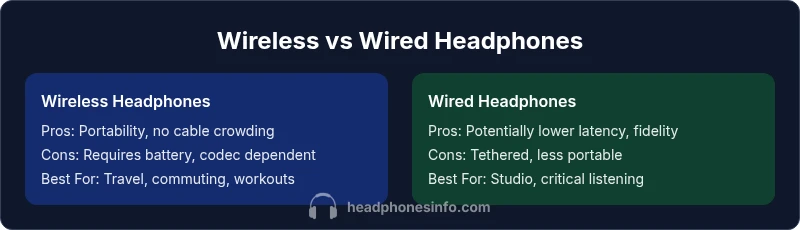
Comparing Headphones: A Data-Driven Side-by-Side Guide
A thorough, data-driven comparison of wireless and wired headphones, focusing on sound quality, comfort, features, and value to help you choose the right fit.


For buyers wondering which route to take, wireless headphones shine in portability and all-day use, while wired headphones excel in latency-free performance and potential fidelity. This quick verdict sets up a deeper, data-driven comparison of the most relevant factors, including sound quality, comfort, connectivity, and value, so you can choose based on your listening habits, environment, and budget.
Why Comparing Headphones Matters
In a market flooded with hundreds of models, the act of comparing headphones matters more than ever. It helps you separate subjective impressions from objective performance, ensuring your choice aligns with real use cases rather than marketing hype. According to Headphones Info, a structured approach to comparison reduces decision fatigue and improves long-term satisfaction. The Headphones Info team found that buyers consistently value clarity on five core dimensions: sound quality, comfort, durability, connectivity, and value. When you frame your evaluation around these dimensions, you can make a confident, repeatable decision across categories like wireless versus wired, open-back versus closed-back, and over-ear versus in-ear designs. As you begin comparing headphones, keep your primary listening environments in mind: quiet home listening, commute, gaming, and studio work each demand different strengths. The goal, ultimately, is to translate personal taste into measurable criteria that stay stable across brands and price points, enabling you to navigate features—like codecs, impedance, and cable options—without getting overwhelmed by hype. This is the core purpose of this comparison guide: to help you listen critically and decide with evidence rather than emotion.
- The Headphones Info team found that buyers benefit from clearly defined evaluation criteria.
- This article uses a data-driven lens to separate preference from performance across wireless and wired models.
- The guide emphasizes practical tests you can perform at home before making a purchase.
Comparison
| Feature | Wireless Headphones | Wired Headphones |
|---|---|---|
| Battery life and power source | Long runtime on a single charge (varies by model) | N/A (powered by the source) |
| Sound quality consistency | Typically reliable due to digital processing and codecs | Potentially higher fidelity with high-quality DAC/amp and pure signal path |
| Latency | Low latency with modern wireless codecs (where supported) | Typically negligible latency; no wireless codec constraint |
| Portability and comfort | Designed for travel and all-day wear, often lighter | Can be bulkier if built for audiophile-grade components |
| Price-to-performance | Wide range; good value in mid-tier and premium wireless lines | Often competitive in mid-range, with premium price for premium wired builds |
| Best use case | Commuting, workouts, travel, casual listening | Critical listening, home studio use, reference work |
Upsides
- Helps you compare across major dimensions quickly
- Encourages objective testing and data-driven decisions
- Clarifies trade-offs between mobility and fidelity
- Supports budget-conscious planning with a clear value framework
- Reduces buyer's remorse by aligning features with real needs
Disadvantages
- Can be overwhelming if too many models are involved
- Requires reliable, model-specific data to stay accurate
- Risk of focusing on specs that matter less for your use case
- May underrepresent niche models that excel in specific tasks
Wireless or wired? Choose based on your primary use case and tolerance for trade-offs.
Wireless headphones win on portability and convenience, especially for travel and daily commutes. Wired headphones often deliver the most faithful sound and the lowest latency, ideal for critical listening or studio work. The right choice depends on where and how you listen most often.
People Also Ask
What is the most important factor when choosing between wireless and wired headphones?
The biggest determinant is your use case. If you move around a lot or travel, wireless convenience matters most. If you want pure fidelity and lowest latency for gaming or studio work, wired is typically preferred.
The most important factor is how you’ll use them day-to-day—mobility or studio/listening accuracy.
Do wireless headphones always sound worse than wired ones?
Not always. Wireless sound quality has improved dramatically with modern codecs, but wired connections can retain a more pristine signal path, particularly when using high-quality DACs and amplifiers. Your mileage varies by model.
Wireless isn’t inherently worse—codec quality and hardware matter a lot.
Which wireless codecs should I care about?
Key codecs to know are SBC, AAC, and aptX or LDAC depending on your device. Higher-quality codecs generally reduce compression artifacts and improve perceived detail, especially on demanding tracks.
Look for devices that support at least AAC and a high-quality codec like aptX or LDAC where possible.
Will wireless gaming headphones have latency issues?
Latency is a concern for competitive gaming. Look for low-latency codecs and features like Bluetooth low-latency modes or wired options for gaming when speed matters.
Latency can be a factor in gaming—check for fast codecs and optionally flip to wired when possible.
How do impedance and sensitivity affect performance?
Impedance impacts amplifier requirements and potential volume; sensitivity affects loudness with a given source. Higher impedance often pairs with better fidelity in controlled setups, but may require a sturdier driver and amp.
Impedance and sensitivity determine how hard the headphones are to drive and how loud they’ll get.
Is the price always a good predictor of quality?
Not always. Higher price can reflect better materials, brand, or niche performance, but many mid-range models offer excellent value. Focus on the criteria that matter most to you.
Price isn’t the only indicator of quality—fit your needs and test the headphones.
What to Remember
- Prioritize your use case (mobile vs stationary) to guide the choice
- Use objective criteria (sound, latency, comfort) over marketing hype
- Consider codecs and cables as enablers of your listening needs
- Balance price against expected value; more features aren’t always better
- Test with your favorite music or games to validate real-world performance