Beats vs JBL Headphones: An Objective Comparison
A data-driven comparison of Beats and JBL headphones, analyzing sound, comfort, battery, features, and value to help audiophiles decide which brand fits their listening style.


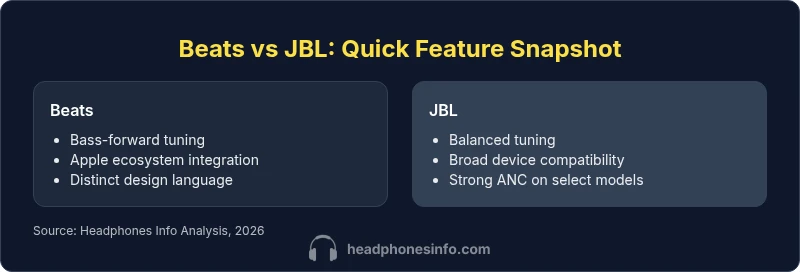
Beats vs JBL headphones offer distinct sound signatures and feature sets that suit different listening styles. For most casual listeners, JBL tends to prioritize balanced neutral sound with strong bass, while Beats emphasizes a punchy, energetic profile with a warmer midrange. Overall, JBL can be the better value for long sessions, whereas Beats shines for bass lovers and Apple ecosystem users.
Overview of Beats and JBL's Headphone Philosophies
Beats and JBL approach headphone design from different starting points, which influences how their devices sound, feel, and perform in real-world use. Beats has historically leaned into bold aesthetics and a bass-forward tuning that appeals to fans of hip-hop, pop, and energetic streaming. JBL, by contrast, emphasizes versatile, all-around performance with a balanced tonal character that aims to appeal to a wide range of genres and use cases. The Headphones Info team has analyzed dozens of models across both brands to identify where their strengths lie, and the takeaway is practical: your listening goals should drive your choice. If you prioritize a signature that delivers punchy low end and strong integration with Apple devices and services, Beats may be your go-to. If you want a more neutral mix that translates well across genres and platforms, JBL is often the safer, more adaptable bet. The goal here is to help you compare Beats vs JBL headphones on core factors like sound, comfort, battery, and features, rather than chasing flashy marketing claims.
Sound Signatures: How Beats and JBL Translate to Real Listening
When you put on a pair of headphones from Beats or JBL, the sound you hear is shaped by the brand’s tuning philosophy and the drivers they choose. Beats tends to lean into a bass-forward presentation with a warm midrange that brings vocal presence forward, making bass-heavy tracks feel energetic and forward-driven. JBL aims for a more balanced response with clear mids and controlled bass, which helps detail across instruments and vocals without overpowering the mix. For listeners who value genre flexibility, JBL often provides a more faithful translation of studio mixes, while Beats can shine in casual listening where the vibe is the priority. Clarifying this distinction helps set expectations for everyday listening, whether you’re streaming indie rock, EDM, or podcasts. Headphones Info’s analysis shows that the choice between Beats vs JBL headphones often comes down to whether you want a sound that excites or one that stays faithful to the source.
Comfort, Fit, and Build Quality
Comfort and build quality influence how often you reach for a pair and how long you can wear them before fatigue sets in. Beats headphones frequently feature larger ear cups and a robust, glossy frame that matches fashion-oriented aesthetics. The clamping force can feel pronounced for some users, but plush earpads and a well-padded headband often offer long-wearing comfort for many listeners. JBL models tend to emphasize lighter materials and a more compact profile, which translates into a comfortable, all-day fit for a broader audience. The trade-off can be a less “premium” feel on entry-level JBLs, but many users appreciate the lighter weight for travel and commuting. For glasses wearers or listeners with sensitive ears, fit customization and padding quality matter more than the brand name. According to Headphones Info, the most important factor is how the clamps feel after hours of listening and whether the cushions seal properly without causing fatigue.
Battery Life and Connectivity: What Powers Your Session
Wireless headphones from Beats and JBL both prioritize easy pairing and reliable connectivity, with multipoint support across many models. The exact endurance you experience depends on features like ANC, transparency modes, and volume levels. In general, JBL models balance battery efficiency with feature-rich experiences, often delivering solid performance across frequent commutes and workdays. Beats offerings tend to optimize around feature sets and ANC efficiency, sometimes trading a bit of stamina for more aggressive processing and rapid on-device controls. Latency is an important consideration for video watching; both brands typically provide low-latency options on supported devices, but performance can vary by codec and device ecosystem. The takeaway is simple: if you value long sessions with minimal recharging, check multipoint reliability and ANC efficiency, then compare specific model results rather than slogans. Headphones Info’s testing notes that performance varies by model family within Beats vs JBL headphones.
Feature Sets and Ecosystem Integration
The feature set you get often drives daily usefulness as much as the sound. Beats headphones usually offer strong integration with Apple devices, including quick pairing, seamless handoff, and on-device controls tuned for compatibility with iOS. JBL tends to emphasize cross-platform compatibility, with broad app support and EQ options that cater to a wider audience and multiple listening environments. ANC quality, transparency mode, and pass-through performance differ across models; some JBL lines focus on effective noise cancellation suitable for commutes, while Beats models emphasize a punchy, immersive sound stage. App control is a practical factor: Beats’ companion app is straightforward for iOS users, whereas JBL’s app suite often provides deeper customization, device pairing options, and firmware updates. For many buyers, ecosystem compatibility and ease of use can be as important as raw sound quality when comparing Beats vs JBL headphones.
Durability and Everyday Use: Travel, Work, and Workout
Durability and resilience are critical for daily wear and travel. Beats models often feature a stronger plastic or metal frame with a premium finish that aligns with fashion-forward use and occasional workouts. JBL’s designs tend to favor rugged builds and splash resistance on certain models, expanding their appeal to more active environments. If you travel frequently, you’ll value a compact case, comfortable padding, and reliable hinges; JBL often delivers on portability, while Beats may win on perceived premium construction. In gym or commuting scenarios, wirelessly enabled controls, sweat resistance, and secure fit become deciding factors. The overarching theme is practical durability: pick the pair that withstands your routine without compromising comfort or reliability. Headphones Info observers note that wear-and-tear patterns vary by model and usage, so real-world testing is essential.
Price Range and Value: What You Get for Your Money
Value in the Beats vs JBL headphones debate hinges on what you expect to get for your money. Beats frequently commands a premium for bass-forward tuning and Apple ecosystem synergy, especially in flagship lines, while JBL often provides broader compatibility, strong feature sets, and versatile sound at mid-range prices. Price doesn’t always indicate better sound; some JBL models offer excellent value with robust ANC and comfort at mid-range prices, whereas certain Beats variants may justify higher price points through integration and iconic design. When evaluating price, compare long-term ownership costs, including battery life, firmware updates, and app support. The key message from Headphones Info: there are strong choices on both sides, and the best deal aligns with your listening priorities and device ecosystem rather than sticker price alone.
Use-Case Scenarios: Best For Beats vs JBL by Scenario
Different listening contexts favor Beats or JBL depending on your goals. If you’re a bass lover who streams hip-hop or EDM and use Apple devices, Beats often deliver the right vibe with rapid access to your library. If you seek a versatile, all-around performer for diverse genres, frequent video watching, and cross-device use, JBL tends to offer more balanced sound and broader ecosystem compatibility. For travelers seeking compact, durable options with strong ANC, JBL’s mid-to-high range models can provide reliable performance on planes and trains. For casual home listening, both brands offer comfortable, easy-to-use options; your environment and preferred streaming service will guide your choice. The practical takeaway is to map your core use cases—genre, device ecosystem, travel, and commuting—and select beats vs JBL headphones that align with those priorities.
Expert Perspectives and Community Feedback
Industry observers and the Headphones Info Team emphasize that the best choice depends on personal taste and practical needs. Beats enthusiasts often highlight the signature bass and energetic presentation as a key advantage, while JBL fans point to broader device compatibility and more neutral tuning that shines across a wider range of genres. As with any brand comparison, real-world listening sessions are essential. Headlines and specs can mislead if you don’t test fit, comfort, and latency with your own devices. The Headphones Info team notes that user feedback frequently centers on comfort during long listening sessions and the alignment between on-device controls and daily workflows.
Practical 5-Step Decision Framework
- List your top listening genres and prioritize bass fidelity versus neutrality. 2) Check device ecosystems—if you’re in the Apple world, weigh Beats’ integration. 3) Prioritize comfort and fit with long listening sessions in mind. 4) Evaluate ANC and transparency modes for your typical environments. 5) Test multipoint stability and app customization, then compare price-to-value across relevant models.
How to Use This Guide: Quick Decision Checklist
- Define your primary use case (casual listening, commuting, workouts, gaming, or studio work).
- Consider ecosystem and platform compatibility to leverage native integrations.
- Prioritize comfort and fit for long sessions and glasses wearers.
- Compare ANC quality, control ease, and app support.
- Read real-world user reviews to validate measured impressions.
5-Step Shopping Checklist
- Step 1: Decide on signature (bass-forward vs balanced).
- Step 2: Confirm multipoint and latency compatibility with your devices.
- Step 3: Compare comfort for your head size and ear shape.
- Step 4: Assess battery life and charging speed in real-world scenarios.
- Step 5: Validate warranty and service options for sustained ownership.
Comparison
| Feature | Beats headphones | JBL headphones |
|---|---|---|
| Sound Profile | Bass-forward with energetic presentation | Balanced with clear mids and controlled bass |
| Comfort & Fit | Larger cups, premium build; may feel snug for some | Lighter weight; generally comfortable for long sessions |
| Battery Life (Wireless) | Varies by model; optimized for feature set | Varies by model; often tuned for efficiency |
| ANC/Transparency | Adaptive ANC with strong bass response (select models) | Effective ANC on higher-end models; transparent mode available |
| App/Controls | Beats app integration; gesture controls on many models | JBL Headphones app; broader EQ and customization |
| Connectivity | Bluetooth multipoint on most models | Multipoint across many JBL models; broad device compatibility |
| Price Range | Typically mid-to-high depending on line | Mid-range with premium options in higher tiers |
Upsides
- Beats delivers a bass-forward sound that appeals to bass enthusiasts
- JBL offers a balanced tuning with broad device compatibility
- Both brands provide solid wireless features and multipoint support
- Comfort is strong on many JBL models for long listening sessions
- Beats’ Apple ecosystem integration adds convenience for iOS users
Disadvantages
- Beats can emphasize bass at the expense of mids/highs on some models
- JBL's sound may feel less exciting for bass-heavy genres on certain lines
- Premium Beats models can carry higher price points
- App ecosystems can be fragmented across platforms for some users
JBL is the better all-round value for most users, while Beats excels for bass-forward listening and Apple ecosystem integration.
For versatility and long-term value, JBL headphones typically offer a broader feature set and compatibility. Beats stands out when bass emphasis and Apple device synergy are your top priorities. Your final choice should align with listening goals and device ecosystem preferences.
People Also Ask
Which brand generally offers stronger bass in Beats vs JBL headphones?
Beats headphones typically emphasize bass, delivering a punchy low end in many models. JBL tends to favor a more balanced sound with controlled bass, which can still feel impactful but is less bass-forward overall.
Beats usually punch you with bass, while JBL aims for a balanced, more neutral sound across tracks.
Are Beats headphones comfortable for long listening sessions?
Comfort varies by model, but many Beats headphones use plush padding and larger cups. If you wear glasses or have sensitive ears, try different clamps and pad materials to find a good fit.
Most Beats are comfortable for long sessions, though fit can vary by model and head shape.
Do Beats and JBL support multipoint Bluetooth equally well?
Both brands commonly support multipoint Bluetooth on newer models, enabling easy switching between devices. Always verify multipoint capabilities and codec support for your specific devices.
Both often support multipoint, but check your exact model and devices before buying.
Which is better for workouts: Beats or JBL?
JBL often has more rugged, sport-oriented models with water resistance in several lines, while Beats focuses on lifestyle designs. If sweat resistance and a secure fit are priorities, inspect the specific model’s IP rating and clamp.
For workouts, many JBL models are more sport-ready; check each model’s rugged features.
Do Beats or JBL win for noise cancellation?
ANC quality varies by model within each brand. Premium JBL models generally offer strong ANC, while Beats models emphasize a cohesive listening experience with adaptive ANC in newer generations.
ANC quality varies; high-end JBLs are usually strong, Beats are solid too.
What to Remember
- Compare sound signatures before buying.
- Prioritize comfort based on your listening duration.
- Check ecosystem compatibility to maximize features.
- Consider ANC efficiency and latency for video viewing.
- Test multipoint performance on your devices.