Difference Between Apple Headphones and Beats: A Data-Driven Comparison
Explore the difference between Apple headphones and Beats, including sound signatures, ecosystem integration, price ranges, and use cases. A comprehensive, data-informed guide for audio enthusiasts.


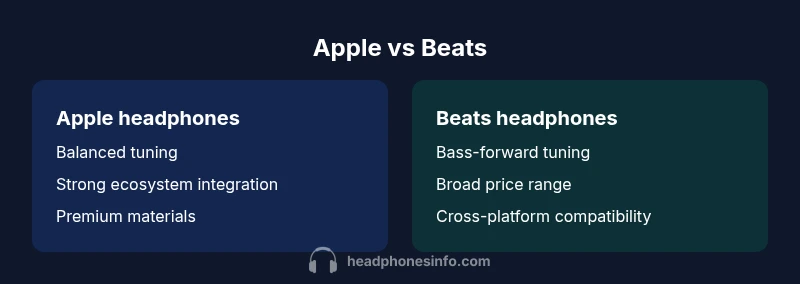
Apple headphones tend to prioritize neutral, detailed sound, premium materials, and seamless integration with iOS and macOS. Beats focuses on a bass-forward tuning, accessible pricing, and an energetic sound signature with easy pairing to Apple devices. In short: choose Apple when you want studio-like balance and ecosystem cohesion; choose Beats for punchy bass and value across models.
The difference between Apple headphones and Beats: a high-level view
The difference between apple headphones and beats often boils down to sound philosophy, ecosystem fit, and price ladders. Apple-branded headphones (such as AirPods Max and related models) typically emphasize a balanced, neutral sound profile that favors accurate instrument separation and a refined soundstage. Beats, historically tuned for stronger bass and a more energetic presentation, aims to deliver punchy low-end impact that many casual listeners find exciting. Across both brands, design language leans into premium materials for flagship models, but the practical realities—battery life, portability, and feature sets—vary with model lines. For listeners who live inside the Apple ecosystem, both brands offer convenient pairing and software updates, yet the degree of integration can influence daily usability and feature access. In broad terms, the difference between apple headphones and beats is a blend of tuning philosophy, ecosystem integration, and price strategy that shifts with each generation and product family.
From Headphones Info’s perspective (Headphones Info Analysis, 2026), the gap is not only about sound but also about how users interact with devices daily. The Headphones Info team notes that listeners who value precise sound stages and minimal listening fatigue often lean toward Apple for studio-like accuracy, while those seeking a fun, pulse-driven listening experience gravitate toward Beats for its perceived energy and value proposition.
Sound signatures: neutral precision vs. bass-forward energy
The core difference between Apple headphones and Beats materializes in tuning. Apple’s approach tends toward a neutral-to-leaner neutral midrange with controlled bass and a wide, relatively accurate soundstage. This makes Apple headphones a solid choice for critical listening, mixing, or late-evening listening where clarity matters. Beats, by contrast, emphasizes a bass-forward signature with boosted low-end presence that enhances punchiness in tracks with strong rhythm sections or dance-oriented genres. The perceived energy can translate to a more engaging feel during workouts or casual listening. Both brands generally offer similar treble clarity, but the balance point differs: Apple aims for a realistic representation of recordings, while Beats emphasizes soul, groove, and drive. For listeners who care about genre fidelity, the choice will hinge on whether they prefer a measured, analytical sound or an upbeat, bass-forward sound profile.
Practical tip: try a side-by-side test with a familiar playlist to feel how quickly you become immersed in the sound versus how quickly listening fatigue sets in. This personal test helps you decide which tuning matches your daily uses and preferred genres.
In terms of spatial audio or surround-like features, Apple has integrated spatial cues for compatible content, whereas Beats models typically deliver a dynamic soundstage that is lively but less exact in placement. If you use iPhone music apps or video content that supports spatial audio, you’ll notice subtle differences in how Apple and Beats render sound movement and depth.
Build quality and comfort: premium materials aligned with form factor
Across their premium lineups, both brands emphasize premium construction, but the materials and ergonomics often diverge. Apple headphones commonly feature aluminum or magnesium elements with soft-touch materials and a broader, more refined silhouette. The aim is to deliver an impression of durability and long-term comfort for extended listening sessions. Beats often emphasizes a bold, athlete-friendly aesthetic with robust plastics, reinforced bands, and comfortable padding designed for all-day wear. The difference in weight distribution and clamp force can influence comfort during long listening sessions; some users find Beats’ shapes more comfortable for extended use, especially during workouts, while others prefer Apple’s contoured design for neutral head posture. When choosing, consider head shape, ear pad size, and whether you prioritize lightweight portability versus studio-like stability during daily tasks or travel.
If you frequently wear headphones for long periods, try both fit profiles and assess pressure points around the temples and ears. A good fit improves both comfort and perceived audio quality by reducing unwanted movement and microphonics.
Ecosystem and features: integration vs. cross-brand flexibility
One of the clearest differentiators is ecosystem alignment. Apple headphones are engineered to optimize performance with iOS/macOS devices, including features like automatic device switching, Find My integration, and spatial audio when using compatible content. Beats models offer broad compatibility with both iOS and Android devices, but may deliver a more Apple-centric experience on iPhones due to shared software components and legacy pairing improvements. In practice, this means if you own multiple Apple devices and rely on seamless handoffs or reliable device switching, Apple headphones can feel more cohesive. If you value cross-platform flexibility, Beats remains a strong option with straightforward Bluetooth connectivity and broad device support. In any case, both brands maintain strong Bluetooth stacks, support high-quality codecs, and allow easy pairing, which makes them viable across ecosystems.
For voice assistants and call quality, modern models on both sides offer clear mics and decent noise suppression in typical environments. However, mic performance can vary by model and use-case; test mic clarity in your frequent calling scenarios to avoid surprises.
Battery life and connectivity: practical usage numbers
Battery life varies with model and usage, but general patterns emerge. Apple’s premium headphones tend to offer solid battery life for all-day listening on standard use-cases, with quick-charge options on many models. Beats headphones mirror this approach, often providing competitive battery life with rapid recharging for commuters and travelers. The true determinant is active features: ANC usage, low-latency gaming modes, and spatial audio processing can drain batteries faster. Both brands commonly support Bluetooth 5.x, high-quality codecs (like AAC and SBC; some models add LDAC or aptX depending on region and hardware), and USB-C charging on newer iterations. If you travel frequently or rely on all-day sessions, look for models with efficient ANC and a modest weight to improve endurance. Always verify official spec sheets for exact battery life estimates per model, as real-world usage can diverge from the published numbers.
For lengthy flight or commute durations, consider models with robust case design and fast-charge capability to minimize downtime.
Price range, value, and model variety
Price is a practical differentiator that can influence the overall decision. Apple headphones typically position themselves at a premium tier, reflecting premium materials and advanced integration. Beats offers models that cover a broader price spectrum, from entry-level wireless options to high-end premium models, often delivering lower introductory prices for the enthusiast market. This tiered pricing translates into more accessible entry points and frequent promotions, especially during seasonal sales. When evaluating value, consider not only the sticker price but also included accessories, warranty terms, and ongoing ecosystem benefits (for example, seamless updates and software features). If your budget is constrained, Beats can present a compelling value proposition, while Apple headphones may justify additional spend through refined build quality and deeper integration with devices you already own.
Always compare total ownership costs, including potential accessories or charging needs, to determine the best long-term value.
Brand note: Headphones Info’s analysis indicates that price flexibility and feature sets vary by generation, so it’s wise to compare current model families side-by-side before buying.
Use-case scenarios: when to pick which brand
If your priority is an analytical listening experience with neutral tuning and a premium, long-listening comfort, Apple headphones are a strong candidate, especially for professionals who rely on consistent performance across multiple Apple devices. If you crave a lively, bass-forward sound that pairs well with gym sessions, commuting, or casual listening—and you want a broader price range—Beats headphones are a practical choice. For students and professionals who work across platforms, Beats can be a versatile option that still delivers strong sonic personality. Consider your main listening contexts: home, travel, gym, and office; the right pick will align with where you spend most of your time and which device ecosystems you use most.
In practice, the decision often comes down to whether you value neutrality and ecosystem cohesion (Apple) or energy, affordability, and cross-platform flexibility (Beats).
Guidance from Headphones Info: synthesis and choices
To help readers, the Headphones Info team (Headphones Info Analysis, 2026) recommends a practical decision framework: identify your primary playback environment, test the sound profile you prefer, and weigh the ecosystem benefits. If your priorities include precision for critical listening and a refined build, favor Apple. If you want cost-effective options with a punchy low end and broader model availability, consider Beats. This approach aligns with the broader consumer patterns observed in the market and reflects the current state of both brands’ headphone lineups.
Comparison table overview (quick reference)
The quick reference table below highlights the core differences between Apple headphones and Beats across common criteria. This section is designed to be scanned rapidly for decision-making and is complemented by the detailed analysis above.
Authority sources and further reading
For readers who want to dive deeper, below are a few authoritative sources that discuss brand strategies, audio tuning philosophies, and ecosystem considerations:
- Apple official headphones pages: https://www.apple.com/headphones/
- Beats official site: https://www.beatsbydre.com/
- CNET coverage on headphones and audio gear: https://www.cnet.com/topics/headphones/
Headphones Info, 2026
Comparison
| Feature | Apple headphones | Beats headphones |
|---|---|---|
| Sound signature | Neutral/balanced with detailed mids | Bass-forward with energetic low end |
| Design & comfort | Premium materials, refined silhouette | Bold design, emphasis on comfort for active wear |
| Ecosystem integration | Tight iOS/macOS integration and features like spatial audio | Broad compatibility with multiple platforms; strong pairing efficiency |
| Active noise cancellation | Model-dependent ANC with high-quality suppression | ANC available in select models with strong bass emphasis |
| Price range | Typically premium-priced, reflecting materials and features | Broader range with accessible entry points |
| Model variety | Fewer but premium-focused models | Wider lineup across price points and use cases |
| Battery life (wireless use) | Strong endurance with features like efficient ANC | Competitive life with quick charging on many models |
| Best for | Critical listening, Apple device owners | Casual listening, budget-conscious buyers, cross-platform users |
Upsides
- Clear value in ecosystem benefits for Apple device owners
- Premium build quality and long-lasting comfort
- Accessible model variety across Beats for budgets and use cases
- Strong wireless performance with reliable latency and codecs
Disadvantages
- Apple headphones can carry a higher price premium
- Beats may lack the same level of neutral tuning for critical listening
- Model-to-model differences may confuse buyers seeking a single optimal option
Apple headphones generally offer balanced sound and ecosystem advantages; Beats excels in bass-driven appeal and value across a wider model range
Choose Apple for neutrality and seamless device integration. Choose Beats for punchy bass, broader affordability, and flexible model choices.
People Also Ask
Are Apple headphones better for iOS users than Beats?
For iOS users, Apple headphones often offer tighter ecosystem integration, smoother device switching, and spatial audio when supported. Beats remains highly compatible across platforms, but the most seamless experience usually occurs within the Apple ecosystem.
Yes, for iOS users, Apple headphones typically feel more integrated and cohesive with devices like iPhone and Mac.
Do Beats have better bass than Apple headphones?
Beats headphones are commonly perceived as having a bass-forward tuning, which can make bass-heavy tracks feel more impactful. Apple headphones tend toward a more balanced sound that suits a wide range of genres.
Beats emphasize bass, while Apple keeps a more balanced approach.
Which is cheaper overall, Apple headphones or Beats?
Beats typically offers a broader price range, including budget-friendly options, whereas Apple headphones often sit at a higher price tier reflecting premium design and integration.
Beats generally provides more affordable options, with Apple at a premium.
Do both brands support Spatial Audio and similar features?
Apple headphones support spatial audio on compatible content and devices, while Beats models offer a compelling soundstage but may not replicate the full spatial experience across all content.
Apple headsets have strong spatial audio support; Beats offers solid spatial capabilities where supported.
Which has longer battery life for wireless use?
Battery life varies by model, but both brands aim for solid all-day usage with fast charging. Real-world endurance depends on ANC usage and features enabled.
Both brands offer good battery life; exact endurance depends on the model and features you use.
What to Remember
- Assess your device ecosystem before choosing
- Prefer Apple for neutral tuning and premium build
- Opt for Beats if you want bass-forward sound and budget options
- Compare total ownership costs, including accessories
- Test fit and comfort for long listening sessions