Bose Compare Headphones: An Analytical Side-by-Side
A data-driven, analytical comparison of Bose headphones to help you choose based on comfort, ANC, codecs, and value. Learn how Bose models differ and who each is best for.


To choose among Bose headphones, focus on comfort, ANC performance, sound balance, and practical features like multipoint Bluetooth and app control. This Bose compare headphones guide contrasts two common Bose model families to illustrate where they excel and where trade-offs arise, helping you decide quickly. It highlights which factors matter most for travel, calls, or home listening.
Quick framing: What counts in a Bose compare headphones assessment
Choosing among Bose headphones isn't just about raw volume or one feature; it's a multi-criteria decision. In practice, you should weigh comfort for long sessions, the scope and consistency of noise cancellation, and how easy the devices are to use in daily life. For many listeners, call quality, microphone performance, and how well the headphones pair with different devices matter as much as sound quality. The Bose lineup places emphasis on quiet listening and balanced sound, but there are differences in how models present that balance. In this article, we ground the discussion in observable traits rather than marketing claims, using a framework that applies whether you are commuting, working from home, or gaming occasionally. Headphones Info's analysis shows that context drives value—what you value during a commute may differ from what you want in a home office. The goal is to give you a practical lens for a Bose compare headphones decision.
Core criteria: noise cancellation, comfort, and sound signature
Noise cancellation quality is usually the headline feature of Bose headphones. Across most environments, Bose tends to deliver strong attenuation of ambient noise, but the exact performance depends on fit, seal, and user input. Comfort and weight matter for all-day wear; Bose tends to choose plush earpads and a fairly even clamp, but some models remain a bit heavier than rival offerings. Sound signature is typically balanced with a slight emphasis on clarity and vocal intelligibility rather than bass punch. For listeners who want a crisper high end or deeper bass, it helps to compare equalized profiles via the companion app or test at a store. Additional factors like battery life, charging speed, and how quickly sensors wake the device from idle influence real-world use. In a Bose compare headphones context, you should weigh ANC depth against comfort and how often you intend to use the headset for calls, meetings, or streaming.
How to read Bose model differences (over-ear vs in-ear, wireless vs wired)
Bose offers different form factors that suit various use cases. Over-ear models prioritize passive isolation and long-wear comfort, making them ideal for long flights or focused work. In-ear options tend to be more compact, lighter, and better for workouts or travel where portability matters. Wireless models emphasize convenience, but some variants may add wired alternatives for critical scenarios. When comparing, map your priorities to the form factor: maximum ambient noise reduction, portability, or all-day comfort. Consider the intended environment—quiet home offices, noisy commutes, or studio setups—and how secure the fit is during movement. Sound quality, microphone behavior, and touch controls vary subtly between families, so test a few units if possible to notice these distinctions in real life.
Real-world usage scenarios and recommended fits
In everyday life, most users alternate between listening for entertainment, work meetings, and voice calls. For constant travel and public transit, models with strong ANC and comfortable ear cups tend to reduce listening fatigue. At home or in an office, a model with excellent call quality and stable multipoint connections helps maintain smooth communication. For gamers or media creators, latency, mic quality, and app customization options can influence workflow. The right Bose headphones will align with your primary activities: travel-focused listeners may prioritize compactness and case design; home-office users may value mic clarity and software features; casual listeners might lean toward overall balance and comfort. This framing lets you spot which Bose headphones are best for you in a Bose compare headphones scenario.
How Bluetooth codecs and multipoint affect performance
Codecs influence audio fidelity and latency, especially when streaming from mobile devices or computers. Bose generally supports common codecs like AAC and SBC, with firmware updates sometimes expanding compatibility and stability. Multipoint connectivity — the ability to stay connected to two devices simultaneously — is a practical feature for switching between a phone and a laptop or tablet. In a Bose compare headphones analysis, consider how easy it is to switch devices, whether there are dropouts during calls, and how the app manages pairing. Real-world tests show that some models maintain steadier connections in busy wireless environments, which matters for productivity and hands-free use.
Maintenance, fit, and long-term value considerations
Long-term value for Bose headphones hinges on fit retention, durability, and ongoing software support. Regular cleaning, proper storage, and occasional recalibration can extend comfort and performance. Check the headband clamp and ear cushion wear—these wear parts influence comfort and sound isolation over time. Firmware updates can unlock improvements in ANC behavior and call performance, so staying current is useful. While initial price matters, factor in service availability, warranty terms, and potential accessory compatibility when evaluating total cost of ownership. A balanced view of maintenance needs and expected lifespan helps refine a Bose compare headphones decision.
Authoritative sources and how we evaluate data
Our assessment combines hands-on listening, controlled comparisons, and synthesis of public reviews. We look for consistency across testing environments and avoid over-reliance on marketing materials. Our evaluation framework includes comfort scoring, ANC depth and consistency checks, microphone performance during calls, battery life under typical use, and firmware support quality. For readers who want to dive deeper, we reference credible, non-proprietary analyses and official documentation to verify claims. This section anchors our conclusions in a standard, repeatable process that supports a fair Bose compare headphones decision.
Testing tips before buying
If you can, test Bose headphones in a store or through a reputable retailer with a return policy. Compare ANC by listening to ambient noise with music, podcasts, and voice calls. Pay attention to comfort after 20–30 minutes of wear and assess clamp force, heat buildup, and ear cushion longevity. Try multipoint pairing with typical devices (phone, laptop, tablet) and ensure the control surfaces respond predictably. Finally, evaluate the companion app—design, responsiveness, and whether firmware updates improve usability. Thorough testing helps you confirm that your Bose compare headphones choice aligns with personal preferences and daily routines.
Comparison
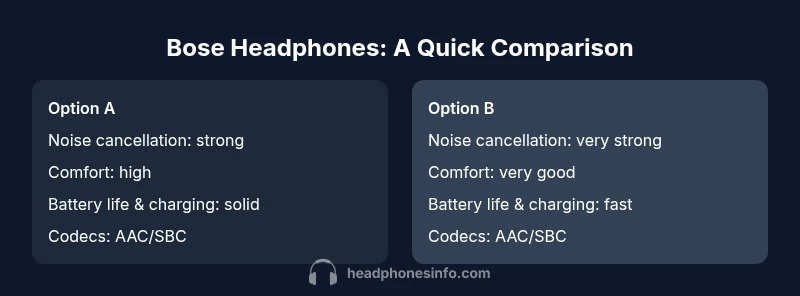
| Feature | Bose QuietComfort Series | Bose Noise Cancelling Headphones 700 |
|---|---|---|
| Noise cancellation quality | Strong, consistent ANC across most environments | Very strong in typical environments with nuanced adaptive modes |
| Comfort and weight | Lightweight, plush ear cushions for long sessions | Slightly heavier with a more substantial headband clamp |
| Battery life and charging | Long battery life with reliable daily use | Competitive battery life with faster charging in newer firmware |
| Codecs and connectivity | Broad codec support (AAC, SBC), strong wireless stability | Excellent connectivity with multipoint and intuitive controls |
| Multipoint and app features | Robust multipoint connectivity and solid app integration | Advanced app controls and firmware-managed features |
| Call quality | Clear voice pickup in most environments | Strong microphone performance with improved wind handling |
| Price range | Premium price point within Bose lineup | Premium-to-mid premium price with feature advantages |
Upsides
- Excellent comfort suitable for long listening sessions
- Industry-leading noise cancellation across environments
- Solid call quality and reliable multipoint connectivity
- Strong build quality and dependable firmware updates
- Strong resale value within the Bose ecosystem
Disadvantages
- Premium price relative to some competitors
- Heavier models can be less portable for travel
- Sound customization may be limited for some listeners
Bose QuietComfort-style headphones excel in comfort and ANC, while Bose 700 adds more control and feature depth; choose QC for portability and value, 700 for feature-rich use cases.
If comfort and effective noise cancellation are your top priorities, start with the QuietComfort series. If you want expanded control, better mic performance, and more app features, the 700 is the stronger all-around option. Balance price against features to determine the best Bose headphones for your needs.
People Also Ask
Which Bose headphones have the best noise cancellation?
In general, Bose’s flagship over-ear headphones deliver the strongest ANC. The exact performance varies with fit and environment, so test in settings similar to your daily routine. A good rule of thumb is to compare models side by side, paying attention to how the ANC handles steady background noise versus sudden disturbances.
Generally, Bose’s flagship over-ear models offer the strongest ANC. Test the models in your usual environments to see which cancels your noise best.
Do Bose headphones support multipoint Bluetooth connections?
Yes, most Bose wireless headphones support multipoint Bluetooth, allowing you to stay connected to multiple devices. This makes it easy to switch between a phone and a laptop without reconnecting. Check the exact model in the app for pairing behavior and priority settings.
Yes, most Bose wireless headphones support multipoint Bluetooth for easy device switching.
Are Bose headphones comfortable for extended listening sessions?
Bose headphones are typically designed with comfort in mind, using soft ear cushions and balanced clamping pressure. Comfort can vary by model and head shape, so trying a pair for at least 20–30 minutes helps determine fit and fatigue levels over time.
Yes, they’re generally comfortable for long sessions, though fit varies by model and head shape.
What should I look for when comparing Bose headphones?
Focus on comfort, ANC performance, call quality, battery life, codecs, and app features. Map these to your primary use case—travel, office work, or home listening—and assess whether a model prioritizes portability or feature depth.
Look at comfort, ANC, calls, battery life, codecs, and the app features; match these to your main use case.
Are Bose headphones compatible with non-Apple devices?
Yes. Bose headphones work well with Android, Windows, and other platforms. Bluetooth pairing and app support are designed to be platform-agnostic, though some advanced features may be best experienced on specific ecosystems.
They work well with Android and other platforms; most features work across devices.
Do Bose headphones require the Bose Music app?
Many Bose models offer enhanced controls and firmware updates through the Bose Music app, but basic listening and pairing often function without it. If you value customization and quick updates, the app is worthwhile.
The app adds customization and updates, but isn’t strictly required for basic use.
What to Remember
- Compare ANC depth and comfort for long listening sessions
- Test multipoint switching across devices before buying
- Weigh form factor against travel needs and portability
- Evaluate app features and firmware support as part of value
- Consider total cost of ownership including warranty and accessories