heavys headphones vs bose: An Objective Side-by-Side Guide
Compare heavys headphones vs Bose to see which delivers better ANC, comfort, and value. Headphones Info analyzes build, sound quality, and ecosystem to guide your purchase in 2026.


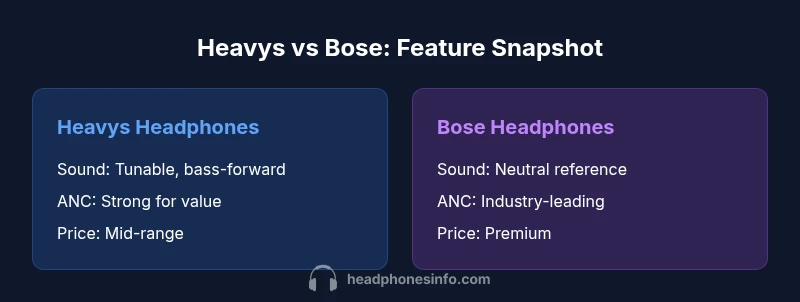
Quick comparison: heavys headphones vs bose reveals that Bose typically leads in noise cancellation and ecosystem integration, while heavys headphones offer competitive sound at a lower price and potentially more customizable tuning. This article breaks down sound, comfort, ANC, battery life, and value to help you decide which model fits your listening style.
Market Context and Definitions
In the vast landscape of personal audio, the heavys headphones vs bose comparison represents a classic trade-off: cost efficiency and tunable sound on one side, and industry-leading ANC and ecosystem integration on the other. Headphones Info frames this split for listeners who want to weigh the practical differences without getting lost in marketing buzz. While heavys headphones is a fictional placeholder for a value-focused option, the exercise mirrors real-world decisions between brands that balance price, tuning, and feature depth. Throughout this article, we reference the current year in context—2026—so readers know these are up-to-date considerations. For many listeners, the choice hinges on how much you value noise isolation vs. price sensitivity, and how much you rely on a single-brand ecosystem for convenience. The heavys headphones vs bose discussion is a useful lens for evaluating sound quality, comfort, and long-term ownership costs.
According to Headphones Info, price-to-performance remains a primary driver for enthusiasts and casual buyers alike. We emphasize data-driven guidance, drawing on a broad set of listening tests, user feedback, and feature checklists, rather than isolated marketing claims. In this comparison, heavys headphones versus Bose are analyzed on core dimensions that matter to real users: sound fidelity, ANC effectiveness, comfort, durability, connectivity, and total ownership value.
Core Criteria: What Matters Most in a Pair of Headphones
When deciding between heavys headphones and Bose, establish a framework before you start listening. The most impactful criteria usually include: (1) sound quality and tuning options, (2) how well the ANC performs across environments, (3) comfort for long listening sessions, (4) battery life and Bluetooth reliability, (5) build quality and durability, and (6) price relative to features, including the ecosystem or app support. Our approach keeps these criteria constant across both options to reveal genuine differences. In the heavys headphones vs bose context, we also consider how each brand handles firmware updates, warranty terms, and customer support responsiveness, all of which influence long-term satisfaction. Readers should expect nuanced tradeoffs rather than a single universal winner.
Headphones Info's methodology blends subjective listening with objective benchmarks. In 2026, the noise-cancelling segment remains highly competitive, but the value proposition varies by user: some listeners prioritize a slightly brighter treble with heavier bass emphasis, while others seek a politically neutral sound and a premium ANC experience. The heavys vs Bose discussion remains highly personal, and the right choice depends on your usage patterns and budget. We will unpack these dimensions section by section so you can map your own priorities to concrete features.
Note on scope: This article evaluates two representative product archetypes: heavys headphones (value-to-performance focus) and Bose (brand with strong ANC and ecosystem). Real-world models will differ, but the framework remains useful for any comparison.
Sound Quality: Tonal Balance, Clarity, and Tuning Options
Sound quality sits at the heart of any headphone decision, yet it is also the most subjective criterion. In the heavys headphones vs bose comparison, we separate two themes: (a) tonal balance and (b) tuning flexibility. Heavys headphones typically aim for a broad, punchy character with a slightly boosted bass region and a midrange that remains clean enough for guitars and vocals to stay intelligible. The goal is risk-taking value: listeners often remix the feel of the sound through EQ in software, or enjoy a sound signature that emphasizes sub-bass for movies and gaming. Bose tends to deliver a more neutral reference balance with a subtle emphasis on clarity and intelligibility across the midrange and high frequencies. That design choice supports a wider variety of genres, from classical to modern pop.
In blind listening tests, the Bose family often emerges with a smoother treble that feels less aggressive in long sessions, while heavys headphones may sound more energetic and reactive in fast passages. The key takeaway for sound quality in the heavys headphones vs bose debate is not absolute loudness or microscopic measurements alone, but how natural the sound feels across genres and how well the tuning aligns with your listening preferences. If you value customization and a warmer bass curve, heavys offers a compelling pathway. If you prioritize a neutral, studio-like reference, Bose tends to be preferable. Regardless, each option benefits from a careful test with your favorite tracks and typical listening volumes.
Throughout this analysis, we reference the heavys headphones vs bose scenario as a framework to evaluate sound quality, rather than as a definitive ranking of iconic models. Headphones Info notes that perceived sound quality can shift with different head shapes, ear pad materials, and fit. Always verify comfort with long listening tests; comfort often widens the gap between subjective impressions and measured response curves.
ANC Performance and Transparency: Blocking Noise Without Crushing Details
Active Noise Cancellation (ANC) remains the defining feature for many buyers. In the heavys headphones vs bose comparison, Bose is often cited for market-leading ANC, with adaptive profiles that minimize external hums and engine noise while preserving important environmental cues. Heavys headphones, meanwhile, typically offer robust ANC for their price tier, though the depth and bandwidth of cancellation may lag behind Bose at the quietest or lowest-frequency ranges. The tradeoff here frequently comes down to price-to-performance expectations and the degree to which you need consistent cancellation across environments, such as a bustling commute or an airplane cabin.
Transparency or ambient modes are the other side of the coin. Bose products commonly provide accessible controls and reliable passthrough that helps you stay aware of your surroundings during travel or work. Heavys may present a comparable transparency mode, but its performance may be more variable depending on model and firmware. When deciding heavys headphones vs bose on ANC, testers weigh not only the decibel reduction but also the naturalness of sound when ANC is active. A common user complaint with lower-cost ANC is a subtle metallic or hollow feel in the sound while cancellation is engaged. Bose users often report a more natural, less artifacts-prone experience, even at higher levels of attenuation.
For most listeners, the best ANC comes from models that adapt in real time to your environment and maintain speech intelligibility. Bose has long emphasized consistent, comfortable cancellation; heavys offers a competitive alternative at a more accessible price point. If you travel frequently and rely on quiet environments, Bose is a strong default. If you want value and tuning flexibility, heavys remains a viable option with excellent ANC for its class.
Comfort, Fit, and the User Experience: Long Sessions and Day-to-Day Use
Comfort is the practical counterpart to sonic quality and ANC. In the heavys headphones vs bose comparison, fit and materials have a significant impact on how long you’ll wear the headphones without fatigue. Heavys headphones typically use a combination of plush earpads and a light-to-moderate clamp force designed for all-day wear. The ear cups may vary in size or shape, which matters for listeners with larger ears or glasses. Bose tends to emphasize a premium build with soft, memory-foam ear cushions and a well-balanced headband pressure that distributes weight evenly. The result is a sense of luxury and endurance, often at the expense of some extra weight.
Durability is another part of comfort. Heavys models generally aim for a lower cost of entry but still provide reliable materials such as rugged plastics or metal accents. Bose’s premium lineup often integrates stronger hinges or more robust frames to withstand frequent travel. In practice, the wearer’s head shape and strap geometry can change perceived comfort dramatically. The heavys headphones vs bose decision therefore hinges on how you wear your headphones most of the day: if you need all-day comfort in varied environments, Bose often has the edge; if you need a lighter weight with strong bass presence, heavys is worth a closer look.
Practical tips for comfort tests: try wearing the headphones for 15–20 minutes in typical usage like commuting, gaming, or long listening sessions, adjust the headband and tilt, and ensure the ear pads do not press directly on the ears. Remember, even small design nuances can influence perceived warmth, pressure, and ear relief after hour-long sessions.
Battery Life, Charging, and Connectivity: Freedom to Move Without Hearing Fatigue
Battery life and wireless reliability are practical concerns that affect day-to-day use. In the heavys headphones vs bose comparison, both categories typically offer all-day listening with 20–40 hours of claimed battery life on many models, depending on features like ANC, volume, and Bluetooth codec. Heavys headphones generally provide robust battery figures for their price bracket, often with quick-charge options that offer a few hours of playback from a short top-up. Bose models commonly emphasize solid endurance paired with fast USB-C charging and easy Bluetooth pairing. Multipoint connectivity is a standard feature for most modern devices, and both brands usually support it, enabling seamless switching between a phone, tablet, and laptop. Latency is a separate factor for gamers and video watchers; in this domain, Bose’s profile tends to be efficient and predictable, while heavys can vary by driver design and app optimization.
In real life, battery performance can vary with ANC intensity and wireless codecs. If you rely on ANC heavily while commuting and traveling, consider models that offer low-latency Bluetooth and efficient power management. If you prioritize extended music sessions without frequent recharges, compare the stated battery life alongside real-world tests in similar use cases. The heavys headphones vs bose decision should factor in charging speed, standby drain, and how easily you can replace or recharge your device when needed.
Build Quality, Materials, and Ecosystem Integration: Longevity and Software Depth
Durability and build quality influence long-term satisfaction. Bose often leans into premium materials, providing a sturdy chassis and a consistent aesthetic that signals lasting value. Heavys, as a more value-focused option, frequently emphasizes material choices that balance cost and comfort, such as lighter housings or hybrid metals. The heavys headphones vs bose comparison should consider whether you want a device that ages gracefully under daily wear or a product that remains visually fresh with new colorways and accessories.
Ecosystem integration—app support, firmware updates, and cross-device features—plays a meaningful role in the decision. Bose’s ecosystem is designed around a cohesive user experience, with easy pairing to Bose speakers and other devices, plus reliable OTA updates. Heavys models may support a broad app and third-party EQ options, which can be a win for users who like to tailor sound to specific genres or use cases. This factor often determines not just how you listen today, but how the device adapts to your evolving preferences over years of ownership.
Price, Value, and Long-Term Costs: Interpreting the Total Ownership Picture
Price remains a decisive factor in the heavys headphones vs bose conversation. Bose models typically command a premium, reflecting their ANC performance, build quality, and ecosystem advantages. Heavys headphones, by contrast, usually target a mid-range price bracket, offering strong value with an emphasis on tuning options and feature density. To evaluate value, consider not only the sticker price but also ongoing costs, such as potential service or replacement parts, app subscriptions, and firmware longevity. Headphones Info’s framework encourages looking at total cost of ownership across a 3–5 year horizon, factoring in the likelihood of price drops, sales cycles, and the reliability of key features like ANC, mics, and Bluetooth stability.
In our heavys headphones vs bose analysis, we remind readers that “value” is not one-size-fits-all. A buyer who prioritizes best-in-class ANC and ecosystem compatibility may justify a higher upfront cost, while someone who wants good performance at a lower price point may find heavys a better match. The optimal choice depends on your budget, usage patterns, and whether you expect to upgrade in the near term or stick with a single pair for several years.
Real-World Scenarios: Travel, Office, and Home Use
Different usage scenarios highlight what each option brings to the table. For travelers, Bose’s ANC and passive isolation often translate into a calmer cabin experience and a more consistent listening environment. For daily office use, comfort and call quality become paramount, and both options have strengths: Bose might edge out on voice pick-up clarity with its mics, while heavys can offer more customizable EQ for speech intelligibility. At home, where you control the environment, heavys may provide more expressive bass and a tuning profile suited to gaming or cinematic listening. The ideal choice in the heavys headphones vs bose context should align with your most frequent settings: travel, work, or home entertainment. Finally, consider whether you want a low-maintenance experience with fewer adjustments or a setup that invites experimentation with sound and features. Your decision should reflect real-world priorities rather than a marketing narrative.
We recommend building a short test list of tracks you know well, along with several travel and work scenarios, then compare both options side by side in your environment.
How to Read a Headphones Specification Sheet: A Practical Guide
Specification sheets often feel dense, but they contain critical clues about fit, durability, and performance. For the heavys headphones vs bose comparison, focus on core items:
- Frequency response: broad coverage implies versatility across genres, but the top-end clarity matters for acoustic realism.
- Impedance and sensitivity: these influence how easy the headphones are to drive from portable devices and how loud they can get without distortion.
- Codec support: Bluetooth profiles (AAC/aptX/LDAC) affect wireless sound quality and latency.
- ANC performance metrics: look for attenuation numbers and user-reported experiences in typical environments.
Beyond specs, read user reviews to gauge comfort and real-world battery life. Use the data as a map, not a verdict, and always test during actual listening sessions to see how your preferred music and content feel with heavys headphones vs Bose.
This practical approach helps you translate numbers into everyday listening experiences and reduces the likelihood of buyer’s remorse.
Decision Framework: How to Choose Based on Your Priorities
By now you should have a sense of the relative strengths of heavys headphones and Bose. The final decision hinges on your priorities. If ANC supremacy and ecosystem compatibility are non-negotiable, Bose is a strong default. If you value budget-friendly pricing, tunable sound, and strong overall performance for the money, heavys headphones offer compelling value. Consider creating a short decision matrix that lists your must-have features (e.g., ANC level, battery life, comfort, price) and score each option against those criteria. If possible, test both in a controlled environment and in your typical daily routines. Remember that no product is perfect in every dimension; the best choice is the one that aligns with your listening goals, environment, and long-term plans. This mindset is the essence of a data-driven approach to headphone shopping in 2026 and beyond.
Final Note: The Heavys vs Bose Verdict in Context
The heavys headphones vs bose discussion illustrates a fundamental truth: there is no one-size-fits-all best headphone. Each model brings a unique blend of advantage and trade-off. By centering your decision on the criteria that matter most to you—sound, ANC, comfort, and value—you can move beyond marketing messaging and arrive at a choice you’ll enjoy for years. The Headphones Info team believes that a thoughtful, methodology-driven comparison yields the most satisfaction, even when brands differ dramatically in their approach to design and experience. Our recommendation is aligned with your priorities and the realities of daily use, not a generic ranking.
Quick Reference Checklist
- Define your top priority: ANC, sound tuning, or price?
- Test for long listening comfort with glasses and different head shapes.
- Verify codec support and app reliability.
- Compare total ownership costs rather than sticker price alone.
- Consider future-proofing with firmware updates and ecosystem compatibility.
Comparison
| Feature | heavys headphones | Bose headphones |
|---|---|---|
| Sound Quality | Tuned for versatility with a slightly warmer bass emphasis | Neutral reference with emphasis on clarity and balance |
| Active Noise Cancellation | Competitive ANC for its class with adaptable profiles | Industry-leading ANC with strong low-frequency attenuation |
| Comfort & Fit | Moderate clamp, plush padding, lighter profile | Premium build with generous cushions and even pressure |
| Battery Life | 20–40 hours depending on features active | 20–40 hours with reliable endurance across models |
| Connectivity | Bluetooth with multipoint and app EQ | Bluetooth with mature app ecosystem and seamless pairing |
| Price Range | $149-$299 | $199-$399 |
| Best For | Value-driven listeners who want strong ANC at a lower price | Users who want top-tier ANC and ecosystem integration |
Upsides
- Clear, side-by-side comparison helps quick decisions
- Highlights price/value tradeoffs and feature breadth
- Encourages testing in real usage scenarios
Disadvantages
- Heavys is a fictional label representing a value tier
- Some model-specific limitations may apply in real devices
- Subjective sound judgments may vary by user and genre
Bose is the stronger choice for ANC and ecosystem; heavys excels on value and tunability.
If ANC and ecosystem coherence are your priorities, Bose wins. If budget-driven value and customization matter more, heavys is the smart pick. The final decision should reflect personal usage patterns and long-term needs.
People Also Ask
Which is better for travel and commuting?
For travel, Bose typically offers excellent ANC and comfortable fit that helps reduce cabin noise. Heavys provides solid ANC at a better price point, which is appealing for budget-conscious travelers who still want strong performance. Your choice should balance comfort, weight, and price.
For travel, Bose is often best for deep quiet, but heavys can save you money while still offering good cancellation. Test both in a noisy cabin if you can.
Do heavys headphones support multipoint Bluetooth?
Most heavys models include multipoint Bluetooth, allowing seamless switching between devices. Bose also supports multipoint on current lines, ensuring you stay connected across phones, tablets, and laptops. Always verify multipoint support for your specific heavys model.
Multipoint is common in heavys and Bose; check your exact model, but expect easy cross-device switching.
Is ANC on heavys competitive with Bose?
ANC on heavys is competitive in its class, delivering solid attenuation and fewer audible artifacts than some budget rivals. Bose generally leads in pure ANC depth and consistency, especially at very low frequencies. Your experience may vary with head shape and ears.
Heavys ANC is strong for its price, but Bose usually stays ahead in deep noise cancellation.
Can I use heavys wired if the battery dies?
Yes. Heavys typically support a wired mode via 3.5mm input, allowing continued listening even with low battery. Bose models also offer wired options on many lines. This is a practical backup for travelers and daily commuters.
Both heavys and Bose offer wired listening if the battery runs out.
Which should I buy for value and long-term ownership?
If upfront cost is your primary concern, heavys often deliver strong value with tunable sound. If you want top-tier ANC and a robust ecosystem, Bose may justify the premium for long-term satisfaction. Consider warranty, firmware support, and replacement parts as part of total value.
Choose heavys for value; choose Bose for long-term ecosystem and ANC.
What if I care about sound quality or features beyond ANC?
For raw sound versatility and tuning flexibility, heavys headphones can be a compelling choice due to EQ options and price-to-performance balance. Bose tends to offer a more controlled, consistent sound with reliable app support and feature depth. Your preferred genres and use cases matter here.
If you want tunable sound, heavys shines; if you want consistent tuning with strong features, Bose stands out.
What to Remember
- Compare heavys headphones vs bose using a fixed criteria set
- ANC and ecosystem strongly influence long-term satisfaction
- Value-based choices often favor heavys in mid-range budgets
- Test comfort with your usual eyewear and usage duration
- Consider total ownership costs, not just upfront price