DJ Headphones vs Studio Headphones: A Data-Driven Comparison
Compare DJ headphones vs studio headphones with a data-driven analysis covering sound accuracy, isolation, durability, and comfort to help you choose the right pair for performance and mixing.


DJ headphones vs studio headphones: for accurate monitoring and mixing, studio headphones typically win on flatness and detail, while DJ headphones emphasize rugged build and strong isolation to perform in loud environments. The best choice depends on your primary use—studio work or live performance. This quick comparison highlights the core tradeoffs to help you decide.
What makes the distinction between dj headphones vs studio headphones important?
In the world of professional sound, the choice between dj headphones vs studio headphones isn’t merely about preference—it affects how you hear, mix, and perform. For DJs, headphones must withstand long sessions, frequent handling, and loud environments, while still delivering usable cues. For studio engineers, headphones are tools for precise listening, critical for accurate mixes and reference checks. The Headphones Info team emphasizes that the right pair aligns with your use-case, whether you’re cueing tracks in a club or evaluating mic positions during a vocal take. Understanding the fundamental differences in design intent helps you avoid gear that sounds exciting but fails under real-world use. This article delves into the key dimensions that separate dj headphones from studio headphones, and it explains how to weigh tradeoffs like isolation, frequency response, and comfort for your specific workflow.
Core design differences you should know when comparing dj headphones vs studio headphones
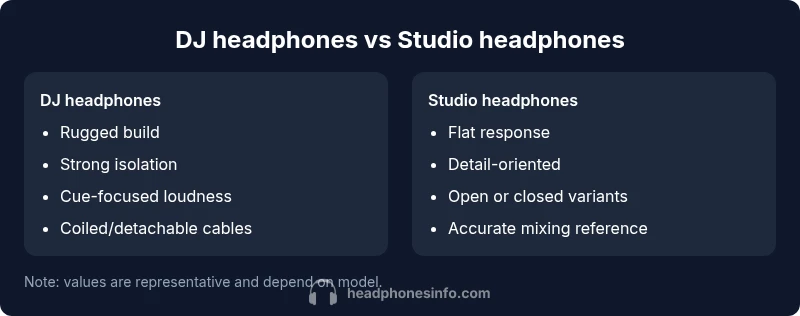
Design decisions for dj headphones vs studio headphones diverge at the core. Studio models often prioritize a flat, wide-frequency response and low distortion to reveal subtle mixing cues. They tend to favor accurate midrange representation for vocal and instrument balance. DJ-oriented models, by contrast, emphasize robustness, higher perceived loudness, and efficient isolation to cut through loud club environments. Many DJ models use closed-back designs with reinforced hinges, detachable cables, and reinforced cups. Studio models may offer a choice between closed-back and open-back designs depending on the monitoring context and the desired soundstage. The Headphones Info analysis highlights that impedance and sensitivity can influence how loud a pair will play from consumer devices or professional interfaces, a practical consideration for anyone who plans to audition headphones before buying.
Sound accuracy and monitoring goals in a dj headphones vs studio headphones comparison
The core listening goal for studio headphones is objective accuracy: you should hear true tonal balance, without exaggeration of bass or treble. This helps producers and engineers make reliable mixing decisions. For DJs, cueing often benefits from a sound that is clear and immediate, with enough bass presence to feel the track and stay connected to the beat. Many DJ headphones emphasize a slightly bass-leaning or energetic signature to ensure you can track mixes in noisy environments. However, modern models increasingly offer reference modes or switchable EQ profiles that approximate a flatter response when needed. The Headphones Info Team notes that sound signatures are not universally “better”—they’re fit-for-purpose, and the best choice depends on whether your priority is precise monitoring or beat impact in noisy venues.
Isolation and leakage: closed-back vs open-back implications for the dj headphones vs studio headphones decision
Isolation is a practical differentiator. Studio headphones are commonly closed-back for critical listening in non-ideal acoustics, but some users prefer open-back designs for natural soundstage during long sessions. In DJ contexts, closed-back CA cups reduce bleed into mic setups and minimize sound leakage that can distract other performers or the audience. Leakage reduction matters in studio environments as well, particularly when recording and tracking live performances. The tradeoffs include soundstage size and listener fatigue. A high-quality closed-back can deliver strong isolation without overly dampening instrument cues, whereas open-back variants may offer wider imaging at the cost of more environmental noise intrusion. The decision should balance the listening environment, the need for privacy, and how much you value spatial cues during mixes.
Comfort, clamp force, and headset geometry for long sessions
Comfort directly influences how long you can work without fatigue. DJ sessions often demand a lighter clamp and a secure, stable fit to prevent cups from shifting during mixes. Studio work, especially during long mixing or mastering sessions, benefits from cushioned headbands, rotatable cups, and breathable padding. The geometry of the headband and ear cups matters: oversized cups can accommodate larger ears but may cause pressure points if the clamp is too tight. Build quality—material durability, cable attachment mechanisms, and hinge reinforcement—matters for both use cases because durability affects how much you rely on the gear in high-pressure environments. The most comfortable model isn’t universally the best; it depends on head shape, wearing glasses, and personal tolerance for warmth during extended listening.
Impedance, sensitivity, and how they affect your setup
A practical concern in this comparison is impedance and sensitivity. High-impedance studio sets often require a dedicated audio interface or headphone amp to reach comfortable listening levels, which can be a limiting factor for mobile setups. Lower-impedance DJ headphones are easier to drive from portable players or laptops, but they may be more prone to coloration from the source and less able to reveal subtle cues. Matching impedance with your gear ensures you aren’t fighting the amp to achieve loudness, and it can prevent clipping or noise. Headphones Info’s research suggests that the best pairing eliminates the need for unnecessary adapters while preserving dynamic range and transient detail across common duty cycles in both DJ and studio work.
Build quality, cables, and customization options
Durability is a frequent deciding factor for DJ gear due to the travel and rigors of live performance. Detachable cables, reinforced connectors, and metal yokes are common on DJ models to withstand rough handling. Studio headphones may prioritize lighter materials and comfort for extended sessions, sometimes at the expense of maximal ruggedness. Cables with locking connectors or twisted cords reduce tangling and yield more reliable performance in mobile environments. Some models offer replaceable parts or modular cups to extend the life of the headphone, which adds value for serious buyers who plan to use their gear for years rather than seasons.
Use-case scenarios: when each shines in the field
DJ headphones excel in noisy environments like clubs, where cueing and quick beat-matching require volume and isolation. They are typically designed to travel well, with compact folding designs and rugged builds. Studio headphones shine in controlled environments—home studios, project studios, or broadcasting rooms—where accurate sound reproduction and low distortion are critical. For headphone users who perform both tasks, a hybrid solution may be warranted: closed-back headphones with a flat reference mode can cover many bases, while an additional pair chosen for either role can optimize performance in specific settings.
Price ranges and value: balancing upfront cost with long-term benefits
Both DJ and studio categories span a wide price range. Entry-level models may emphasize ruggedness or aggressive bass, but higher-priced options tend to combine durability with improved drivers, impedance matching, and more comfortable materials. Price should be considered alongside build quality, warranty, and replacement part availability. The practical takeaway is to identify your required duty cycle window (short gigs vs. daily studio use) and choose a model that sustains performance over that period. Between the two categories, don’t assume more expensive always equals better monitoring; instead, map your needs to the features you’ll actually use, and test how comfortable the pair feels after hours of wear.
How to test and compare in practice: a step-by-step framework
Create a structured audition process when evaluating dj headphones vs studio headphones. Start with a quiet room to establish a baseline, then test in a louder, club-like setting or simulate traffic noise. Compare bass tightness, midrange clarity, and treble smoothness across several tracks you know well. Try both with and without a portable driver to assess how responsive each model is to different source devices. Evaluate comfort by wearing each for at least 20–30 minutes and noting any heat buildup or pressure changes. Finally, consider noise isolation in real environments: does the model prevent bleed into a microphone or project at a performance level? This practical approach helps you translate spec sheets into actual, day-to-day performance.
Putting it all together: a decision framework for choosing between dj headphones vs studio headphones
The final decision should be driven by your primary use-case. If you perform live, prioritize durability, isolation, and a loud, reliable cue. If you’re mixing or mastering, favor accuracy, a linear response, and long-term comfort for extended sessions. A balanced approach is to own two pairs: one optimized for live performance (dj headphones) and one for critical listening (studio headphones). Always audition in environments that resemble your real work, consult independent reviews, and factor in after-sales support and warranty. Following this framework ensures you select a pair that aligns with your workflow and budget, backed by a data-driven rationale rather than trend or novelty.
Comparison
| Feature | DJ headphones | Studio headphones |
|---|---|---|
| Sound profile | Bass-forward, energetic for live cueing | Flat, accurate, detailed for mixing and mastering |
| Isolation | Strong closed-back isolation for noisy environments | Closed-back or open-back options; depending on model, isolation varies |
| Impedance & amp pairing | Often easier to drive from portable sources | Higher impedance often paired with dedicated interfaces/amps |
| Durability & build | Rugged builds with reinforced hinges | Lighter builds focused on comfort and precision |
| Cable options | Detachable, coiled or straight cables | Detachable cables, often with locking connectors |
| Best use case | Live DJing, cueing, and club use | Critical listening, editing, and reference work |
Upsides
- Pros: Strong isolation helps in loud environments while maintaining cue integrity
- Pros: Detachable cables and rugged builds extend lifespan for touring and performances
- Pros: Studio models often offer flatter frequency responses for accurate mixes
- Pros: Budget-friendly options exist in both categories with solid value
Disadvantages
- Cons: DJ headphones can color the sound, potentially masking subtle details
- Cons: Studio headphones may be less robust for heavy gigging and rough transport
- Cons: Open-back studio options sacrifice isolation in loud venues
- Cons: Higher-end models can be expensive and require dedicated amplification or audio interfaces
DJ headphones are best for live performance and durability, while studio headphones excel in precise monitoring and mixing.
Choose DJ headphones when you need rugged reliability and strong isolation in noisy environments. Choose studio headphones when your priority is flat response, detail, and long-term comfort for editing and mixing. A two-pair approach is common among pros who demand both attributes.
People Also Ask
Are DJ headphones suitable for studio mixing?
DJ headphones can be used for mixing, but they may emphasize bass and cue energy, which can bias decisions. For critical mixing, rely on studio headphones with flatter frequency response as your reference. If you must mix on DJ cans, use them as a secondary reference and verify with near-field monitors.
DJ headphones work for rough mixes, but use a studio pair for final decisions.
What is the main difference between DJ headphones and studio headphones?
The main difference is intended use: DJ headphones prioritize cueing, isolation, and durability in loud environments, while studio headphones prioritize neutral, accurate sound for mixing and mastering. Both aim for clarity, but their targets differ based on workflow.
DJ cans are built for live cues; studio cans are built for accurate listening.
Should I choose closed-back or open-back for DJ or studio use?
Closed-back designs are common in both categories for isolation and preventing bleed. Open-back headphones are favored in studios when you want a wider soundstage and natural acoustics, but they leak sound and don’t isolate well in loud environments.
Closed-back is safer for both DJ and studio use; open-back is for open spaces and critical listening.
Do I need an amp for DJ headphones?
Many DJ headphones are designed to be driven by portable devices, but higher-impedance models may benefit from a dedicated headphone amp or audio interface to reach optimal loudness and dynamic range.
An amp helps if your cans are high-impedance or you need more headroom.
Can I use DJ headphones in a home studio?
Yes, you can use DJ headphones in a home studio for cueing and rough mixes, but pair them with a reference studio headset for critical listening checks to ensure accuracy.
DJ cans can work at home, but keep a studio pair for accuracy.
Are wireless headphones suitable for DJing or studio work?
Wireless headphones exist for both DJing and studio work, offering convenience but often adding latency and potentially reduced fidelity. If latency matters (sampling, cueing), prefer wired headphones or low-latency wireless options.
Wireless cans are convenient but may introduce latency or pop in fidelity.
What to Remember
- Choose based on primary use: live performance vs critical listening
- Look for isolation and build in DJ models; seek accuracy and comfort in studio models
- Test in real-world environments similar to your workflow
- Prefer detachable cables and upgradeable parts for longevity
- Consider owning both types for maximum versatility