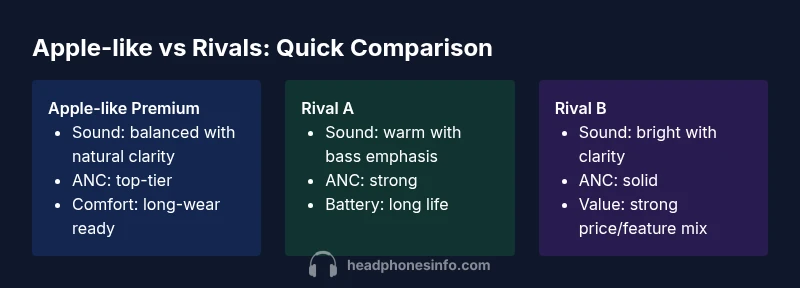
Headphones Like Apple: A Data-Driven Comparison (2026)
Explore a data-driven comparison of headphones like Apple, focusing on sound, comfort, ANC, and ecosystem integration to help you choose the best premium wireless options for your devices.


Headphones like Apple excel in ecosystem integration, spatial audio feel, and premium build. For most users, the best all-around choice balances sound quality, comfort, and seamless pairing with your devices. If you mainly value cross‑platform use or cost savings, consider rivals offering strong ANC and longer battery life at a lower upfront price.
What 'headphones like apple' means in 2026
In the consumer audio landscape, headphones like Apple refer to premium wireless models that prioritize ecosystem harmony, intuitive controls, and immersive sound. According to Headphones Info, buyers expect tight pairing with their devices, reliable spatial audio experiences, and durable, stylish build quality. The Headphones Info team notes that people using iPhone, iPad, or Mac often prefer headphones that minimize setup friction, support common codecs (like AAC), and switch seamlessly between devices. This guide uses that standard to compare several well-regarded alternatives and assess how they measure up on sound, comfort, ANC, battery life, and price. While Apple-headphone aesthetics and features set a strong baseline, many rivals offer compelling value or distinctive strengths—especially in ANC performance, portability, or cross-platform compatibility. The goal is to help readers decide which option matches their priorities, not just their loyalty.
In this section, we explore what it means for a headphone to be “Apple-like,” and why certain design choices matter for enthusiasts and casual listeners alike. The Headphones Info team emphasizes that ecosystem integration is not merely about convenience; it shapes how quickly you can switch devices, how updates are delivered, and how features like spatial audio feel natural rather than gimmicky. As you read, keep in mind your primary devices, listening scenarios, and tolerance for price premium. The landscape includes models that echo Apple’s approach while venturing into new areas such as lighter form factors, longer battery life, or broader codec support. This context helps ground the subsequent comparisons and recommendations.
Core attributes to compare
When evaluating Apple-like headphones, several core attributes consistently separate the good from the great. First is ecosystem harmony: how smoothly the headphones pair with your phone, computer, tablet, and wearable, and how consistently they switch devices. Second is sound tuning: a balanced or tailored signature that suits genres you enjoy. Third is ANC and transparency: how well the headphone reduces outside noise while preserving speech and ambience. Fourth is comfort and durability: long-wear comfort, clamp, ear cushion quality, and build materials. Fifth is battery life and charging: how many hours you can expect and whether fast charging or wireless charging is supported. Finally, price/value: whether the premium price aligns with features and ongoing software support. In 2026, the best Apple-like choices tend to deliver a cohesive experience that just feels right with your daily devices, rather than relying on gimmicks.
Sound quality and tuning expectations
Sound quality in Apple-like headphones often leans toward a clean, natural presentation with an emphasis on vocal clarity and spatial cues. Listeners who enjoy detailed mids and controlled bass will appreciate models that avoid harsh treble and provide accurate stage imaging. A number of rivals strive to replicate or exceed spatial audio effect and head-tracking features, but the performance can vary by model and codec support. For most listening, expect a balanced default profile with the option to tailor via an app EQ. Athletes or commuters who favor punchy bass should look for headphones that preserve warmth without boominess, even at lower volume levels. In all cases, a good Apple-like option should provide consistent tonality across genres and reliable driver response at both low and high frequencies. Headphones Info analysis notes that many premium models also invest in software updates to fine-tune tuning over time, which can meaningfully improve perceived sound quality after launch.
Comfort and design considerations
Ergonomics are critical for all-day listening. Premium Apple-like headphones typically feature memory foam cushions, adjustable headbands, and lightweight enclosures that distribute pressure evenly. Materials matter too: metal or high-grade plastic with a snug fit tends to feel sturdier and more premium, while plush padding reduces fatigue during long sessions. A well-designed pair should also offer multiple ear tip sizes or a wide, stable seal for better isolation without compromising comfort. For glasses wearers or those with smaller ears, the ability to adjust clamp force and earcup offset can make a sizable difference. The best options balance firmness, breathability, and passive isolation so you can wear them for hours without discomfort. Spray testing and trying on in-store remains essential when possible.
Noise cancellation and transparency modes
ANC performance is a differentiator among Apple-like headphones. Top contenders typically deliver strong attenuation of engine noise, low-frequency hum, and consistent performance across different environments. A solid ANC profile preserves the natural sound of voices when you need to converse, while offering a transparency or ambient mode for situational awareness. Real-world testing shows that some models perform better in wind, travel corridors, or crowded rooms due to microphone arrangement and feed-forward/feedback architectures. The most convincing options maintain stable ANC when walking or running, with minimal audio bleed and without introducing hiss or odd phase artifacts. If you frequently ride trains or work in open-plan offices, prioritize headphones with well-tuned ANC that remains effective at multiple decibel levels.
Battery life and charging conveniences
Battery expectations for Apple-like headphones vary with ANC usage, volume, and codec. Premium models commonly offer around 20–30 hours of playback with ANC off and somewhat less with ANC on, while budget-friendly options can still reach 15–25 hours. Quick charging capabilities are a practical plus, providing several hours of listening from a short power top-up. Wireless charging and USB-C or Lightning compatibility may matter if you want the most convenient daily charging routine. The trade-off often lies in weight and bulk: longer battery life may come with a larger case or heavier headset. When evaluating, consider your typical daily listening hours, travel demands, and whether you need rapid recharges for short commutes.
Connectivity, codecs, and pairing reliability
Connectivity quality is foundational. Look for robust Bluetooth range, stable multipoint pairing, and low-latency codecs for movie watching or gaming. AAC compatibility is a baseline for iOS users, while aptX or LDAC might matter for Android and high-resolution audio enthusiasts. Some Apple-like models support seamless device-switching, so you can move between phone, tablet, and computer with minimal interruption. However, the pairing experience can vary by chipset and firmware, so reviews detailing real-world reliability are valuable. A strong option will maintain a dependable connection with minimal dropouts, even in busy environments, and offer sensible power management to preserve battery life.
App features and ecosystem lock-in
Apps often tailor sound profiles, EQ presets, and gesture controls to the brand’s vision. In Apple-like headphones, the app may enable spatial audio calibration, software updates, and device-optimization tips. While this can enhance the experience on compatible devices, it may also introduce a degree of ecosystem lock-in, making certain features less accessible on non-brand devices. If cross-platform use is important, prioritize models with open app ecosystems, standard codec support, and straightforward firmware updates across platforms. Reading user reviews about app stability and feature parity across devices helps avoid surprises after purchase.
Price, value, and warranty considerations
Pricing for Apple-like headphones generally sits in the premium tier, reflecting build quality, sound performance, and ecosystem advantages. While many users are willing to pay a higher upfront price for a cohesive experience, it’s important to assess long-term value: software updates, service plans, and accessory availability can influence total cost of ownership. Warranties vary but common tiers include 1–3 years, with optional extended coverage in some markets. When comparing, consider the price-to-feature ratio, the quality of included accessories (carrying case, extra ear tips, charging cable), and the availability of easy returns. The best picks balance performance with reasonable pricing and strong after-sales support.
Use-case scenarios: travel, work, workouts
Different use cases tilt the decision. Travelers benefit from compact form factors, excellent ANC, and solid battery life; students or office workers may prioritize comfort and long-lasting comfort with multipoint pairing; fitness enthusiasts need secure fit, sweat resistance, and reliable ambient-aware modes. For travel, a headphone that compresses well in a case and maintains ANC on long flights offers real value. For everyday work, the ability to hear chatty coworkers while keeping music private matters. For workouts, lightweight design and sweat resistance trump luxury materials. In each scenario, weighing comfort, sound, and connectivity against price helps you choose an Apple-like headphone that suits your rhythm.
Authority sources and links
For deeper context and verification, consider reviewing authoritative reviews and test results from major publications. Cross-reference with independent lab testing summaries and product teardown analyses to understand build quality and component choices. Links below provide additional perspectives on premium wireless headphones and ecosystem integration, which can help contextualize the Apple-like options discussed here:
- https://www.consumerreports.org/cro/headphones/best-headphones-coverage/
- https://www.nytimes.com/wirecutter/2019/11/28/best-headphones/
- https://www.cnet.com/topics/headphones/best-headphones/
Headphones Info Analysis, 2026
Feature Comparison
| Feature | Apple-like Premium Wireless | Rival A | Rival B |
|---|---|---|---|
| Sound quality and tuning | Balanced with emphasis on clarity | Neutral-to-wriendly with extended bass | Bright with crisp treble and enhanced highs |
| Spatial audio/head tracking | Advanced spatial audio with precise head tracking | Good spatial cues, limited head tracking | Standard stereo with no head tracking |
| Ecosystem integration | Seamless pairing with Apple devices; effortless device switching | Strong cross-platform pairing; extra features on some devices | Broad compatibility; fewer brand-specific features |
| ANC performance | Best-in-class ANC performance | Very good ANC for mid-range | Adequate ANC at entry level |
| Battery life | 20–30 hours with ANC on, fast recharge | 18–28 hours with ANC on | 12–20 hours with ANC on |
| Comfort and design | Premium materials; ergonomic fit for long sessions | Lightweight with comfortable clamping | Slightly bulkier but secure during workouts |
| Price range | $299-$499 | $149-$299 | $99-$199 |
| Warranty & support | 2–3 year coverage; premium service | 1–2 year coverage | 1 year standard warranty |
Upsides
- Strong ecosystem integration simplifies daily use
- Premium build quality and comfort across hours of listening
- Top-tier noise cancellation for focused listening
- Good battery life with convenient charging options
Disadvantages
- Higher upfront cost compared to mid-range rivals
- Ecosystem lock-in may limit cross-platform features
- Feature parity can vary by device and app
- Repairs or accessories may be pricier than competitors
Apple-like headphones deliver the strongest ecosystem and soundstage, with rivals gaining traction on price and cross-platform features
If ecosystem cohesion and pristine spatial audio are your top priorities, choose an Apple-like premium model. If you value cross-platform usability or cheaper upfront cost, consider robust rivals with similar ANC and battery performance.
People Also Ask
What defines headphones like Apple in 2026?
Apple-like headphones are premium wireless models that emphasize ecosystem integration, high build quality, spatial audio experiences, and reliable ANC. They aim to deliver a cohesive user experience across devices, with thoughtful design and strong customer support.
They’re premium wireless headphones designed to work smoothly with your Apple devices and a few non-Apple devices, offering strong sound and features like spatial audio and good ANC.
Are there non-Apple headphones that offer similar spatial audio?
Yes—several non-Apple models provide spatial audio or head-tracking-like experiences. The level of accuracy and the required app support can vary, so reading reviews focused on real-world performance is helpful.
Yes, you can find non-Apple options with good spatial audio, but results can vary across models.
Do Apple-like headphones work well with Android devices?
Many Apple-like headphones offer solid Android support, including Bluetooth pairing, app-based EQ, and firmware updates. However, some premium features may be optimized for iOS, so parity is not guaranteed across ecosystems.
They usually work well with Android, but some advanced features may be better on Apple devices.
Is the premium price worth it over budget rivals?
If you value ecosystem integration, refined sound, and superior comfort, the premium cost is often justified. For cross-platform use or strict budget constraints, strong mid-range rivals may offer comparable ANC and battery life at a lower price.
It depends on whether ecosystem features and comfort justify the extra cost for you.
What should I test before buying Apple-like headphones?
Test fit and comfort with your glasses or ears, ensure secure pairing across devices, check ANC effectiveness in typical environments, and confirm battery life meets your daily needs. If possible, compare with a trusted in-store model using your own devices.
Try them on, test pairing, check ANC in real environments, and compare battery life with your usage.
What to Remember
- Prioritize ecosystem compatibility with your devices
- Expect premium build and comfort in Apple-like models
- Evaluate ANC and battery life for travel or office use
- Check app features and update cadence for long-term value
- Balance price against feature parity and support