Monitor Headphones vs Studio Headphones: A Comprehensive Comparison
Compare monitor headphones vs studio headphones to understand which design fits mixing accuracy, critical listening, and comfort. Learn key differences, use cases, and buying considerations for smarter headphone choices.


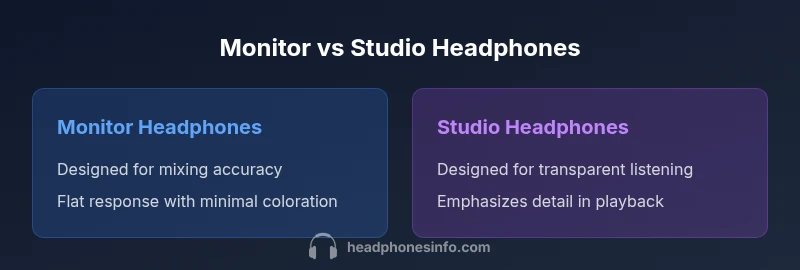
Monitor headphones vs studio headphones represent two distinct listening philosophies. In practice, monitor models emphasize a flat, uncolored response ideal for mixing, while studio models prioritize a transparent, truthful playback for critical listening and mastering. This comparison highlights the most important differences in sound, build, and use cases so you can decide which type supports your workflow.
What are monitor headphones and studio headphones?
In professional audio work, the choice between monitor headphones and studio headphones hinges on how you intend to use them. Monitor headphones are engineered to reveal problems in a mix without adding coloration, making them a staple in editing suites and home studios where accurate balance matters most. Studio headphones, by contrast, aim for honest playback with minimal psychoacoustic embellishment so engineers can judge subtle details during mastering and final checks. According to Headphones Info, the distinction isn’t merely marketing—it reflects fundamental design goals that shape resonance, damping, and acoustic footprint. The Headphones Info Team emphasizes that understanding this intent helps audio enthusiasts select gear that aligns with their tasks, room acoustics, and workflow pace.
How the design goals differ
The core divergence between monitor and studio headphones is purpose-driven design. Monitor models prioritize flatness and low distortion across the audible spectrum so mixers can hear planed changes without secondary cues. Studio models, meanwhile, lean toward a naturally honest sound with careful emphasis on technical cues like transient response and spatial cues. This difference affects perceived loudness balance, bass texture, and the heaviness of highs. In practical terms, a monitor headphone will tend to sound more even across frequencies, while a studio headphone might reveal more of the recording’s sonic character. Your choice should map to whether you’re shaping a mix or validating a final master under critical listening conditions.
Sound signature and measurement criteria
Sound signature is a central practical criterion. Monitor headphones strive for a near-neutral response with minimal coloration so overlaps in a mix aren’t exaggerated in the wrong frequency bands. Studio headphones focus on transparent reproduction that preserves the original recording’s intent, even if that means hearing slight deviations from an industry baseline. When evaluating, listeners should compare metrics such as harmonic distortion, transient response, and channel separation rather than relying on subjective color alone. Real-world testing with familiar reference tracks is essential to confirm whether a headphone set serves mixing accuracy or critical listening. This approach aligns with Headphones Info Analysis, 2026, which highlights how what you hear in isolation translates to decisions in the last few mix passes.
Transducers and impedance considerations
Transducer size and impedance influence sensitivity and compatibility with audio interfaces. Monitor headphones often use larger drivers to deliver a broad, controlled bass region while maintaining linearity. Studio models may adopt different driver geometries to preserve micro-detail and airiness. Impedance and sensitivity determine how easily a headphone can be driven from typical audio interfaces or dedicated headphone amps. If you work with low-output interfaces, you’ll notice differences in loudness and dynamic response that can affect your perception of space and depth. The practical takeaway: choose a driver size and impedance that matches your typical gear, room, and listening distance to avoid under- or over-driving the headset.
Comfort and wearability across long sessions
Long sessions demand comfort beyond initial impressions. Both monitor and studio headphones come in various clamping forces, pad materials, and headband designs. For some users, the flatter headband and lighter weight of certain monitor models reduce fatigue during extended editing sessions. For others, studio headphones with plush earpads can minimize pressure on the ears during lengthy mastering checks. Comfort is subjective, but a good test involves hours of continuous wear at typical monitor volumes. Remember that unwanted pressure points can skew listening accuracy, especially when you’re perched in front of a screen or near a treated wall. Ergonomics matter as much as sound in day-to-day work.
Build quality and durability choices
Durability varies across brands and price tiers. Monitor headphones often focus on clinical accuracy and robust, high-stability enclosures that resist daily studio wear. Studio models may emphasize lighter frames with more flexible hardware to maximize micro-detail retrieval, sometimes trading off peak rigidity. Look for metal or reinforced plastic construction, reinforced cable connections, and replaceable pads if you plan to use the headphones daily. While build quality can influence longevity, it should not override critical listening needs. Headphones that feel sturdy yet comfortable tend to deliver consistent performance across sessions.
Cable, connectors, and portability
Cable design and connector types affect usability in busy studios. Detachable cables are advantageous for quick swaps and travel, while coiled or angled designs can reduce micro-movements that introduce cable noise. If you travel with your headphones, consider models with foldable frames and protective cases, as these features help preserve calibration and physical integrity over time. Connectivity options (coaxial/1/4
},
comparisonTable
rows00
rows01
Comparison
| Feature | Monitor headphones | Studio headphones |
|---|---|---|
| Best for | Mixing and editing workflows | Critical listening and reference monitoring |
| Ideal environment | Controlled studio setups with accurate monitors | Varied rooms where neutral, transparent playback matters |
| Sound signature | Flat/neutral emphasis for balance | Transparent playback with faithful representation of detail |
| Impedance and drive | Moderate to high efficiency; easy to drive | Higher impedance variants may require dedicated amps |
| Comfort and wearability | Comfort optimized for long editing sessions | Comfort balanced with micro-detail retrieval |
| Durability and build | Rigid builds to withstand daily use | Durable but sometimes lighter frames for extended use |
| Price/value context | Mid-range to premium depending on brand | Mid-range to premium with emphasis on accuracy |
Upsides
- Clarifies which headphone type fits specific tasks
- Highlights how design goals affect listening perception
- Encourages testing in proper room conditions
- Supports better budgeting by aligning needs with features
Disadvantages
- Risk of over-simplifying a hybrid model that blends roles
- Model-to-model variance can blur general distinctions
- Sound preference can override category labels in practice
Choose based on your primary task: monitor headphones for mixing accuracy, studio headphones for critical listening and mastering reference.
If your work centers on shaping mixes and ensuring translation across systems, monitors are often the safer bet. If you need transparent playback to verify detail and texture in a final check, studios tend to serve better. For many studios, a hybrid approach—having both types—offers the most flexible workflow.
People Also Ask
What is the main difference between monitor headphones and studio headphones?
Monitor headphones aim for a flat, neutral response to aid mixing decisions, while studio headphones strive for transparent, accurate playback for critical listening and mastering checks. The difference is rooted in intended use and how the frequency spectrum is presented.
The main difference is their job: monitors help you mix without coloration, studios help you hear the true recording.
Can I use monitor headphones for recording tracking?
You can, but many monitoring-focused models don’t isolate as well as dedicated tracking headphones. If isolation and bleed control matter for your setup, choose models with better passive or active isolation or pair with a good mic technique.
Yes, you can, but isolation can be important for tracking—so pick wisely.
Are studio headphones always more expensive than monitor headphones?
No absolute rule exists. Both categories span entry-level to premium models, so price depends on brand, materials, and features rather than category alone.
Not always. It depends on the specific model, features, and build quality.
What else should I consider besides sound quality?
Comfort, durability, impedance, cable design, and how you connect them to your gear all impact usability and long sessions. Ergonomics and room setup are often as important as pure fidelity.
Think about comfort, durability, and how you’ll connect them, not just the sound.
Is there a best practice for testing headphones in this category?
Test with familiar reference material at similar listening levels, in your treated room, and compare against your current references. Document how each headphone translates across different tracks.
Test with what you know best, in a space that’s similar to where you’ll listen most.
Do I need a separate headphone amp for these?
Some higher-impedance models benefit from a quality headphone amp, while efficient, lower-impedance variants may sound fine directly from interfaces. Consider your gear’s output capability.
A good amp helps with some high-impedance models, but not all.
What to Remember
- Match headphones to your primary task
- Test in your actual room and with familiar material
- Prefer detachable cables and robust builds for long campaigns
- Consider a hybrid setup if your work spans mixing and critical listening