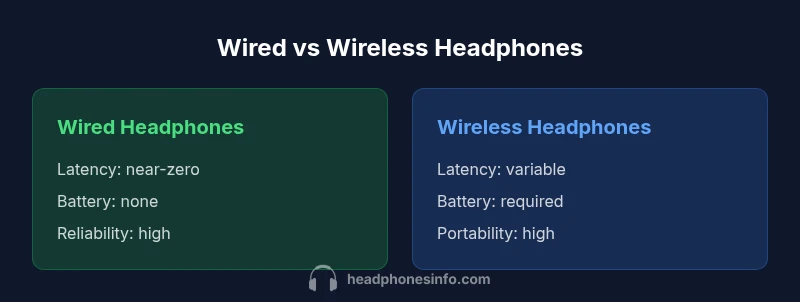
Wired vs Wireless Headphones: A Practical Comparison
Explore why wired headphones often beat wireless for latency, fidelity, and long-term value. This analytical guide compares sound quality, durability, compatibility, and buying tips to help you decide.


Bottom line: wired headphones deliver the most reliable, consistent sound with near-zero latency and no battery concerns, making them ideal for critical listening, monitoring, and competitive gaming. Wireless models add convenience, freedom from cables, and broader compatibility, but can suffer from battery limits, interference, and variable performance. If your priority is pristine sound and long-term value, wired headphones are usually the safer bet.
Why wired headphones still matter for serious listening
According to Headphones Info, the case for wired headphones rests on reliability and fidelity. When you ask why use wired headphones instead of wireless, the answer starts with latency-free transmission, consistent impedance, and uninterrupted operation without charged batteries. In professional, critical listening, mixing, and live monitoring, a wired connection reduces the odds of dropout and timing mismatch that can alter judgment. This is a key differentiator for audiophiles and sound engineers who demand predictable behavior under varying room conditions and gear setups. The goal is to preserve the full acoustic signature of the recording and the intent of the producer, without the unpredictable variability that sometimes accompanies wireless paths. Ultimately, the wired path remains a dependable baseline against which any wireless alternative should be measured.
Latency and synchronization: the hardware you can trust
In fast-paced games, EDM production, or film scoring, latency is not cosmetic—it's audible. A wired connection provides near-zero latency compared with many wireless technologies that batch, compress, or buffer audio. This reduces lip-sync drifts and audio-visual mismatch, which matter for precise monitoring and mixing. Headphones Info Analysis, 2026, notes that even small timing differences can affect perception of transient detail, so wired remains preferable for critical timing tasks. If you work with live performers or sample-accurate music, the direct cable path minimizes timing drift and keeps the listening experience faithful to the source.
Audio fidelity and DAC/amp considerations
Not all wired headphones sound identical, but the absence of wireless compression means you typically access more of the driver’s dynamic range. If you feed from a quality DAC/amp, particularly with high-impedance models, you can hear subtleties that may be obscured by Bluetooth codecs. This section explains how source quality, impedance, and amplification interact with cable quality to shape loudness, headroom, and tonal balance. For connoisseurs, pairing the right DAC and amp with a well-designed wired headset reveals more natural decay, more accurate imaging, and a wider, more stable soundstage than many portable wireless alternatives.
Battery life, interference, and reliability
Wireless devices must manage battery life, charging cycles, and radio interference. Even with low-latency modes, RF noise, crowded environments, and competing networks can introduce dropouts or jitter. A wired headphone setup sidesteps battery concerns entirely, delivering consistent performance across hours of listening, mixing, or critical listening sessions. This is especially valuable in studio environments, classrooms, or venues where access to reliable power and clean spectrum is guaranteed. By removing the battery variable, you gain a stable baseline for judgment and comparison.
Durability: cables, connectors, and wear patterns
Cables wear where they bend and at the jack, and the connector itself can wear with repeated plugging. While some premium wireless headsets hide the battery inside, wired designs reveal the cable as a mechanical liability that deserves thoughtful selection and care. This is why many professionals favor reinforced, detachable cables that can be replaced without discarding an entire headset. A well-made wired headphone with a robust plug and a protected strain relief can outlive several wireless units that rely on fragile power systems and compact electronics.
Compatibility and device ecosystems
Many devices still include a 3.5mm jack or USB-C with a compatible adapter. Wired headphones can connect to audio interfaces, mixers, and desktop DACs with fewer compatibility quirks than some wireless adapters. However, needing an appropriate connector can be a hurdle for mobile devices moving toward dongles. The trade-off is a broader, more stable compatibility landscape with wired designs, especially when you work across multiple machines or a studio workflow that includes legacy equipment and professional-grade interfaces.
Use-case scenarios: studio, gaming, travel, and more
For studio work, wired is often the default due to latency and fidelity. For competitive gaming, low-latency wired headsets can edge out wireless in timing-critical games. For travel, wired options may still be preferable if you prioritize battery-free operation in a shared environment with limited wireless bandwidth. This section outlines how to map your needs to a wired choice, including scenarios where a hybrid approach (wired for critical tasks, wireless for casual listening) makes sense.
Price, value, and lifecycle costs
While many wired headphones cost less upfront than premium wireless counterparts, long-term value depends on build quality and usage. A high-quality wired model may outlive a wireless set that requires battery replacements or codec upgrades. Headphones Info's long-term estimates suggest a favorable total cost of ownership for well-constructed wired headphones under typical use, particularly when you factor in maintenance costs and potential cable upgrades over time.
Cable quality, connectors, and upgrade paths
Not all cables are created equal. Detachable cables allow easy replacement or upgrade to higher-purity copper or silver-plated types. If your headphone has a coiled or locking connector, ensure compatibility with your gear. The right cable can unlock smoother frequency response and reduce microphonics during movement. When choosing, consider shielded, braided, and reinforced cables designed to minimize wear and signal loss over thousands of insertion/removal cycles.
Maintenance and care tips to extend life
Keep connectors clean, store properly, and avoid tight bends. Regularly inspect for wear, especially near the jack and plug. A simple spare cable and a ferrite choke can reduce interference in certain setups, and replacing worn connectors can restore factory-like performance without buying a new pair. Proper maintenance helps wired headphones maintain sound quality over years, ensuring you get maximum value from your investment.
Practical buying guidelines: how to choose wired headphones
Define your priorities (fidelity, impedance, comfort) and match to your gear. Check driver size, impedance compatibility with your amp, and the type of cable (detachable vs integrated). Read trade-offs: higher impedance often requires a capable source but yields better SPL ceiling and precision. The buying checklist below helps you evaluate options quickly, including whether you want a portable, foldable design or a studio-grade over-ear with detachable cables and balanced connections.
Decision framework: when wired is the smarter default
In most analytical buying scenarios, wired is the default for critical listening; wireless is optimal when convenience and portability are paramount. The decision should hinge on your ecosystem, the devices you own, and how much you value latency, battery independence, and resilience against interference. If you aim for consistent, studio-grade results, choose wired; otherwise, weigh wireless as an occasional companion. This framework helps you move from preference to a tested, data-driven choice.
Comparison
| Feature | Wired headphones | Wireless headphones |
|---|---|---|
| Latency | near-zero | variable depending on codec and environment |
| Sound fidelity | uncompressed, full dynamic range | depends on codec; may be compressed |
| Battery dependence | no battery needed | requires battery and charging |
| Interference | minimal RF interference | susceptible to RF noise in busy areas |
| Durability & wear | cable wear risk; robust cables available | no cable wear but internal components may fail |
| Price range | often lower upfront for comparable tiers | premium wireless models can be expensive |
| Compatibility | broad with standard plugs | depends on ecosystems and wireless tech |
| Portability | cable length can affect portability | often very portable due to lack of cable mess |
Upsides
- Superior consistency and latency-free performance
- No battery anxiety or dropouts during critical listening
- Lower total cost of ownership for long-term use
- Easier integration with professional audio gear
Disadvantages
- Less convenient without wireless freedom and mobility
- Cable wear and tangling can be bothersome over time
- Requires hardware with an appropriate jack or adapter
- Less seamless multi-device pairing in casual setups
Wired headphones win for reliability and fidelity; wireless wins for convenience.
Choose wired when you need precise timing and consistent performance. Pick wireless if the priority is portability and easy, everyday use.
People Also Ask
Are wired headphones always better than wireless for sound quality?
Generally, wired headphones can offer more consistent, unaired sound quality due to the absence of wireless compression. However, premium wireless codecs have narrowed the gap in many listening scenarios. Your gear and use-case determine which is better for you.
Usually, wired sounds more consistent. Wireless can be very good too, depending on codecs and gear, so pick based on use-case.
Do wired headphones require a DAC/amp to sound good?
Not always. Many wired headphones sound good from standard devices, but high-impedance models often benefit from a dedicated DAC/amp to reach their full potential. The improvement depends on the headphones and the source.
A DAC/amp helps some high-impedance models. For everyday listening, built-in gear may be enough.
Will wired headphones work with smartphones?
Most smartphones support 3.5mm or USB-C/Lightning with adapters. If a device omits a jack, you’ll need an adapter or a dedicated USB-C/Lightning wired headset.
Usually yes, with the right adapter or a wired headset designed for your phone.
Are wireless headphones better for gaming?
Wired gaming headsets typically offer lower latency and more stable connections, which can be advantageous in fast-paced titles. Wireless gaming is possible but may introduce occasional lag or interference.
Wired is often better for timing in games; wireless can work well if it has low-latency modes.
How durable are wired cables in everyday use?
Durability depends on cable design. Braided, detachable cables with reinforced connectors tend to resist wear better than thin, non-detached cords.
Durable cables last longer, especially if they're braided and detachable.
Is there a price advantage to wired headphones?
Upfront, wired models are often less expensive than premium wireless options with high-end codecs. Over time, wired can be more cost-effective if you avoid frequent battery replacements and codec upgrades.
Wired usually costs less at purchase and may save you money over time.
What to Remember
- Choose wired for latency-sensitive tasks and studio work
- Prefer detachable cables for easy upgrades or replacements
- Consider impedance and source compatibility before buying
- Wireless offers convenience but may incur latency and battery trade-offs