Why Are Wired Headphones Better? A Thorough, Analytical Comparison
A rigorous, data-driven look at wired vs wireless headphones, focusing on signal fidelity, latency, durability, and value. Learn when wired is the smarter choice for audiophiles, professionals, and everyday listeners.


Why are wired headphones better? In short, wired designs deliver near-zero latency, consistent high-fidelity audio, and no battery or codec dependencies. They excel in gaming, studio work, and critical listening where timing and signal integrity matter, making them a strong default choice for enthusiasts who value pure sound. While wireless gear has its place, the wired path preserves dynamics, responds instantly to fast transients, and avoids latency introduced by Bluetooth. Read on for a comparison of wired vs wireless advantages.
Why wired headphones are better for certain listeners
According to Headphones Info, you might be asking why are wired headphones better for some listeners. The core reasons are signal integrity, latency, and independence from power sources or codec limitations. In practice, a wired path leaves fewer variables between your source and the driver, preserving dynamic range and timing. For audiophiles and professionals, that means more consistent sound across genres, fewer artifacts during transients, and a closer representation of the recorded performance. This article, informed by Headphones Info, explores the nuances across listening styles, gear setups, and budgets, helping you decide when wired is the smarter default.
- The absence of battery drain means you can listen for longer sessions without planning charging stops.
- Direct connections reduce latency, which is crucial for gaming and mixing.
- A robust, universal 3.5mm or 6.35mm jack reduces compatibility headaches in studios and on the road.
- If you care about environmental stability and ongoing support, wired models tend to have longer product cycles with fewer disruptive updates.
- For many listeners, the tactile feedback of cable connections reinforces a sense of control over the listening experience.
Audio fidelity and signal integrity
Wired headphones offer a direct signal path from source to driver, which reduces the number of processing steps that can degrade audio quality. In practice, this means better preservation of dynamic range and transient detail, particularly in genres with wide frequency content or complex micro-motions in the music. The absence of lossy codec encoding ensures that what you hear aligns closely with the recording. Headphones chosen with high-quality drivers and cables can reproduce subtle textures, plate reverb tails, and micro-dynamics with clarity. While many premium wireless models strive to match fidelity, the wired route remains a dependable benchmark for objective listening. For critical listening, mastering, and reference checks, wired designs are often the preferred baseline.
- Cable quality and shielding play a crucial role in minimizing interference.
- The choice of driver type (dynamic, planar magnetic, or balanced armature) influences perceived detail and weight.
- Amplification matters; even a wired connection benefits from a capable source or DAC.
Latency and synchronization advantages
Latency is the delay between a signal entering the headphone system and the listener perceiving it. In many wireless setups, latency can become noticeable during fast-action games, video editing, or live performance monitoring. Wired headphones virtually eliminate this issue because the signal path is continuous and uncompressed. In scenarios where timing matters—rhythmic accuracy in gaming, tempo alignment in DAW projects, or cueing in live performances—wired headphones offer a tangible edge. This isn’t just about “feeling in sync”; it’s about preserving phasing, image stability, and the precise alignment of instrumental cues. Headphones Info notes that for tasks demanding strict timing, wired connections reduce source-to-ear lag to a minimum, making them superior for high-precision work.
- Zero codec-induced delays in most setups.
- Predictable performance across different software and hardware configurations.
- Consistent stereo imaging during complex mix passages.
Power delivery and DAC considerations
Wired headphones operate without built-in batteries, which means you don’t have to manage charging cycles or worry about battery degradation affecting your listening sessions. The dependency shifts to the DAC or amp in your chain, making the overall sonic outcome contingent on the quality of the source and cable. This arrangement can simplify troubleshooting; if the volume drops or the sound changes, you can trace the issue to the source, the cable, or the driver itself, rather than a battery or wireless chipset. For many users, this leads to a more stable, linear listening experience. Headphones Info emphasizes that upgrading DACs or amps can yield meaningful gains with wired headphones, often more predictably than with wireless counterparts.
- No built-in power management issues to monitor.
- Upgrading ancillary gear (DAC/amp) directly impacts fidelity.
- Fewer failure points related to wireless modules or battery health.
Durability, maintenance, and long-term value
Durability and value are central to the wired headphone proposition. A well-constructed wired model with a detachable cable can last many years, provided the plug and jack are cared for and not bent repeatedly. Detachable cables reduce wear at the most common failure point and make field replacement feasible. Regular cleaning of connectors and proper coiling when stored help prevent corrosion and resistance changes that can degrade signal quality. In the long run, wired headphones tend to deliver a steady listening experience with fewer surprises, which makes them attractive to enthusiasts who prioritize reliability and predictability over the latest wireless feature set. Headphones Info highlights that proper maintenance can significantly extend the usable life of wired headphones.
- Detachable cables simplify repairs and upgrades.
- Fewer components to fail compared with wireless systems.
- Long product cycles support sustainable listening habits.
Compatibility with gear and jacks
Wired headphones leverage universal jack standards that have persisted for decades. A standard 3.5mm or 6.35mm plug offers broad compatibility across computers, mixers, portable players, and some smartphones with adapters, reducing the need for proprietary ecosystems. Adapters exist for modern devices lacking 3.5mm jacks, but they can introduce minor impedance or fit challenges. The upside is that you can pair wired headphones with a wide array of gear without worrying about codecs or Bluetooth profiles. In professional environments, this compatibility translates to fewer compatibility headaches and greater confidence in performance consistency.
- Common connector standards minimize compatibility hurdles.
- Detachable cables enable quick swaps for different gear.
- Some devices require adapters; be mindful of impedance changes with adapters.
Use-case scenarios: studio, DJ, and gaming
Different listening contexts reveal the strengths of wired headphones. In a studio, wired headphones allow precise monitoring, flat frequency response, and reliable cueing during mixing and mastering sessions. DJs rely on fast, stable playback with minimal latency when cueing tracks and syncing with mixers, which wired designs typically support. In gaming, near-zero latency helps maintain accurate positional audio and faster response times in competitive environments. While wireless options are improving, for professionals and purists who demand exacting control over sound reproduction, wired headphones remain a strong default. Headphones Info notes that the best choice depends on priorities such as fidelity, latency, portability, and budget, and encourages readers to map their use case against the trade-offs of each format.
- Studio reference monitoring benefits from a wired path.
- DJ setups value robust, interference-free connections.
- Gaming benefits from predictable latency and stable imaging.
Trade-offs: portability, convenience, and cable management
No overview of wired headphones would be complete without acknowledging the trade-offs. Cables add bulk and tangling risk, and carrying multiple cables or adapters can complicate travel. Cable length and mic placement require planning for optimal comfort, especially during commutes or workouts. However, many listeners accept these drawbacks in exchange for consistent sonic performance, enduring build quality, and a more predictable listening chain. If you value minimal signal processing, transparent imaging, and a straightforward path from source to ear, wired headphones offer a compelling balance of control and fidelity that many rivals struggle to match.
- Cable management becomes a daily practice.
- Travel requires planning for adapters and storage.
- Fewer devices to charge during long sessions.
How to assess wired headphones: key specs to read
When evaluating wired headphones, start with driver size, impedance, and sensitivity to gauge compatibility with your gear and the expected loudness. Impedance indicates how much power the headphones draw from the source and can influence the need for a robust amp. Sensitivity relates to perceived loudness at a given power level. Driver type (dynamic, planar magnetic, or balanced armature) shapes the frequency response and texture of the sound. A detachable cable is a practical feature for longevity, while a balanced or gold-plated plug can reduce corrosion risk and contact impedance. Finally, check physical build quality, headband clamping force, and ear-pad materials for long listening sessions. By systematically comparing these specs, you can select a wired model that aligns with your gear, listening preferences, and budget.
Care and maintenance to maximize life
Simple, routine maintenance yields substantial benefits. Clean connectors with a soft, dry cloth, avoid forcing plugs, and store cables loosely to prevent kinks. If the model uses detachable cables, replace worn cables promptly to avoid intermittent signal issues. Keep headphones away from moisture and extreme temperatures, and inspect the plug for any signs of bending or corrosion. Periodically test the impedance and ensure the cable shielding remains intact to preserve sound quality. With conscientious care, wired headphones can remain viable and enjoyable for many years, preserving the investment and the listening experience.
Debunking common myths about wired headphones
There are several myths that persist about wired headphones. One misconception is that wires always limit mobility; in practice, many wired sets are compact and travel-friendly, especially with briefly coiled cables or detachable cords. Another myth is that wired means outdated; in reality, many high-end studios and gaming rigs favor wired gear for reliability and timing. Finally, some assume wireless always sounds worse; while codecs can influence wireless fidelity, modern digital transmission can be excellent, yet wired still offers a baseline of fidelity and latency that remains hard to beat in critical listening contexts.
Practical buying guide and decision framework
If you want a straightforward path to a solid wired choice, start by defining your core use case and budget. Pick a driver type that suits your listening preferences, verify impedance aligns with your source or amplifier, and favor detachable cables for longevity. Check for build quality, comfort, and optional extras like inline controls or premium connectors. Finally, compare a small set of models that share comparable specs to isolate differences in driver tuning and cable quality. A structured approach helps you avoid decision fatigue and leads to a more satisfying, long-term listening experience when exploring wired headphones.
Comparison
| Feature | Wired Headphones | Wireless Headphones |
|---|---|---|
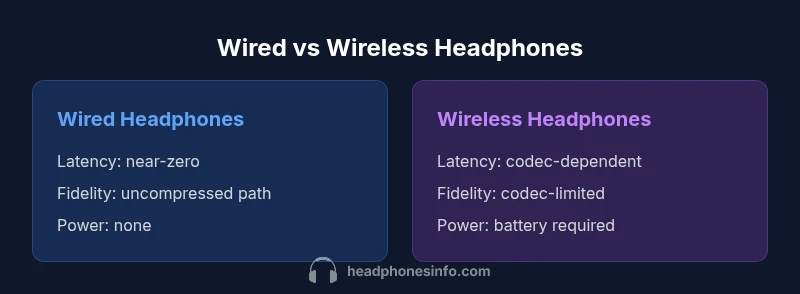
| Latency | Near-zero latency; ideal for synchronization | Variable latency depending on Bluetooth version and codec |
| Audio Fidelity | Typically uncompressed signal path; potential for higher fidelity | Quality depends on codec; some compression artifacts possible |
| Power/Battery | No battery required; powered by source | Requires battery/charging; potential degradation over time |
| Durability & Reliability | Fewer components to fail; robust cable designs possible | Wireless modules and batteries introduce additional failure points |
| Cost Over Time | Lower ongoing costs; no battery replacements | Potential ongoing costs for batteries, dongles, or replacements |
| Compatibility | Broad compatibility with adapters; classic analog jacks | Device compatibility depends on codecs and wireless stack |
| Portability & Convenience | Cable management adds bulk; often less convenient for travel | Wireless offers mobility and clutter-free pockets |
Upsides
- Stable audio quality with no codec-induced artifacts
- No battery anxiety; simple plug-and-play use
- Long-term value with replaceable cables and durable builds
- Broad compatibility across devices and platforms
Disadvantages
- Cables can restrict movement and portability
- Cable wear and tangling can annoy users over time
- Less convenient for truly wireless, on-the-go use
Wired headphones win for fidelity and timing; wireless excels in convenience and mobility
If precision and timing matter, choose wired headphones. If you prioritize freedom of movement, consider wireless, but expect some trade-offs in latency and potential compression.
People Also Ask
Are wired headphones better than wireless for studio use?
In most studio contexts, wired headphones are preferred due to consistent frequency response and no codec-induced compression. The reliable signal path helps with accurate monitoring and mixing. Wireless options can introduce latency and variability that complicate professional work.
Yes—wired is usually the go-to for studio work because it gives you consistent, uncompressed sound without delays.
Can wired headphones work with phones without adapters?
Many phones no longer include a 3.5mm jack, so an adapter or USB-C/Lightning DAC may be required. If your phone lacks a jack, you’ll need an appropriate dongle to use wired headphones. Some newer phones support USB-C or Lightning audio natively with compatible headphones.
You might need an adapter or a DAC, depending on your phone.
Do wired headphones always sound better than wireless?
Not always; it depends on the model and the codec used in wireless transmission. High-quality wireless systems can approach wired performance, but wired paths typically preserve dynamics and timing more consistently.
Depends on the model, but wired often stays ahead for fidelity and timing.
What should I look for when buying wired headphones?
Check impedance, sensitivity, and driver type; ensure the cable is durable or detachable; verify jack compatibility with your gear; consider comfort and build quality for long listening sessions.
Look for impedance, driver type, and a durable or detachable cable.
How durable are wired headphones in daily use?
Durability depends on build quality and cable design. Detachable cables reduce wear on the connector, and careful storage minimizes kinks. With proper care, wired headphones can last many years.
Durable if you choose well-built cables and store them properly.
Are there myths about wired headphones that I should ignore?
Common myths include that all wired gear is outdated or that cables always impede mobility. In reality, wired designs can offer superior fidelity and timing, while modern cables and connectors improve practicality.
Some myths say wired is outdated; in truth, wired can offer the best fidelity and timing.
How should I begin a wired headphones purchase?
Start with your primary use case, then compare key specs (impedance, driver type, cable design). Read reviews focusing on build quality and comfort, and try to audition models if possible.
Define use-case, compare specs, and consider comfort when buying.
What to Remember
- Prioritize wired for studio work and competitive gaming
- Expect near-zero latency and stable amplification with wired gear
- Cable quality and jack compatibility affect long-term value
- Wireless offers convenience but may incur codec and latency trade-offs