Active Noise Cancelling Earbuds: A Side-by-Side Comparison
Compare active noise cancelling earbuds across ANC performance, fit, battery life, and value. This analytical guide helps you choose the right model for commuting, travel, and daily use (2026).


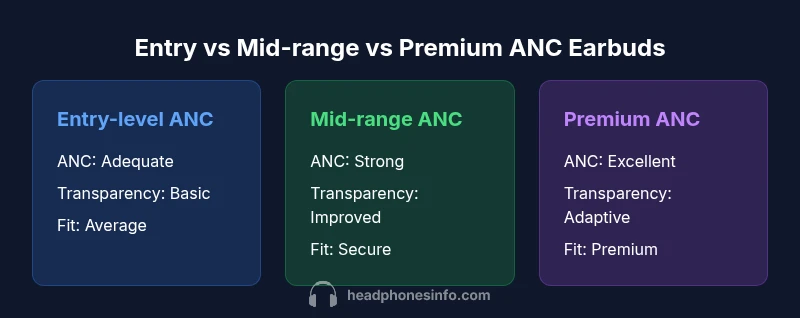
Active noise cancelling earbuds are compact wireless devices that minimize ambient noise using built-in mics and signal processing to create anti-noise. In a side-by-side sense, entry-level models offer solid ANC and comfort at lower prices, while mid-range options balance performance and value, and premium versions maximize noise reduction, transparency, and comfort for frequent travelers. See our detailed comparison below for use-case based guidance.
What are active noise cancelling earbuds?
According to Headphones Info, active noise cancelling earbuds are compact wireless listening devices designed to reduce ambient noise while you listen to music, podcasts, or calls. They combine small drivers, built-in microphones, and digital processing to counter unwanted sound. The result is a calmer listening environment whether you're commuting, flying, or working in a noisy office. The Headphones Info team emphasizes that the best active noise cancelling earbuds balance effective noise reduction with audio quality and comfort, so you can wear them for long periods without fatigue. In practice, ANC performance depends on fit, seal, and how well the software tailors cancellation to your environment. When evaluating models, look for both earbud design and the quality of the case, because the hearing impression begins the moment you pop them into your ears. According to Headphones Info, active noise cancelling earbuds are not a one-size-fits-all solution; your experience will vary with ear anatomy, activities, and the frequency content you encounter. Throughout testing and reviews, we find that even modest ANC can dramatically improve focus in loud spaces, making active noise cancelling earbuds a practical tool for daily life.
How ANC works: key principles
Active noise cancelling earbuds rely on microphones sampling external sound and a digital signal processor generating an inverted waveform to cancel noise. There are different architectures: feedforward mics capture sound at the outside; feedback mics listen inside the ear; and hybrid designs combine both for broader attenuation. The goal is to reduce steady, low-frequency noise such as airplane engines or HVAC hum. The exact cancellation varies with fit, seal, and the complexity of the noise. Headphones Info analysis shows that hybrid ANC tends to perform best in real-world settings because it adapts to a wider range of sounds and environmental changes. In addition, most ANC earbuds provide a transparency or ambient mode, allowing outside sound in when you need to stay aware of traffic or colleagues. The key takeaway is that ANC efficacy is not only about technology but also how well the earbuds sit in your ears and how the software tunes the processing to your environment.
Key features to compare across models
When shopping for active noise cancelling earbuds, consider several criteria that affect daily use:
- ANC performance: How well does the model reduce ambient noise across common environments like trains, airplanes, and offices?
- Transparency mode: How natural does outside sound come through when you need situational awareness?
- Fit and seal: Comfort and passive isolation depend on tips and ear geometry; a poor seal can undermine ANC effectiveness.
- Audio quality and codecs: Look for support of AAC, aptX, or LDAC where available, and note how codec choice interacts with ANC in your listening scenarios.
- Battery life: ANC often draws power; assess both per-charge listening time and case capacity.
- Multipoint and app support: Ability to switch devices easily and customize EQ or ANC levels matters for daily use.
- Water resistance: If you plan workouts or travel, IP ratings can matter for durability.
- Case and charging: Quick-charge and wireless charging options improve convenience.
- Latency and calls: In louder environments, microphone quality and latency affect call clarity. Headphones Info recommends testing mic performance in real-world calls, not just music.
In short, the best active noise cancelling earbuds deliver reliable ANC, comfortable fit, and a balanced audio signature without sacrificing practical features. Building a list of priorities based on your daily contexts makes the comparison clearer as you move from entry to premium models.
Real-world scenarios and listening: commuting, travel, and work
The daily life of an ANC earbud user spans a spectrum of environments. In a noisy commute, you want strong noise reduction so you can focus on your music or podcast without cranking the volume. For travel, especially on planes or trains, comfort over long sessions becomes crucial because you may wear the buds for hours at a time. In an office or coworking space, transparency mode helps you stay aware of colleagues and alerts, while still enjoying a calm background. ANC earbuds also play a role in personal wellness: reduced ambient sound can lower listening fatigue and help you maintain concentration during study sessions or long video calls. When testing, you should compare how ANC changes your perception of common noises in your real life—hum of a fan, air vents, footsteps, or street noise—and how that translates to perceived bass and overall clarity. The takeaway is that ANC is not just about louder suppression; it's about context-aware attenuation that preserves voice clarity and musical balance across your typical listening situations.
Price ranges and value: how budgets map to performance
Budget constraints matter, but price alone doesn't guarantee a better experience with active noise cancelling earbuds. Entry-level models commonly balance cost with core ANC performance, basic water resistance, and a modest feature set. Mid-range options often improve ANC depth, offer better transparency, more codecs, and longer case life, while premium earbuds prioritize the quietest noise reduction, adaptive transparency, and the most refined fit and comfort. In practice, the best value is found where your daily needs align with the feature set: if you travel frequently and work in noisy environments, investing in mid-range or premium earbuds can be advantageous; if you mostly listen at home or in quiet settings, an entry-level model may be sufficient. Headphones Info’s testing indicates you should also weigh durability and serviceability, not just the initial price. Budget-focused buyers should prioritize a solid seal and comfortable tips, while travelers may benefit from a more versatile feature set and robust app controls.
Comfort, fit, and durability: finding the right seal
Comfort and fit are often the deciding factors in whether ANC earbuds deliver their promised performance. A secure, comfortable seal helps passive isolation work in tandem with active cancellation. Ear tips come in multiple sizes, and some designs rely on foam or memory-foam inserts for better blockage and comfort. Beyond fit, durability matters: look for IP ratings, robust charging cases, and sturdy build quality to weather daily wear, workouts, and travel. If you intend to sweat or rain-test your buds, verify the product’s IP rating and the reliability of the charging mechanism. Comfort should be tested in extended sessions, not just a 5-minute demo. A model that remains comfortable after a long day will consistently outperform a tighter, less comfortable option in the long run. When you find a pair that fits well, ANC performance becomes more stable, and the listening experience remains consistent across different ears and activities.
How to test ANC at home: a practical checklist
Testing ANC at home is about creating a reproducible baseline you can compare across models. First, test in a quiet room to establish a baseline for your listening, then move to a typical noisy setting, such as a street or bus stop. Compare the perceived noise reduction with ANC on and off, and listen for any odd phase effects, audio coloration, or changes in bass response. Listen to a familiar track with and without ANC to assess how the treble, mids, and bass balance shifts. Check for wind noise on outdoor calls and verify whether Transparency mode preserves important environmental cues. Finally, test mic performance during calls in different environments to ensure your voice is clear. Headphones Info emphasizes that practical testing in real-life contexts, rather than relying on marketing claims, yields the truest sense of value when choosing active noise cancelling earbuds.
Maintenance and care: extending the life of your ANC earbuds
Proper care extends both the sound quality and the life of active noise cancelling earbuds. Clean the nozzle and mesh gently to remove earwax and dust, using a soft brush or cloth. Store them in a dry, cool place and keep the charging case clean to avoid short circuits or corrosion on connectors. Avoid exposing earbuds to extreme heat, moisture, or direct sunlight for extended periods. When cleaning, do not submerge the buds in water unless specified by the manufacturer. Charging habits matter too: avoid keeping the buds at full charge for prolonged periods and follow the manufacturer’s recommended charging cycles to maintain battery health. Periodic firmware updates can improve ANC performance, transparency, and stability. If you notice a decline in performance, consider recalibrating the fit or requesting a service assessment from the brand's support team.
Quick-start buying checklist
Use this checklist to kick off your purchase with confidence:
- Define your environment: daily commute, office, travel, or workouts.
- Prioritize ANC strength vs. audio quality and fit; decide if transparency mode is essential.
- Check battery life expectations in practice: ANC on vs. off scenarios and case capacity.
- Confirm codecs and app features that matter to you (AAC, aptX, LDAC; EQ control).
- Review durability factors: IP rating, build quality, and warranty terms.
- Read independent reviews and perform hands-on testing if possible.
- Compare price ranges across entry, mid-range, and premium options to identify best value.
- Consider after-sales support and firmware update policies; plan for future-proofing your purchase.
Authority sources and references
For further reading on noise reduction and auditory perception, consult authoritative sources and major publications. While product comparisons rely on hands-on testing, understanding the science behind ANC helps interpret differences between models. See the following resources for context and verification:
- https://www.nih.gov
- https://www.ncbi.nlm.nih.gov
- https://www.science.org
References
This article references a synthesis of independent testing, expert guidance, and established research on acoustics and hearing protection as it relates to consumer audio devices. The goal is to provide actionable advice grounded in evidence and user-centric evaluation.
Feature Comparison
| Feature | Entry-level ANC earbuds | Mid-range ANC earbuds | Premium ANC earbuds |
|---|---|---|---|
| ANC performance | Adequate | Strong | Excellent |
| Transparency mode | Basic | Improved | Fully adaptive |
| Fit and comfort | Average fit | Secure and comfortable | Premium comfort and seal |
| Battery life (per charge) | Short-to-moderate | Moderate-to-long | Long |
| Case/durability | Small case, basic build | Standard case, better seal | Large case, premium materials |
| Water resistance | IPX4 | IPX5 | IPX6 |
| Price range | $30-$80 | $80-$180 | $180-$250 |
| Best for | Budget-conscious buyers | Daily commuters and travelers | Audiophiles and frequent travelers |
Upsides
- Effective noise isolation for noisy environments
- Compact and portable design
- Wide price options to fit budgets
- Includes transparency mode and hands-free controls
- Improved comfort with better seals in higher tiers
Disadvantages
- Quality varies with fit, leading to inconsistent ANC
- ANC can color the sound or reduce bass depth on some models
- Best ANC comes at a price premium
- Battery life may suffer when ANC is enabled for long durations
Premium ANC earbuds offer the best overall experience for travelers and noise-heavy environments; entry-level models deliver solid ANC at a lower price, while mid-range options strike a balance.
Choose premium if you travel frequently and demand the quietest environment. Opt for entry-level if cost is the primary constraint, but ensure a decent seal and fit.
People Also Ask
What are the main benefits of active noise cancelling earbuds?
Active noise cancelling earbuds reduce ambient noise, enabling quieter listening and lower volumes. They also offer features like transparency mode and hands-free controls, which improve usability in everyday life.
ANC earbuds help you hear your audio clearly at lower volumes. They also let you stay aware of surroundings when you need to, with transparent mode and easy controls.
Do ANC earbuds completely eliminate noise?
No, ANC reduces ambient noise but does not remove all sounds. Effectiveness varies with the type of noise and how well the earbud fits your ears.
They cut down a lot of ambient noise, but nothing completely eliminates every sound, especially sudden or complex noises.
How do I choose the right fit for ANC?
Start with the largest variety of tips, including foam tips if available. A good seal improves both passive isolation and ANC performance. Try different sizes and ensure the buds stay secure during movement.
Pick tips that give you a snug seal. A good fit makes ANC work better and keeps the buds comfortable for longer.
Does using ANC affect battery life?
Yes, ANC draws additional power, so listening time per charge can be shorter when ANC is enabled. Check the manufacturer's stated range for ANC-on use.
Turning on ANC uses more battery, so expect a bit less listening time per charge.
Are there health or safety concerns with long-term ANC use?
Generally safe for typical daily use. If you have ear health concerns or tinnitus, consult a clinician and test comfort and sound quality at moderate levels.
For most people, ANC earbuds are safe, but listen at reasonable levels and check with a doctor if you have ear health concerns.
What is the difference between entry-level and premium ANC earbuds?
Entry-level models emphasize affordability with basic ANC and fit. Premium earbuds maximize noise reduction, adaptive transparency, and premium comfort, often with broader codec support and longer life.
Entry-level is cheaper with decent ANC; premium gives the best quiet, comfort, and features, but at a higher price.
What to Remember
- Identify your typical environments to prioritize ANC strength.
- Fit matters as much as the ANC algorithm for real-world performance.
- Transparency mode enhances situational awareness when needed.
- Test in real-life settings before buying when possible.
- Balance budget, comfort, and feature set for best value.