ANC Headphones Comparison: Noise-Canceling Showdown (2026)
A thorough, objective comparison of anc headphones, covering noise cancellation strength, comfort, battery life, codecs, and value. Learn how to pick the right model for travel, work, and daily listening with data-driven guidance from Headphones Info.


ANC headphones vary widely in ANC strength, comfort, and value. In short, choose a model with adaptive or hybrid ANC for the strongest suppression, good-fit comfort for long listening, and broad codec support for flexibility. For most users, mid-range options offer the best balance of performance and price; premium models push comfort, features, and sound quality higher. See our detailed comparison chart to pick the best fit for travel, work, or home listening.
How Active Noise Cancellation Works
ANC headphones rely on built-in microphones to capture ambient sounds, then generate an inverted signal to cancel. The result is an attenuation of external noise, especially the low-frequency rumble from engines or HVAC. There are three main architectures: feedforward, feedback, and hybrid. Feedforward mics are placed on the outside of the earcup; they respond quickly to certain noise types but can be less effective at blocking bass. Feedback mics sit inside near the ear and can compensate for what leaks in. Hybrid designs combine both approaches, often delivering the most consistent cancellation across frequencies. In practice, you’ll notice deeper suppression in cabins and trains, with residual noise at higher frequencies. It’s also common for ANC to be perceptible in windy conditions due to microphone sensitivity. For anc headphones, the tuning of the algorithm matters: two models may feel similar in suppression, yet one may sound brighter or more distant due to processing choices. According to Headphones Info, effective ANC hinges on design, microphone placement, and algorithm tuning.
ANC Technologies: Feedforward, Feedback, and Hybrid Designs
Understanding the core architectures helps demystify why two ostensibly similar headphones perform differently. Feedforward ANC uses microphones on the outer surface to sense the environment first, enabling rapid cancellation of constant rumbles. Feedback ANC places mics inside the cups, reacting to what actually reaches your ears. Hybrid designs blend both inputs, often delivering the broadest frequency coverage and the most stable suppression in varied environments. Each approach has trade-offs: feedforward can be vulnerable to wind noise, while feedback may react more slowly to sudden changes. Hybrid systems strive for consistency but can be more complex and power-hungry. For anc headphones, the choice often comes down to how the brand tunes the algorithms and how the physical design minimizes leak and resonance. In practice, test both styles in real-world settings to see which aligns with your listening habits.
Why ANC Performance Varies Across Environments
The effectiveness of noise cancellation is not a universal constant. In quiet offices, the difference between a good ANC pair and an excellent one can be subtle, while on a plane or train, the gap becomes more noticeable. Headphones with adaptive or hybrid ANC adjust to changing noise levels, delivering smoother attenuation across a broader spectrum. However, some environments—wind, air conditioning gusts, or high-pitched chatter—still leak through. This is where transparency modes and ambient-aware features matter: they let you hear the world when you need to. Headphones Info analysis shows that the perceived value of ANC often depends on your typical environment, fit, and how well you can customize the settings via a companion app.
What to Look for in a User-Focused ANC Model
When evaluating anc headphones, prioritize adaptability, consistent suppression, and comfort. Look for models that maintain ANC efficacy across multiple frequency bands and offer a transparent mode that stays clear when you need situational awareness. Battery life, fast charging, and intuitive controls affect daily practicality. Also check the fit: relatively even clamp force and soft earpads reduce fatigue during long listening sessions. Codec support matters for wireless quality, especially if you pair with high-fidelity devices. Don’t overlook app features: EQ, ANC sliders, and firmware updates can improve performance over time. In short, the best ANC experience balances strong suppression with long-lasting comfort and flexible connectivity.
Comfort and Ergonomics: Fit Matters for Long Listening Sessions
Even the most capable ANC headphones can feel tiring if they press too hard or sit uncomfortably on your head. Weight distribution, headband padding, and earcup geometry all influence comfort. Look for models with plush memory foam, breathable materials, and adjustable clamps to minimize pressure points. A secure, comfortable fit improves perceived noise cancellation, because leaks from gaps reduce efficacy. Consider the circumaural design and overall width to avoid pressure on the temples or jaw. If you wear glasses, factor in how the headband and earcups interact with the temples for comfort. In this arena, the right balance of weight and padding often trumps marginal gains in ANC depth, especially for all-day use.
Battery Life and Real-World Usage
Battery life for anc headphones varies with ANC on, codecs active, and volume level. In practice, most users will experience longer endurance than the minimum advertised numbers when ANC is used at moderate levels. Fast charging can help top up between commutes, while some models offer USB-C PD or wireless charging. Real-world stamina also depends on app features like transparency mode and spatial audio processing, which consume additional power. For travelers, a model with robust battery life and efficient standby performance can be a deciding factor. In any case, expect some trade-offs: the most aggressive ANC tuning may slightly reduce maximum battery life, while the leanest tuning may compromise suppression in louder environments.
Connectivity, Codecs, and App Support
A headphone’s wireless capability is more than just Bluetooth. Look for AAC or aptX/LDAC support for higher-quality streaming, especially if your source supports these codecs. Multipoint connectivity allows pairing with two devices simultaneously, a practical feature for switching between laptop calls and mobile music. App support matters: a well-designed companion app enables granular ANC control, adaptive modes, and firmware updates. If you rely on voice assistants, ensure the mic array handles calls clearly. For anc headphones, such details can dramatically affect perceived value, so test the fully featured model against your daily device ecosystem.
Transparency Mode and Ambient Awareness
Transparency or ambient modes let you mix in environmental sounds with music. This feature is essential for safe commuting and staying aware of surroundings. Some implementations are ring-fenced to a fixed percentage of ambient bleed; others offer adjustable levels or even adaptive transparency that responds to your activity. When evaluating anc headphones, try different transparency levels in busy spaces to see how natural voices and background noise sound. A smooth transition between ANC and transparency modes is a sign of thoughtful tuning and a better overall listening experience.
Use Cases: Travel, Office, Home, Gaming
Your most critical decision factor may be your primary use case. Travelers benefit from strong ANC and expansive soundstage; busy offices require comfortable wear and clear call quality; home listening calls for balanced sound with minimal fatigue; gamers look for low latency and precise mic pickup. Some models tailor their profiles to these scenarios, offering presets or adaptive tuning that shifts emphasis from pure suppression to overall sonic balance. Understanding your own needs and testing in realistic environments will help you choose anc headphones that excel where you spend most of your time.
Common Pitfalls and How to Avoid Them
Beware models that overpromise on ANC without delivering comfort or consistent performance across sources. A strong bass boost can mask ANC weaknesses, while a glossy finish might wear down with daily use. Avoid headphones that require constant software tweaking to reach acceptable performance. Instead, seek a balanced product that works well out of the box and receives timely firmware updates. Finally, don’t overlook portability: a bulky pair may provide better sound, but you’ll sacrifice convenience for travel or commuting. In short, prioritize consistent ANC, comfort, and real-world usability over dazzling specs on the box.
Maintenance, Care, and Longevity of ANC Headphones
Maintaining ANC headphones extends their life and keeps the performance stable. Regularly clean the pads and grilles with a soft cloth, avoid moisture, and store them in a case when not in use. Check for mic blockages and ensure the headband adjustment mechanisms stay smooth. Firmware updates can also improve ANC performance and fix bugs that degrade experience. If you notice a drop in suppression, verify seals, lid fit, and cable connections if your model uses a detachable cord. Proper care helps preserve comfort, sound quality, and battery reliability over time.
How to Test ANC Headphones Before You Buy
Testing anc headphones in-store or during a trial period can save you from buyer’s remorse. Try on the headset, walk through a noisy environment, and switch between ANC modes. Listen for wind noise, if any, and compare suppression while music is playing. Pay attention to the transition between ANC and transparency modes and check for any audible artifacts. If you have a trusted test track, use it for consistency across models. Finally, verify comfort with extended wear and ensure your typical devices pair cleanly with the headphones you’re considering.
Comparison
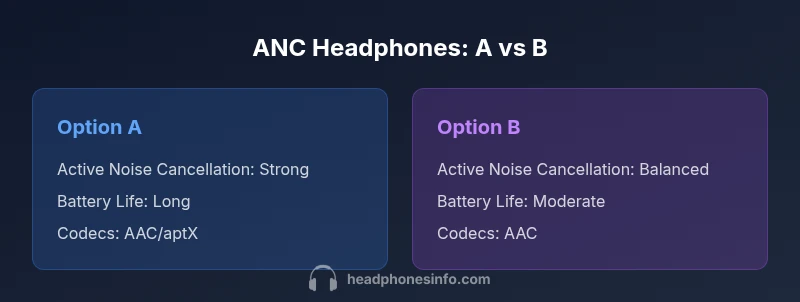
| Feature | Option A | Option B |
|---|---|---|
| Active Noise Cancellation | Strong adaptive ANC across most environments | Balanced ANC with good suppression in quiet environments |
| Battery Life & Charging | Long, all-day use typical | Moderate, shorter-than-average battery |
| Comfort & Build | Ergonomic with plush cushions | Slimmer profile with lighter weight |
| Codecs & Connectivity | AAC/aptX/LDAC; multi-point | AAC/SBC; basic multipoint |
| Price Range | $120-$260 | $250-$420 |
| Best For | Travel and open-plan offices | Audiophiles and long sessions |
Upsides
- Strong noise cancellation across diverse environments
- Good battery life for daily use
- Comfortable fit for long listening sessions
- Broad codec support and reliable Bluetooth pairing
Disadvantages
- Higher price compared to non-ANC headphones
- ANC may cause listening fatigue or pressure for some users
- Requires charging and may degrade over time
Mid-range to premium ANC headphones offer the best overall balance of suppression, comfort, and value
Choose ANC headphones with adaptive or hybrid cancellation for strongest suppression, but ensure comfort and codec support meet your device ecosystem. The Headphones Info analysis suggests prioritizing models with consistent ANC and long-term reliability over flashy but narrow feature sets.
People Also Ask
What is active noise cancellation (ANC) and how does it work?
ANC uses microphones to capture ambient sounds and generates an inverted signal to cancel them out. Most models employ a mix of feedforward, feedback, and hybrid processing to target different frequencies. The result is reduced external noise, especially low-frequency rumble, enabling clearer listening in busy environments.
ANC uses tiny microphones to “listen” to the surroundings and then play the opposite sound to cancel it out. It’s most effective on low-frequency noises like engines and air conditioning.
Are ANC headphones good for calls?
Many ANC headphones include a dedicated microphone array and wind noise reduction to improve voice pickup during calls. While ANC can slightly affect microphone sensitivity, quality models balance noise suppression with clear voice transmission. If call quality is a priority, check mic specs and test in real-world calls.
They can be good for calls, but you’ll want to test the mic with your typical speaking voice in a quiet and noisy setting.
Does ANC work well with eyeglasses or during travel?
Wearing glasses can introduce gaps that reduce seal and ANC effectiveness, but modern ANC headphones are designed to minimize this issue. On planes or trains, adaptive or hybrid ANC tends to perform best due to changing noise profiles. If you travel often, prioritize models known for stable ANC across environments.
Glasses can affect fit, but many ANC headphones handle it well; try before buying.
What should I test when evaluating ANC in-store?
Test ANC by simulating real-world scenarios: a noisy environment, a calm room, and a transition between ANC and transparency modes. Listen for artifacts or wind noise and note how smoothly the mode shifts. Also verify comfort and fit during extended listening.
Bring a noise source and check how well the headset cancels it and how it feels after a while.
How important is battery life for ANC headphones?
Battery life matters for portability and uninterrupted use. ANC drains more power than passive listening, especially with high volumes or advanced codecs. Look for real-world endurance, fast charging options, and standby performance to make sure the headphones fit your daily routine.
Battery life matters if you travel or commute a lot; check tests or reviews for real-world numbers.
What to Remember
- Prioritize adaptive or hybrid ANC for best all-around suppression
- Choose a comfortable fit for long listening sessions
- Ensure codec support matches your devices
- Test transparency mode for awareness when needed
- Evaluate real-world performance in travel, office, and home environments