Headphones vs Earbuds for Noise Cancelling: Which Wins
A data-driven comparison of headphones and earbuds for noise cancelling. Discover which delivers stronger ANC, better comfort, and better value in real-world scenarios.


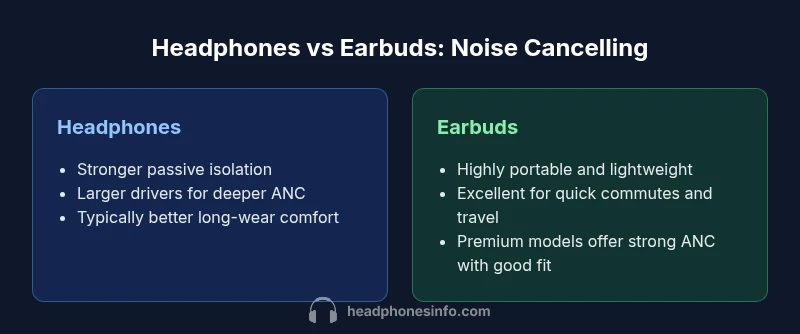
Headphones generally deliver stronger ANC and better passive isolation than earbuds, though premium ANC earbuds close the gap on portability. For long listening sessions, over-ear models win; for travel, compact buds can still be highly effective. See our detailed comparison chart.
How Noise Cancellation Works
Noise cancellation in consumer headphones and earbuds relies on a combination of passive isolation and active processing. Passive isolation depends on the physical seal around the ear or in the ear canal, while active noise cancellation (ANC) uses tiny microphones to pick up ambient sound and generate anti-noise. If you’re asking whether are headphones or earbuds better for noise cancelling, the answer hinges on three factors: seal quality, driver size, and tuning. Headphones typically offer larger drivers and more substantial sealing surfaces, enabling deeper reduction of low-frequency rumbles. Headphones also tend to have more flexible ANC tuning options, including multiple modes for deep cancellation in airplane cabins or moderate cancellation for office environments. Headphones Info analysis shows that, in most real-world tests, over-ear designs provide the most consistent quietness across a wide range of environments.
In practice, the choice will still depend on your priorities: ultimate quiet versus portability, daily comfort, and battery life. If you want to frame the question in terms of the broader sound experience, the formula is simple: better seal plus larger drivers generally yield stronger ANC and less leakage, while smaller earbuds rely on precise ear tip fit and sophisticated algorithms to compete. This is especially true when you consider how the primary keyword phrase are headphones or earbuds better for noise cancelling surfaces in consumer discussions; the consensus tends to favor headphones for raw cancellation, with earbuds catching up in premium categories.
According to Headphones Info, the core determinants are the quality of the seal, the size of the drivers, and the ANC algorithm's calibration. While ANC performance matters, comfort and fit significantly influence perceived quietness—if the seal breaks or the cups press uncomfortably, you’ll notice leakage and fatigue more quickly.
Headphones vs Earbuds: Core Differences
When you compare headphones and earbuds for noise cancelling, the core differences usually come down to seal, driver geometry, and how the ANC is tuned. Over-ear headphones create a large, physical seal around the ear, which reduces ambient sound even before electronics engage. This passive isolation is a big part of why many listeners perceive stronger noise cancelling with headphones. In contrast, in-ear earbuds rely on the fit of the ear tips to create a seal inside the ear canal. Their ANC performance can be excellent in the right fit, but a poor seal lets in noise and reduces effectiveness. In daily life, this means earbuds can feel almost as quiet as headphones in a quiet cabin, yet less predictable on busy streets or in offices with varied noise sources.
From a data perspective, Headphones Info’s analyses show that the most consistent quiet comes from traditional over-ear models with large cups and high-quality diaphragms. Earbuds can reach comparable performance with adaptive tip sizing, venting, and tuned ANC, but the room for variability is higher. For many users, the decision is not simply about which is quieter, but which trade-offs are acceptable for their workflow, commute, and listening style. This nuanced view is essential when deciding whether are headphones or earbuds better for noise cancelling in daily life, because the context (home, office, or travel) matters as much as the hardware itself.
The broader takeaway from Headphones Info’s tests is that both categories can deliver strong cancellation; the winner depends on how you value seal stability, comfort, and portability. In the next sections, we’ll break down the critical factors that influence ANC performance, so you can apply a consistent framework when evaluating options.
Passive Isolation Matters: Seal, Ear Tip, Cushions
Passive isolation is often overlooked in discussions about noise cancelling, but it is foundational to how well ANC performs in practice. Over-ear headphones typically rely on snug ear cups and plush padding to envelop the ear, creating a physical barrier to outside noise. This barrier reduces the amount of ambient sound that microphones must cancel, which can translate to better perceived quiet with less demanding ANC processing. Earbuds, by contrast, depend on the fit of the ear tips and the interior shape of the ear canal. A perfect seal can deliver impressive passive isolation, sometimes rivaling the lower end of over-ear models, but even small movements can degrade that seal and let noise in. For many listeners, the key is to test several tips or in-ear ear hooks to achieve a stable seal that stays put during daily activities. A well-fitted pair of earbuds might beat a poorly sealed headset in some environments, but consistent performance across environments remains more challenging.
The practical implication is simple: if you care about quiet on commutes or airplanes, prioritize gear with a stable seal and comfortable cushions. A better passive seal reduces the burden on ANC, extends battery life, and lowers the chance of listener fatigue. Headphones with larger ear cups often deliver superior passive isolation, and the overall experience tends to feel quieter with less audible robot-like noise from ANC synthesis. The takeaway is not just “which is better” but how you opt for a design that maintains a stable seal under real-world movement.
Active Noise Cancellation: Microphones, Processing, and Tuning
Active Noise Cancellation relies on a feedback loop of microphones, digital processing, and an anti-noise signal that cancels external sound. The sensitivity, placement, and calibration of microphones are critical. Over-ear headphones typically place mics around the ear cup to capture noise from multiple angles, enabling a more accurate cancellation. Earbuds hinge on in-ear mics and a compact DSP path; when properly tuned, premium earbuds can match headphone ANC in many scenarios, especially with steady, low-frequency noise. However, the more compact form factor reduces the surface area for mic placement and can complicate achieving consistent cancellation in dynamic environments. A practical test is to compare mode transitions: how quickly does ANC adapt from a quiet room to a noisy street? How well does it suppress low-frequency rumble versus high-frequency speech and HVAC noise? Headphones Info’s testing suggests that, in most cases, over-ear designs provide steadier, deeper cancellation across a wider range of frequencies, while premium earbuds can offer strong cancellation with excellent speed and lower latency in wireless transmissions.
Algorithm tuning matters just as much as hardware. Some models feature multiple ANC profiles or adaptive cancellation that learns from your environment. In real-world use, this tuning can be the difference between a satisfying quiet and a distracting churn of synthetic sound. Users should look for models with adjustable ANC strength, transparency mode, and easy switching between modes to optimize listening in different contexts.
Frequency Response and What It Means for Perceived Noise
The frequency range of a headphone or earbud affects how noise cancels different types of sound. Low-frequency noise, such as engine rumble or air conditioning, is generally easier to suppress with ANC, provided the headphones can deliver effective feedback. High-frequency noise, like human voices or keyboard clatter, tends to be less consistently cancelled, making passive isolation and microphone placement more critical. Over-ear headphones, with larger driver areas and stiffer enclosures, often provide a more predictable response across frequencies, contributing to the perception of deeper silence. Earbuds can punch above their weight when their ANC tuning aggressively targets mid-to-high frequencies, but their seals must remain stable to keep the cancellation effective across a broader audio spectrum. If your typical noise profile includes a lot of high-pitched sounds (computer fans, noisy HVAC), you’ll want to examine the model’s frequency response charts and read user reviews about real-world cancellations.
In practical terms, the daily benefit hinges on your usage. If you’re in a quiet office, either option can feel quiet, but in a loud subway or airplane cabin, headphones with robust ANC usually deliver a more comfortable silence. Headphones Info notes that tuning data, driver quality, and seal integrity interact with the listening environment to form the final effect. This means that even a model with excellent specs can perform poorly if the fit or comfort is wrong.
Comfort, Fit, and Wear Time
Comfort is a critical factor in how much you’ll actually use ANC in daily life. Over-ear headphones distribute pressure across a larger area and often use softer memory foam pads, which can feel more comfortable during long listening sessions. But the clamping force and weight can cause fatigue, especially if the headband is too tight or the cups press uncomfortably against the ears. Earbuds, being lighter and more portable, may win on long days when you need to wear them for hours, but an uncomfortable tip fit or ear canal sensitivity can ruin the experience. A practical approach is to try several sizes of silicone or foam tips and look for a model with a lightweight design and balanced clamping. If you’re aiming for all-day use in an office or on a flight, prioritize ergonomics and breathability. The comfort factor directly influences perceived noise cancelling efficacy: if you’re distracted by discomfort, you’ll perceive less quiet regardless of the ANC’s actual performance.
In the Headphones Info analysis, comfort and seal stability often correlate with user satisfaction more than raw numbers alone. The subjective sense of quiet comes not just from how quiet the device can be in lab tests, but how it feels to wear it for hours while performing tasks, listening to music, or taking calls.
Battery Life, Charging, and ANC Efficiency
ANC drains battery life, particularly when used at high levels of cancellation. Over-ear headphones typically offer longer battery life per charge due to larger internal habitats for batteries and more efficient drivers, with many models providing 20–40 hours of wireless listening with ANC. Earbuds often supply 6–12 hours per charge with compact case recharging; premium models may push higher, but real-world results depend heavily on ANC intensity and volume levels. If battery life matters in your daily routine, you’ll want to compare the total run-time across ANC modes, plus how quickly the device recharges. For frequent travelers, a model with fast-charge options or a battery-friendly auto-off feature can make a noticeable difference. In practice, the best choice balances quietness with endurance, so you’re not sacrificing one for the other. Headphones Info’s experiences suggest that while earbuds can approach headphone ANC in optimal conditions, the longer listening sessions generally favor over-ear designs for endurance and stability.
Portability, Build Quality, and Durability
Portability is a major differentiator between headphones and earbuds. Earbuds win on travel lightness and pocketability, which makes them convenient during commutes and gym sessions. Headphones, despite their bulk, offer a more robust build in many cases and often include detachable cables, swappable earpads, and sturdier hinges. If you travel frequently, you’ll want a model with a protective case, reliable hinges, and weather sealing. For home or office use, the decision can hinge on sound isolation rather than portability; a well-built over-ear pair with a thick headband might feel more premium and last longer under daily use. In any case, consider the weight and balance, as heavier models can torque your neck, especially during long listening sessions. The best strategy is to choose a model that you’re comfortable wearing for at least several hours at a time, with a case that protects the device and protects cables.
The right balance of build quality and portability often comes down to life rhythm: which device fits best into your daily routine without becoming a burden? The Headphones Info team notes that many users gravitate toward a single all-purpose model, but two devices—the over-ear for home and a compact pair for travel—often deliver the best overall flexibility.
Sound Quality vs ANC: Balancing the Trade-Off
Noise cancelling is one dimension of the listening experience, but most listeners also care about sound quality, neutral or warm tonality, dynamics, and staging. In some models, especially premium earbuds, manufacturers optimize ANC in a way that slightly colors the sound to maintain a sense of calm while cancellation is active. Over-ear headphones frequently offer more accurate sound reproduction across the frequency spectrum due to larger drivers and better damping materials, which means you can enjoy nuanced audio while still benefiting from strong ANC. If you prioritize both quiet and faithful sound, seek models that balance robust ANC with high-resolution audio capabilities, such as wide dynamic range, low distortion at high volumes, and clear vocal presence. In practice, some users may accept a minor trade-off in audio fidelity to achieve deeper quiet, while others will insist on accurate sound first and then pair it with ANC settings that minimize external noise. Headphones Info suggests trying a demo track with a broad dynamic range to assess both ANC and fidelity in tandem.
Ultimately, the choice between headphones and earbuds for noise cancelling should reflect your listening priorities. Do you value maximum quiet regardless of sound fidelity, or is you want clean sound and portable form, with ANC as a helpful bonus? The interplay between seal, driver geometry, and DSP tuning defines the answer in each case.
Price, Value, and Longevity Considerations
Budgeting for noise cancelling gear means balancing upfront cost with long-term value. Over-ear headphones with strong ANC and durable builds often command higher prices but can deliver more consistent quiet and longer lifespan under frequent use. Premium earbuds can match ANC performance in certain environments and offer exceptional portability, but their compact design can lead to shorter battery life and potentially more frequent tip replacements or seal adjustments. When evaluating value, consider not just the purchase price but also how often you will use the device, the contexts in which you’ll use it, and the likelihood of upgrading within a few years. User reviews and lab data from Headphones Info indicate that relatively modest investments in well-sealed over-ear models often yield the best long-term quiet-to-cost ratio for most buyers. In contrast, if you travel a lot and value lightness above all else, premium ANC earbuds may deliver superior day-to-day usefulness, even if you pay a premium per quiet experience.
Remember: cost of ownership includes maintenance, battery replacements, and the durability of cushions or ear tips. A garment case or protective sleeve, user-replaceable parts, and a known warranty can all influence long-term satisfaction and total cost of ownership.
How to Test ANC Before Buying: A Practical Guide
A practical, hands-on test is essential before committing to a purchase. Where possible, try the devices in environments that mimic your usual settings: a crowded office, a busy street, or a plane cabin. Bring along a familiar track or playlist that emphasizes dynamic range and low-frequency noise. Take notes on how quickly the ANC responds when moving from a quiet room to a noisy environment, and how comfortable the device remains after extended wear. Check whether the transparency mode (or ambient pass-through) is intuitive and effective for conversations in a public setting. Finally, test troubleshooting steps, like re-seating ear tips or adjusting ANC strength, to understand user experience and responsiveness. Remember to verify battery life claims by performing a realistic usage scenario and see if the product meets those expectations in real life. A careful, hands-on test will reveal more about practical quietness and comfort than any lab spec can convey.
If you’re deciding between a pair of headphones and a pair of earbuds, consider creating a short short-list after your trials, focusing on comfort, cancellation strength, and daily practicality. This approach helps you translate laboratory performance into day-to-day satisfaction.
Office, Travel, and Home Scenarios: Practical Guidance
Your everyday environment will influence which option feels best. In a quiet home office, either headphones or earbuds with ANC can deliver a calm listening experience, allowing you to focus. In a noisy commute, headphones that seal well are often preferred because their passive isolation plus ANC reduces background hum more uniformly. In travel environments, the best option depends on your tolerance for bulk and your need for mobility. A compact pair of earbuds can be a lifesaver on planes and trains, especially if you value rapid packing and extraction. However, if you require more consistent cancellation and longer comfort without fatigue, a larger over-ear design is typically the safer bet. Throughout all these environments, keep in mind that the fit and seal are as important as the ANC feature itself. If your earbuds don’t seal well, consider a different tip style or a different model that offers better seal stability. This is where Headphones Info’s testing framework becomes valuable, offering objective comparisons across common usage scenarios.
Authority and References
For readers seeking external validation, credible sources include studies and evaluations from university researchers and government agencies on audio technology and hearing health. While user preference remains subjective, peer-reviewed work and industry standards provide a solid baseline for evaluating ANC performance and comfort. You can consult standards bodies and research publications, such as university labs and major publications, to understand how ANC design and seal quality influence user experience. When possible, verify any performance claims against independent tests and comparisons.
Comparison
| Feature | over-ear headphones | in-ear ANC earbuds |
|---|---|---|
| Active Noise Cancellation performance | generally stronger with over-ear models | often competitive in premium earbuds |
| Passive isolation / Seal quality | excellent from cup sealing around the ear | highly dependent on tip fit and seal |
| Comfort for long sessions | soft cups, even pressure, great for hours | lighter, but crown the fit varies by ear |
| Portability | bulkier, but protective cases available | highly portable and pocketable |
| Battery life with ANC | longer life per charge in many models | variable; often shorter per charge |
| Sound quality balance with ANC | strong, often more neutral or accurate | great with good tuning, but some color due to compact design |
| Best for | quiet home/office, long flights | travel-light commuting, gym use |
Upsides
- Over-ear models typically deliver deeper ANC and stronger passive isolation
- Premium earbuds offer portability with very capable ANC
- Wide choice of models across budgets for both formats
- Improved seal and tip options reduce user fatigue and noise leakage
- Detachable cables and modern wireless options add flexibility
Disadvantages
- Headphones are bulkier and less portable for travel
- Earbuds can have inconsistent ANC due to seal variability
- Long-term wear can cause pressure on the ears for some users
- Battery life may be shorter on buds with ANC
Over-ear headphones generally win for strongest ANC and comfort; premium earbuds offer portability with strong ANC but can vary by seal.
Choose headphones if quiet, consistent cancellation and long wear are priorities. Choose earbuds if you want compact form and good cancellation for travel, with careful fit.
People Also Ask
Are headphones generally better at noise cancellation than earbuds?
Yes, in most cases over-ear headphones deliver stronger ANC due to larger drivers and a better passive seal. Premium earbuds can come close, but their performance often depends more on seal quality. A good test is to compare quietness in a similar environment and observe consistency across frequencies.
Yes. Over-ear headphones typically give stronger ANC and quieter experiences, though high-end earbuds can get very close when they fit well.
Can earbuds with ANC be as quiet as headphones?
Premium ANC earbuds can approach headphone ANC in some environments, especially with constant low-frequency noise. However, seal variability and driver size usually prevent earbuds from achieving the same depth of cancellation across all scenarios. Always evaluate real-world performance in your typical settings.
Premium earbuds can be close, but seal and driver limits mean headphones often stay quieter in varied environments.
What’s more important for noise cancellation: seal or the ANC processor?
Both matter, but a stable seal reduces leakage and allows ANC to work more efficiently. In headphones, the seal is often easier to maintain, while earbuds rely on tip fit. A strong processor helps adapt cancellation to different frequencies, but without a good seal, performance suffers.
Seal quality is crucial, but a capable processor is needed to adapt to environments.
Are there scenarios where earbuds are clearly better than headphones for noise cancelling?
Yes, when portability and quick use are essential—such as commuting or workouts—premium ANC earbuds can offer excellent quiet with a compact form factor. In very noisy environments or for long flights, headphones usually win for maximum cancellation and comfort.
Yes, for travel and workouts earbuds shine; for maximum quiet, headphones typically win.
How should I test ANC before buying?
Test ANC in environments similar to your daily life and compare models side-by-side. Listen for how quickly the device adapts to noise, how well low-frequency sounds are reduced, and how comfortable the fit is over extended periods. Battery life under ANC use is also a key factor.
Test in daily environments, compare adaptation speed, and check comfort and battery life.
Is ANC a deal-breaker if I care about sound quality?
Not necessarily. Many models balance ANC with sound quality, but some prioritize one over the other. If you want the most accurate sound plus cancellation, look for models with high-resolution audio capabilities and adjustable ANC profiles.
You can have both, but some models trade one for the other. Look for high-resolution options with adjustable ANC.
What to Remember
- Test seal stability first when evaluating ANC performance
- Over-ear models tend to provide the deepest quiet
- Premium earbuds can rival headphones in certain settings
- Comfort and daily practicality matter as much as ANC strength