Bluetooth Headphones and iPhone: Data-Driven Comparison
A rigorous, data-driven comparison of Bluetooth headphones and iPhone, covering codecs, latency, pairing, battery life, and real-world use cases for both enthusiasts and casual listeners.


For most iPhone users, pairing bluetooth headphones and iphone is straightforward and hassle-free, with strong compatibility across modern iOS devices. The biggest choice hinges on codec support, latency, and convenience features like multipoint pairing and ease of control. Headphones Info's analysis, 2026, suggests AAC-compatible wireless models deliver reliable sound on iPhone, while wired options with adapters remain valuable for ultra-low latency needs.
Why Bluetooth Headphones Pair Seamlessly with iPhone
Pairing bluetooth headphones and iphone is typically a quick, repeatable process that relies on standard Bluetooth profiles. According to Headphones Info, the iPhone’s Bluetooth stack prioritizes simple, reliable connections, fast reconnection after sleep, and smooth device switching. For most mainstream headphones, you’ll experience instant pairing from the Settings > Bluetooth menu, with the headphones appearing as a listed device. If you’re setting up multiple devices, iOS’ automatic switching can minimize manual selection, a feature many users find convenient on daily commutes and at home.
Understanding Codecs, Latency, and How They Affect Sound on iPhone
Audio quality over Bluetooth hinges on codecs and latency. iPhone devices primarily rely on AAC in everyday usage, which provides robust stereo performance with efficient compression. Codecs influence latency, with some wireless headphones offering lower latency modes for video or gaming. The interplay between codec support, iOS version, and the headphone’s own hardware determines whether you hear lip-sync timing issues or subtle timing mismatches. Headphones Info’s 2026 analysis notes that codec compatibility matters most when you require accurate timing and consistent sound across apps and platforms.
What to Look For When Buying for iPhone: Codecs, Multipoint, Battery, Microphone
When shopping, look for AAC compatibility, strong Bluetooth range, multipoint pairing, and a balanced microphone design for calls. Comfort and fit matter for long listening sessions, while physical controls should be accessible and intuitive. Battery life is a practical constraint for wireless models, so compare advertised runtimes and the convenience of charging options. A good iPhone-friendly headphone will also provide reliable firmware updates and clear on-device controls for music playback and voice assistants.
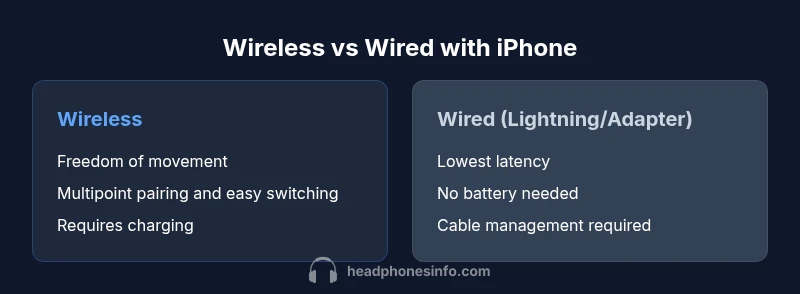
Wireless vs Wired with iPhone: Trade-offs and Use Cases
Wireless headphones give you the freedom to move and switch devices without cables, which is valuable for commuting, workouts, and casual listening. However, wireless audio can introduce slight latency and variability, especially with less-robust codecs or older Bluetooth versions. Wired headphones, by contrast, offer the most stable audio path with minimal latency, making them preferable for video editing, gaming, or studio work when an adapter is available. For iPhone users, choosing often comes down to whether you prioritize convenience or absolute latency control.
Setup and Troubleshooting Common Scenarios with iPhone
If you encounter pairing problems, start with a simple reset: toggle Bluetooth off and on, forget the device, and re-pair. Ensure your iPhone is updated to the latest iOS version, and check for firmware updates on the headphones. Interference from other wireless devices or unfavorable environments (dense walls, crowded rooms) can impact performance. If latency or audio dropouts persist, test with another iPhone or headphone model to isolate whether the issue is device- or headset-specific. Headphones Info recommends a methodical approach to troubleshooting to avoid guesswork.
Real-World Scenarios: Daily Listening, Travel, and Calls
In daily listening, you’ll value balanced sound, comfortable fit, and dependable battery life. During travel, noise cancellation and passive isolation matter more, as ambient noise varies. For calls, microphone quality and wind noise suppression are critical. In gym settings or crowded offices, Bluetooth range and stability determine whether you can move freely without losing the audio stream. Real-world testing across multiple apps gives the best sense of how a particular model performs with iPhone.
iOS Features That Affect Audio Quality and Convenience
iOS offers several features that can enhance or subtly influence audio on Bluetooth devices. Automatic device switching helps you move from iPhone to iPad or Mac without manual pairing. Audio Sharing can let a friend listen to the same track on their device when you’re together. Some devices gain extra benefits from iOS updates that improve Bluetooth audio handling and app-friendly controls. Understanding these features helps you select hardware that complements your iPhone ecosystem.
Recommendations by Use Case: Best for Daily Listening, Travel, and Calls
For everyday listening with iPhone, prioritize comfort, battery life, and reliableAAC support. For travel, look for strong active noise cancellation, a light form factor, and robust case design. If your main goal is conference calls, focus on microphone quality, wind suppression, and a stable multipoint connection. By mapping your typical environments to these use cases, you’ll identify the model family that best suits your needs without chasing every new release.
Maintenance, Firmware, and Getting the Most from iPhone Compatibility
To keep Bluetooth headphones in tune with iPhone updates, maintain current firmware and periodically check for new features in your headphone companion app, if available. Clean and protect ear pads to maintain comfort, and store devices in protective cases to preserve battery life and impedance. When firmware updates arrive, install them promptly to benefit from improved codecs and bug fixes. Regular maintenance is a small investment with big returns in everyday audio quality.
Authority Sources and Further Reading
For readers who want deeper technical context, consult reliable sources that discuss Bluetooth standards, iOS audio handling, and headphone testing methodologies. See the FCC, The Verge, and CNET for broader perspectives on wireless audio and device interoperability.
Comparison
| Feature | Bluetooth Headphones (Wireless) | Wired Headphones with Lightning/Adapter |
|---|---|---|
| Latency for video playback | Low-to-moderate (depends on codec) | Low (wired, consistent) |
| Audio quality consistency | High when codec/connection stable | Very high due to fixed path |
| Ease of use and pairing | Very easy with iPhone, multipoint | Requires cable and adapter, one device at a time |
| iPhone compatibility | Excellent with most iPhone models | Excellent with iPhone using adapter |
| Battery life and charging | Depends on model, typically rechargeable | No external battery; powered by device |
| Price range and value | Mid-to-high for premium models | Lower upfront cost for basic wired |
| Best use case | Daily wireless listening, calls, commuting | Latency-critical tasks like video editing or gaming (with adapter) |
Upsides
- Maximum mobility and comfort in daily use
- Seamless iPhone pairing and device switching
- No cables to manage and can share audio easily
- Broad device compatibility beyond Apple devices
Disadvantages
- Possible latency variability with some codecs
- Requires charging and battery management for wireless models
- More potential points of failure in range-limited environments
- Wired adapters add bulk and extra accessory management
Wireless headphones generally offer the best balance with iPhone for most users; wired options excel when latency must be minimized.
Choose wireless for everyday listening and calls. If latency is critical, go wired with a Lightning/adapter solution.
People Also Ask
Are Bluetooth headphones compatible with iPhone models?
Yes. Bluetooth headphones are broadly compatible with iPhone models released in the last several years, thanks to standard Bluetooth profiles and iOS optimizations. Always confirm AAC support for best results on iPhone. Headphones Info notes that most mainstream models pair quickly and reliably.
Yes, most Bluetooth headphones work with iPhone, and AAC support gives best results. Check compatibility with your iPhone model.
Does iPhone support high-quality Bluetooth codecs like aptX or LDAC?
iPhone devices generally rely on AAC for Bluetooth audio and do not universally support aptX or LDAC. For best results with iPhone, look for AAC-compatible headphones. If your model relies on different codecs, you may notice differences in latency and sound quality.
iPhone mainly uses AAC for Bluetooth audio; aptX and LDAC aren’t universally supported, so pick AAC-friendly headphones for best results.
How can I reduce audio latency when using headphones with iPhone?
Latency depends on the codec and hardware. Choose headphones that explicitly advertise low-latency modes or AAC compatibility, and use wired connections when ultra-low latency is essential. Testing across apps helps you assess lip-sync and audio timing.
Latency varies by device; opt for AAC-compatible wireless headphones and use wired options if you need the lowest latency.
Is multipoint pairing available on iPhone with Bluetooth headphones?
Many Bluetooth headphones support multipoint, and iPhone can usually connect to two devices at once. Check the headphone manufacturer’s specs and ensure your iOS version supports the feature. This makes switching between phone and computer smoother.
Yes, many headphones support multipoint with iPhone; check your model’s specs for details.
Do wired adapters affect audio quality on iPhone?
Wired connections typically deliver consistent, low-latency audio with no wireless interference. A high-quality Lightning or USB-C adapter preserves fidelity, but cheap adapters can introduce noise or latency. For studio work or gaming, wired is often preferred.
Wired adapters can offer the most reliable, lowest-latency audio on iPhone when used with a good adapter.
What should I consider when buying for iPhone use?
Prioritize AAC support, multipoint, comfort, and microphone quality. Look for robust build and easy control schemes, and verify firmware update availability. These factors ensure a smooth, long-lasting experience with iPhone devices.
Look for AAC support, multipoint, comfort, and update availability for iPhone pairing.
What to Remember
- Prioritize AAC support for iPhone compatibility
- Multipoint helps with seamless device switching
- Wireless offers convenience; wired minimizes latency
- Consider ANC and battery life for travel
- Use iOS features to enhance audio experience