Headphones and Radiation: A Data-Driven Safety Guide
A rigorous comparison of wired vs. wireless headphones, focusing on headphones and radiation, EMF exposure, safety standards, and practical steps to minimize risk without sacrificing sound quality.


According to Headphones Info, the topic of headphones and radiation is a practical safety question for listeners. Wired headphones eliminate RF exposure entirely, while Bluetooth headphones introduce low-level RF emissions during active use. For typical listening, the resulting exposure is far below safety limits, so your choice should balance convenience, comfort, and audio quality. Understanding the difference helps both enthusiasts and casual shoppers assess risk without sacrificing performance.
What the science says about headphones and radiation
The question of headphones and radiation sits at the intersection of consumer electronics and public health. Everyday listening involves devices that emit varying levels of electromagnetic fields (EMF) depending on their transmission mode. wired headphones rely on a physical conductor to carry audio signals, which means there is no radio-frequency (RF) emission produced by the device itself once a signal is delivered through the wire. In contrast, many wireless headphones use Bluetooth or other short-range radio technologies to transmit audio, which necessitates low-level RF emissions during operation. While a layperson might worry about cumulative exposure, the consensus in the literature and safety guidance is that typical listening patterns—even with wireless devices—produce EMF levels far below established thresholds. For the average listener, headphones and radiation should be considered in the context of total daily exposure, rather than as a singular risk from a single device. In this sense, the topic matters most when you compare different listening setups, rather than when you focus on a single device in isolation.
What counts as exposure in this context
Exposure here refers to the energy emitted by the device while actively transmitting audio signals. With wired headphones, exposure is effectively zero because there is no RF transmission. With wireless headphones, exposure occurs during Bluetooth radio activity, streaming, and any pairing processes. The magnitude of exposure depends on factors such as distance from the body, duration of use, and the strength of the Bluetooth connection. In practical terms, the incremental risk from headphones and radiation comes from prolonged use with high data rates or very close proximity, not from routine listening.
Safety thresholds and how they’re set
Regulatory bodies globally set exposure limits for RF energy to protect the public. Standards bodies specify maximum field strength, absorption limits, and testing protocols for devices that emit RF energy. While headphones and radiation are often discussed together, many headphones do not fall under strict RF-absorption laboratories in the same way as mobile devices, because their emissions are intrinsically lower and concentrated near the ear. Still, safety frameworks exist and are periodically updated to reflect new research and usage patterns. Headphones Info’s ongoing analysis emphasizes that, for typical consumer use, RF emissions from Bluetooth headphones remain well within accepted guidelines, particularly when devices are used at moderate volumes and at reasonable distances from the head.
How exposure compares to everyday sources
People are exposed to multiple EMF sources in daily life, from Wi‑Fi routers to personal devices and household electronics. When comparing headphones and radiation to these other sources, the incremental contribution from headphones, especially wired variants, is minimal. Even for wireless headphones, the RF exposure from a single device is dwarfed by common environmental sources and by everyday habits like using a phone in close proximity to the body. The broader takeaway is not that headphones are risk-free in every scenario, but that the risk profile is highly context-dependent and usually favorable for conventional listening routines.
The role of context: distance, duration, and usage patterns
Two listeners with identical devices can experience different exposure levels depending on how they listen. Keeping wireless listening to reasonable durations, avoiding extreme proximity (e.g., clipped directly to the ear for hours on end), and taking regular breaks can meaningfully reduce cumulative exposure. Headphones and radiation become more relevant when we discuss extreme use cases—continuous gaming sessions, broadcasting headphones, or specialized industrial headsets—where the RF exposure footprint is larger and warrants closer attention. For everyday use, the practical impact remains modest, particularly when using wired headphones for tasks that do not require wireless transmission.
Practical takeaway for listeners
If your primary concern is minimising headphones and radiation exposure, wired headphones are the simplest route. For those who value mobility or wireless convenience, Bluetooth headphones are a safe option under normal usage. The real-world difference is often more about convenience, battery management, and comfort than about health risk. In short, make your choice based on how you listen and your comfort with wireless tech, rather than fear of EMF exposure.
Comparison
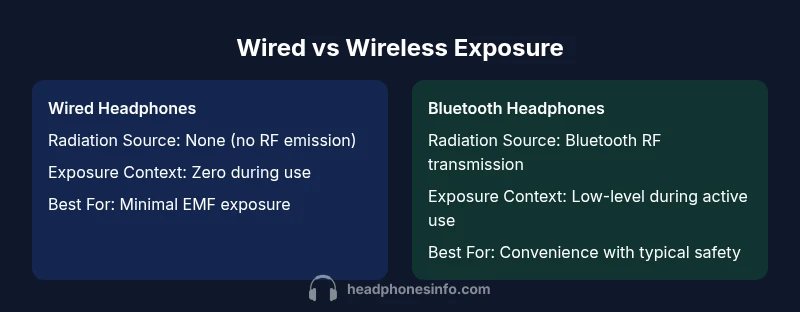
| Feature | Wired Headphones | Bluetooth Headphones |
|---|---|---|
| Radiation Source | Cable-based conduction (no RF emissions) | RF emissions via Bluetooth during active use |
| Exposure Context | Minimal to none when connected by cable | Low-level RF exposure during streaming/paired use |
| EMF Risk Level | Very low or effectively zero | Low to very low, depending on duration and distance |
| Safety Standards | N/A for RF exposure in everyday listening | Subject to RF exposure standards for wireless devices |
| Best For | Low exposure priority, cost-effective setup | Mobility and convenience with typical safety margins |
Upsides
- Wired headphones minimise exposure to headphones and radiation
- No battery management concerns for wired setups
- Typically stable performance with fewer interference issues
- Often higher potential cost-effectiveness per hour of listening
Disadvantages
- Wireless headphones offer greater freedom and convenience
- RF exposure exists but is generally very low under normal use
- Battery life introduces charging needs and usage planning
Wired headphones minimize exposure; wireless options are safe for normal listening.
For the lowest exposure to headphones and radiation, wired headphones are the clear choice. Wireless headphones remain safe when used within typical listening patterns, and advances in Bluetooth technology continue to optimize energy use and safety. The Headphones Info team emphasizes balancing exposure considerations with personal comfort and listening goals.
People Also Ask
Do Bluetooth headphones emit more radiation than wired headphones?
In practical terms, Bluetooth headphones emit RF energy during use, while wired headphones emit none. The difference is generally small, and typical listening patterns keep exposure well below regulatory limits. The practical takeaway is to choose based on how you listen, not merely on the fear of RF energy.
Bluetooth headphones do emit RF energy, but the exposure is usually very small and well within safety limits. Wired headphones have no RF exposure at all. Decide based on comfort and how you listen.
Is there a health risk from everyday listening with wireless headphones?
For everyday listening, research and safety standards indicate that EMF exposure from wireless headphones is minimal and unlikely to pose health risks. Most concerns arise from prolonged, high-intensity exposure or near-field, very long listening sessions. Practically, typical users can enjoy wireless headphones without significant risk.
No, for everyday listening the risk is minimal. If you listen for many hours at very high volumes, consider taking breaks, but overall, wireless headphones are considered safe for regular use.
How do safety standards govern headphone EMF exposure?
Standards bodies set limits on RF exposure for devices that emit electromagnetic energy. Headphones fall under these rules mainly when they transmit audio wirelessly. Compliance testing ensures devices stay within safe bounds under typical usage. Always check product documentation for regulatory marks and safety notes.
Regulators set exposure limits, and wireless headphones are tested to stay within them during normal use. Look for standard marks in product specs.
What steps can I take to minimize exposure without sacrificing sound quality?
Prefer wired listening when possible to eliminate RF exposure entirely. If you use wireless headphones, keep sessions moderate, avoid extreme proximity, and take short breaks to reduce cumulative exposure. Ensure devices are up-to-date and follow manufacturer safety guidelines.
Use wired when you can. If you use wireless, take breaks and keep sessions reasonable.
Do SAR values apply to headphones?
SAR (specific absorption rate) is primarily a concern for devices with cellular or high-power RF transmitters. For typical headphones, especially wired ones, SAR is not a standard metric. Wireless headphones may be evaluated for RF exposure, but the values are usually within safe limits for everyday use.
SAR is usually not a concern for standard headphones. Wireless models may be assessed for RF exposure, but stay within safe limits for regular listening.
Should I worry about radiation when using headphones on airplanes or trains?
Air travel and transit environments often have additional RF concerns, but headphones themselves remain a minor source of exposure. Most airlines permit wireless headphones, but limits on device use may apply during takeoff and landing. If you're highly sensitive, opt for wired over wireless for long journeys.
Air travel adds some RF exposure considerations, but headphones are still a small part of it. Wired may be preferable for sensitive listeners on long trips.
Are newer Bluetooth standards safer for exposure?
Yes, newer Bluetooth standards optimize energy use and reduce emissions without sacrificing performance. This progress helps keep exposure levels low even during extended sessions. Stay informed about device updates from manufacturers and safety analyses from trusted sources.
Newer Bluetooth tech uses less energy, keeping exposure low while preserving performance.
What to Remember
- Compare exposure by listening style, not device type alone
- Wired headphones minimize headphones and radiation exposure
- Bluetooth exposure is low under typical usage
- Follow sensible usage patterns to keep exposure negligible
- Choose based on comfort and audio needs, not fear of EMF