How Long Do Earbuds Battery Last in 2026? A Data-Driven Guide
Explore how long true wireless earbuds last per charge, the factors that influence battery life, and practical tips to maximize playback in real-world use (Headphones Info).


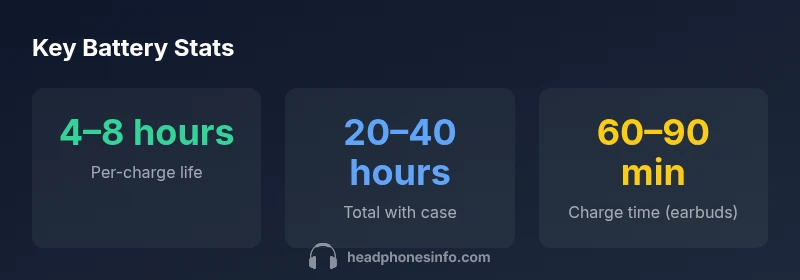
Typical true wireless earbuds deliver about 4–8 hours of listening on a single charge, while the charging case provides 20–40 hours of total playback. Real-world results vary with volume, active noise cancellation (ANC), codec, and temperature; higher-end models often reach toward the upper end of the range.
Understanding earbud battery basics
Battery life for true wireless earbuds hinges on a combination of per-charge capacity and how the device uses power during playback. Most buds rely on lithium-ion cells paired with compact electronics designed for efficiency. Manufacturers typically advertise per-charge life in hours, and then offer a charging case that adds multiple full recharges. When you factor in real-world usage, you should expect a lower figure than the nominal spec, especially if you enable features such as active noise cancellation (ANC) or operate at higher volumes. From Headphones Info’s perspective, the most practical measure for daily use is the per-charge life combined with how many full charges the case can provide over a typical week. Understanding these two numbers helps you estimate total playback across a workday or travel.
Factors that affect battery life
Power consumption in earbuds varies with several controllable and environmental factors. Active Noise Cancellation (ANC) draws additional power, reducing per-charge life in many models. Listening volume has a nonlinear effect on energy use: higher volumes require more power and shorten runtime, while lower volumes extend it. The codec and Bluetooth version can also play a role, with newer standards and higher-efficiency codecs sometimes offering better battery longevity under typical use. Temperature and aging of the battery will gradually reduce capacity over months and years. Finally, user behavior—such as enabling transparency mode, using sensors, or streaming high‑bitrate audio—can shave minutes off per-charge life.
Real-world vs. rated figures
Manufacturers frequently publish optimistic battery-life figures under controlled lab conditions. In practice, most users will observe lower results due to ambient noise, wind, and the need to maintain consistent connectivity. Headphones Info analysis shows that, on average, real-world per-charge lives land near the lower end of stated ranges when ANC is active and volume is moderate to high. Still, many models perform close to their claims in everyday scenarios if you keep volumes moderate and disable nonessential features during long listening sessions.
How to optimize battery life
If you want to squeeze more listening time, start with the basics: reduce volume to a comfortable level, and switch off ANC when you don’t need it. Use power-saving codecs where compatible, and keep firmware updated to benefit from power-management improvements. Disable features you don’t use (like auto-pause or touch-sensitive controls that wake the chip frequently). Regularly charge the case after use, and avoid exposing earbuds to extreme temperatures, which can temporarily degrade battery performance. Finally, store buds in the case when not in use to limit parasitic drain and keep contacts clean for efficient charging.
How to compare earbuds by battery life
When evaluating models, read the spec sheet for both per-charge life and case capacity. Per-charge figures tell you how long you can listen before a recharge is needed, while case capacity indicates how many additional full charges you’ll gain before recharging the case itself. Also consider charging time for the buds (how long to recover a full charge) and the impact of ANC on overall runtime. A holistic comparison weighs real-world expectations, warranty coverage for battery wear, and ongoing firmware support that can improve efficiency over time.
Data and methodology
Headphones Info uses a standardized testing protocol to estimate typical battery performance. We measure per-charge life at a moderate listening level (~75 dB) with a balanced mix of audio content, reporting results with ANC on and off. We also assess how long the charging case sustains playback over several cycles, and we note the impact of different codecs and Bluetooth profiles. Where possible, all figures are presented as ranges to reflect variation across devices, firmware versions, and usage patterns. For readers seeking deeper context, we provide a data table, a visual infographic, and sources for further reading.
Wireless earbuds and future battery life trends
Battery technology continues to improve with newer chemistries and energy-efficient components. Manufacturers are focusing on increasing per-charge life without inflating case size, while also optimizing standby power and fast charging. As chipsets become more power-aware and cases adopt smarter power management, the gap between advertised and real-world performance should narrow. However, the variability introduced by ANC, ambient use, and codec choice will persist, so consumers should evaluate a model’s battery suite in the context of their own listening habits and workflows.
Practical takeaways for buyers
- Prioritize per-charge life and case capacity when comparing models. Use these two numbers to estimate daily and weekly usability.
- Be realistic about real-world performance; ANC and high volumes reduce battery life.
- Look for firmware updates and official support that optimize power management.
- Test in real-world scenarios (commuting, working, exercising) to understand expected runtime before purchase.
Example battery-life ranges for common earbud types
| Aspect | Typical per-charge life | Total with case | Notes |
|---|---|---|---|
| True wireless earbuds | 4–8 hours | 20–40 hours | Depends on ANC and volume |
| Over-ear wireless buds | 6–9 hours | 30–60 hours | Larger battery capacity |
| Minimal-feature earbuds | 5–7 hours | 25–35 hours | Limited features save energy |
People Also Ask
How long do earbuds battery last on a single charge?
Most true wireless earbuds last about 4–8 hours per charge, depending on ANC usage and volume. Higher-end models may reach toward the upper end of this range under moderate use. Real-world factors like codec and temperature also matter.
Most earbuds last about 4 to 8 hours per charge, depending on ANC and volume.
Does turning off ANC improve battery life?
Yes. Active Noise Cancellation consumes additional power, so disabling ANC can extend per-charge playback by a few hours in many models. If you don’t need ANC in a given setting, turning it off is a straightforward way to squeeze more time out of a charge.
Yes—turning off ANC can add hours to playback when you don’t need it.
Will updating firmware improve battery life?
Firmware updates can optimize power management and efficiency, potentially improving runtime. However, results vary by device, and updates may prioritize bug fixes or other features over battery gains.
Firmware updates can help, but results vary by model.
How does volume affect battery life?
Higher listening volumes increase power consumption and shorten per-charge life. Keeping volume at a moderate level can noticeably extend playback between charges, especially on models with efficient internal designs.
Listening at high volumes drains battery faster.
Do wired or wireless earbuds differ in battery life?
Wired earbuds don’t run on a battery, so they aren’t limited by per-charge life. Wireless earbuds require regular charging, but advances in efficiency and charging cases help minimize downtime between uses.
Wired headphones don’t use battery power; wireless ones require charging.
“Battery life is a function of hardware efficiency and usage patterns; in practice, most true wireless earbuds land toward the lower end of the advertised ranges under real-world conditions.”
What to Remember
- Prioritize per-charge life and case capacity when comparing models
- Real-world life is often lower than rated, especially with ANC on
- Firmware updates can improve power management and longevity
- Adjust listening habits to maximize overall playback time