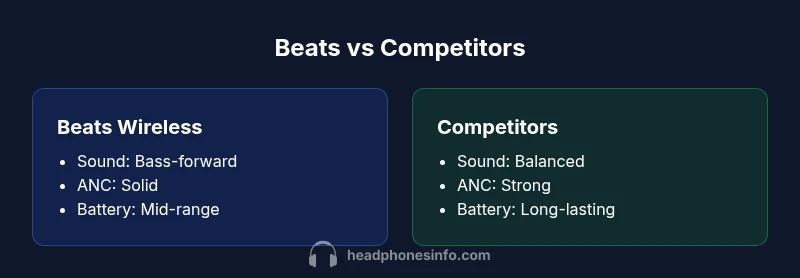
Wireless Beats: Beats vs Competitors — A Data-Driven Comparison
A data-driven comparison of wireless Beats headphones against key rivals, focusing on sound, ANC, battery life, comfort, and ecosystem integration for informed buying decisions.


According to Headphones Info, Beats wireless headphones deliver a bass-forward sound with strong ecosystem integration for Apple devices. In a side-by-side comparison with other wireless headphones, Beats typically excel in low-end punch and branding, while rivals often lead in noise cancellation and all-around endurance. This makes them a solid pick for bass lovers who value seamless device pairing, though you may trade some ANC performance and runtime in some scenarios.
The Landscape of Wireless Beats and Competitors
In the market for wireless headphones, the phrase wireless beats is often associated with Beats by Dre products. These headphones are known for a bass-forward signature, strong branding, and an emphasis on ease of use across devices—especially within the Apple ecosystem. The broader landscape, however, includes a wide range of competitors that compete on ANC efficacy, battery life, comfort, and feature sets such as multi-point pairing and intuitive companion apps. Headphones Info notes that consumer preferences have become more nuanced: some listeners want a characterful sound with punchy bass, while others seek a neutral reference profile for critical listening. As a result, comparison shopping now involves multiple axes of evaluation—from sound precision and spatial cues to fit, build quality, and software experience. The goal is to identify a model that aligns with everyday listening patterns, travel needs, and the devices you own.
Core Differentiators: Sound, ANC, Battery, and Comfort
When comparing Beats against competitors, the most salient differences typically emerge in four areas: sound signature, active noise cancellation (ANC), battery life, and comfort. Beats is frequently associated with a bass-forward signature that can feel energetic and exciting for genres like hip-hop and EDM. Competitors, especially premium rivals, often aim for a more balanced or neutral sound that appeals to a wider range of genres and critical listening. ANC performance varies by model and environment; some rivals offer stronger isolation in jet cabins or noisy offices, while Beats emphasizes a strong overall package with a simpler control scheme and straightforward pairing. In terms of comfort, Beats models tend to feature cushioned ear cups and a secure clamp that suits longer sessions, though this can vary by head size. Battery life—real-world endurance—depends heavily on usage patterns, particularly how aggressively ANC is used and whether features like transparency mode are active. Finally, the user experience around controls and apps can tip the balance: Beats often provides intuitive pairing and Apple-friendly features, while rivals may offer broader cross-platform compatibility and more granular app customization.
Battery Life and Charging: Real-World Performance
Battery life is a pivotal criterion for many buyers, serving as a practical daily measure rather than a marketing claim. Beats headphones typically offer competitive endurance for common daily use, with one or two power states affecting runtime when ANC and high-volume output are engaged. In real-world scenarios, you may find that battery life aligns with user habits: streaming at moderate volume with ANC on can yield shorter durations than lighter listening with ANC off. Competitors frequently report longer cosmopolitan endurance, particularly in models designed for all-day use or travel where efficiency modes optimize power draw. Charging speed also matters: quick-charge features can replenish a portion of battery in a short break, while full recharge times depend on the hardware architecture and charger standards. Headphones Info emphasizes testing battery life across multiple use cases—music, calls, video, and gaming—to understand practical performance beyond the box spec. Remember that battery longevity can degrade slightly with heat exposure and frequent charging cycles, so protecting the battery from harsh conditions is wise.
Noise Cancellation and Transparency: How They Compete
Noise cancellation is a critical battleground in the wireless headphone space. Beats typically delivers ANC that reduces steady-state ambient noise effectively, creating a quieter listening experience for most environments, but competitors sometimes push ANC into higher echelons with multiple microphones and adaptive profiles. The resulting noise attenuation often matters most in travel, offices, and public transit. Transparency modes—allowing ambient sound to pass through—varies by model and can influence safety and awareness in street or campus environments. Some rivals implement more natural-sounding transparency, which can be preferable for public spaces or commuting. When evaluating ANC, consider the balance between bass reproduction and noise suppression, as aggressive ANC can sometimes alter perceived sound balance. Overall, your priority—maximum isolation vs. natural ambient awareness—will guide which model fits your daily workflow and listening habits.
Comfort and Fit: Long-Term Listening
Comfort is highly subjective and depends on head shape, ear size, and clamping force. Beats headphones are often praised for plush padding and an ergonomic headband that distributes weight for extended sessions. The seal you achieve around the ear affects both passive isolation and bass response, which is particularly relevant for Beats’ signature sound. Competitors may employ different cup shapes, materials, and clamp tensions, resulting in variation in comfort over long listening periods. For travelers and daily commuters, lighter weight and more evenly distributed pressure can reduce fatigue. If you wear glasses or have sensitive ears, pay attention to ear pad material and the overall pressure points. A good test is to wear the headphones for 20–30 minutes and move your head to simulate daily activities to gauge pressure distribution and comfort over time.
Integration and Ecosystem: Compatibility and Usability
The ecosystem around wireless headphones can be as important as the hardware itself. Beats typically offer seamless pairing with Apple devices and straightforward switching between devices on the same account, which is a major convenience for iPhone and Mac users. Competitors often emphasize broader cross-platform support, including rapid pairing with Android devices, Windows PCs, and multiple Bluetooth codecs. App ecosystems can provide features such as EQ customization, firmware updates, and sound profiles tailored to personal tastes. If you rely on a mixed-device setup, this can be a decisive factor. Even small nuances—like gesture controls, multipoint connection reliability, and how updates are delivered—can affect daily use. When testing, try pairing with a smartphone, laptop, and tablet to see how well the hands-off switching and connectivity hold up in real-world scenarios.
Price vs Value: Is the Premium Justified?
Price is a practical lens through which listeners evaluate any headphone purchase. Beats often carry a premium tied to brand prestige and ecosystem benefits, especially for users deeply embedded in the Apple environment. The value proposition hinges on whether the listener prioritizes bass emphasis, branding, and streamlined integration, or whether the decision leans toward more neutral sound, stronger ANC, and longer battery life at a similar or lower price point. To judge value, compare the total experience: sound quality across typical listening scenarios (pop, rock, jazz), performance of ANC and transparency in common environments, comfort for long sessions, durability, and the convenience of pairing, updates, and service. For some buyers, Beats represents a strong value due to the combination of sound signature and ecosystem perks; for others, the premium might feel excessive if ANC, battery endurance, and cross-platform versatility are more important.
Practical Scenarios: Best Use Cases
Different listening scenarios highlight where Beats and its competitors shine. If you prioritize bass-forward music and a quick, frictionless pairing experience with Apple devices, Beats can be an excellent choice for daily commuting, gym sessions, and casual listening. For professionals or listeners who require the most neutral sound for critical critique, alongside top-tier ANC and multi-device reliability, competitors may be preferred. Travelers who value comfort and long battery life may favor models with more substantial cushions and longer run times, especially if ANC is a constant requirement. Gamers may look for low-latency codecs and a stable wireless connection, while office workers might prefer comfortable wear for long calls with clear microphone performance. The key is to map your use-case profile—sound preference, typical environments, devices you own—and test where the scales tip.
Build Quality and Durability
Durability is essential for daily use, especially for portable devices that travel in bags or sit on desks for extended periods. Beats headphones commonly feature solid construction with reinforced hinges and quality padding, but the perceived durability can vary across models and production batches. Competitors may offer metal frames, ceramic components, or higher-end materials that feel sturdier and more premium to some users. While materials influence aesthetics and longevity, the most reliable predictor of durability is how you care for and store the headphones: avoid bending the headband excessively, store them in a protective case when not in use, and keep away from excessive moisture. If you expect frequent travel or rough handling, look for models with robust build testing credentials and warranty coverage that reflects daily wear and tear.
Wireless Tech and Codecs
Modern wireless headphones support a range of Bluetooth codecs, from the ubiquitous AAC to higher-resolution options like aptX and LDAC. Beats often optimize for broad compatibility and fast pairing, with a focus on stable connections and predictable performance across commonly used devices. Competitors may push higher-fidelity codecs and more configurable Bluetooth profiles for enthusiasts who demand the best possible streaming quality. When evaluating, confirm supported codecs with your primary devices and consider potential trade-offs: higher-fidelity codecs can improve sound under ideal conditions but may not be effective if your devices don’t support them fully. Also, check for multipoint pairing reliability, latency considerations for video or gaming, and the ease with which firmware updates are delivered.
How to Choose the Right Option for You
Choosing between Beats and rivals comes down to your listening priorities and environment. If you prize bass-forward sound, Apple ecosystem ease, and a recognizable brand, Beats might be the right fit. If you want top-tier ANC, longer battery life, cross-platform flexibility, and a more neutral sound signature, consider competing brands. Create a decision checklist: list your primary use cases (commuting, office, travel, critical listening), assess device compatibility, weigh the importance of sound character versus versatility, and consider budget constraints. Whenever possible, audition in-store or with a tried-and-true demo sample, and read updated reviews that test models in real-world conditions rather than relying solely on official specifications. By aligning your choice with real-world usage and device ownership, you’ll maximize satisfaction and value.
Comparison
| Feature | Beats wireless headphones | Competitive wireless headphones |
|---|---|---|
| Sound profile | Bass-forward, energetic | Balanced/neutral with wide frequency response |
| ANC | Strong for casual environments | Advanced with multiple modes |
| Battery life | Mid-range endurance | Longer endurance in many models |
| Comfort and fit | Cushioned cups, secure fit | Ergonomic design with adaptive fit |
| Ecosystem integration | Tight Apple-device integration | Broad cross-platform compatibility |
| Price range | Premium price level | Mid-to-premium price range |
| Controls and app | Intuitive controls, simple app | Extensive app customization and settings |
Upsides
- Punchy bass that appeals to Beats fans
- Seamless pairing with Apple devices
- Solid build quality and comfortable for long sessions
- User-friendly controls and quick setup
Disadvantages
- ANC may not match top rivals in extreme noise
- Battery life can vary with aggressive ANC use
- Premium price may deter budget buyers
Beats wireless headphones excel in bass and ecosystem convenience, but may lag top rivals in ANC and endurance depending on use case.
Prioritize bass and device ecosystem if you choose Beats. If ANC or longest battery life is your priority, compare against leading rivals.
People Also Ask
What defines 'wireless beats' in headphones?
Wireless beats typically refer to Beats-brand wireless headphones that connect via Bluetooth, offering a bass-forward sound and ecosystem-driven features. They vary by ANC, comfort, and battery life.
Wireless beats are Beats-brand wireless headphones using Bluetooth with a bass-forward sound and ecosystem features.
How do Beats compare to other wireless headphones on ANC?
Beats models generally provide solid ANC but may not always match the strongest noise cancellation found in some flagship rivals, depending on the environment and mode selected.
Beats ANC is solid but not always the strongest; some rivals may outperform in very loud settings.
Are Beats comfortable for long listening sessions?
Most Beats models offer cushioned pads and adjustable headbands designed for extended wear. Comfort can vary with head size and glasses, so try before you buy if possible.
They’re generally comfortable for long use, but comfort can vary by person.
Do Beats headphones work well with Android devices?
Beats headphones are broadly compatible with Android devices, delivering solid Bluetooth performance, though some ecosystem features may be Apple-centric.
They work well with Android, but some features feel easier on Apple devices.
Is the price justified for Beats vs rivals?
Value depends on priorities: if bass and Apple integration matter most, Beats can justify the premium; if isolation and battery longevity are top concerns, rivals may offer better long-term value.
Value depends on what you prioritize—bass and Apple integration or stronger ANC and longer battery life.
Which Beats model is best for travel?
For travel, look for models with strong comfort, reliable wireless performance, and durable construction. Battery life and foldable design also matter for portability and long flights.
For travel, choose Beats with comfort, solid wireless performance, and good battery life.
What to Remember
- Prioritize your main listening goals (bass vs. neutrality).
- Evaluate device ecosystem compatibility before buying.
- Weigh real-world battery life against claims.
- Test comfort for daily wear and travel.
- Check codec support and latency for your use case.