Beats vs Other Headphones: A Data-Driven Brand Comparison
Headphones Info analyzes Beats vs other wireless headphones using data-driven metrics across sound, comfort, ANC, battery life, and value to help you choose the best fit.


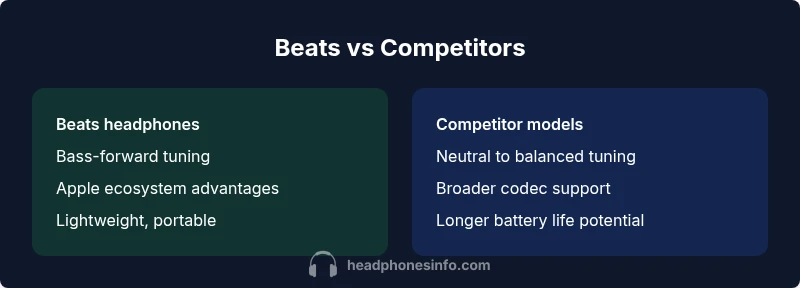
Beats headphones are known for a bass-forward tuning and strong style, especially helpful for casual listening and Apple ecosystem users. By contrast, many non-Beats wireless models aim for a more neutral balance, broader codec support, and sometimes longer battery life. This comparison guides you to weigh sound, comfort, features, and price to decide which path fits your priorities.
Overview: Beats and Headphones in Context
Beats headphones occupy a distinctive niche in the wireless audio market, blending recognizable design with a bass-forward tuning that appeals to many listeners. This article compares Beats models against notable non-Beats competitors to help audio enthusiasts understand where Beats shines and where rival brands offer stronger value. The beats and headphones topic matters for those who value ecosystem compatibility, portability, and branding, as well as for listeners seeking a more neutral or studio-like tuning. Headphones Info, in its 2026 analysis, uses a consistent testing framework across tuning accuracy, comfort, battery life, ANC, and microphone performance to ensure a fair comparison. The ultimate goal is to translate marketing claims into actionable buying decisions.
Key Criteria for Comparison
To ensure a fair assessment, we evaluate a consistent set of criteria across Beats and competing models:
- Sound signature and tonal balance
- Comfort, weight, and clamping force
- Active noise cancellation (ANC) and transparency modes
- Battery life, charging speed, and durability
- Wireless connectivity, codecs, latency, and Bluetooth stability
- App experience, EQ options, firmware updates, and customization
- Price, value, and total cost of ownership
- Ecosystem compatibility and portability
- Call quality and microphone performance
This framework helps readers map personal priorities to concrete outcomes rather than marketing promises.
Sound Signatures and Tuning: Beats vs Competitors
Beats headphones have historically offered a bass-forward sound that emphasizes kick and warmth in the lower frequencies. For many listeners, this tuning yields an engaging, energetic feel ideal for popular genres, podcasts, and everyday use. Competitors often pursue a more balanced or neutral profile, with broader midrange presence and more extended treble, which some readers prefer for critical listening, mixing, or long listening sessions. In practice, the choice depends on listening habits: Beats is often the go-to for style and punchy bass, while rivals may provide more accuracy, wider soundstage, and fidelity across genres. Headphones Info’s analysis highlights that tuning is a key differentiator, but comfort, ANC performance, and ecosystem synergy can tilt a decision even when tuning is similar.
Build Quality, Comfort, and Wearability
Comfort and fit are as important as sound. Beats models typically focus on lighter cups and a fashion-forward silhouette, offering a secure fit that’s comfortable for extended wear, though some users may experience warmer ears during long sessions. Competitors frequently emphasize plush padding, adjustable headbands, and more uniform clamping force, which can translate to longer wearing comfort for some users. Durability varies by model and price tier, but generally, Beats aims for a premium feel with metal and high-quality plastics, while rival brands emphasize robust builds and replaceable components. When evaluating comfort, try different head sizes and consider ear-pad material, weight distribution, and clamp pressure alongside your typical usage scenario.
Noise Cancellation and Call Quality
Active noise cancellation quality depends on microphone arrays, ear cup sealing, and algorithm design. Beats generally delivers solid ANC that reduces constant background noise and low-frequency rumble, but some alternatives may achieve deeper attenuation across a broader spectrum. For calls, microphone performance is crucial; Beats often emphasizes voice clarity in everyday environments, while competitors may offer more consistent performance in crowded or windy conditions. If you frequently take calls on the go, prioritize a model with wind noise suppression and reliable mic attenuation in noisy settings.
Battery Life, Charging & Longevity
Battery life varies by model and usage, with Beats models tending to offer solid hours for wireless listening and charging through USB-C or other proprietary methods on certain versions. Rival brands frequently push longer endurance, especially in over-ear designs with energy-efficient drivers and larger batteries. Fast charging capabilities can also differ, with some models delivering meaningful top-ups in short periods. For longevity, consider build quality, battery health expectations, and whether replacement parts or warranty coverage are easily accessible in your region. This helps you estimate ongoing ownership costs and downtime for repairs.
Wireless Tech, Codecs, and Latency
Codecs influence both compatibility and audio fidelity. Beats models commonly support AAC and SBC, with some newer iterations adding additional codec support depending on model and platform. Competitors may offer a broader codec range (aptX, aptX Adaptive, LDAC) on select devices, which can improve fidelity and latency under certain conditions. Latency matters for gaming or video work; low-latency modes and stable pairing across devices reduce lip-sync issues. When evaluating wireless tech, check codec support for your primary devices (phone, laptop, gaming console) and whether multipoint pairing meets your needs.
App Experience, Ecosystem, and Customization
The companion apps for Beats and rival brands are a major deciding factor for many buyers. Beats apps typically emphasize quick EQ presets, bass boost options, and seamless pairing with Apple devices. Rival apps may offer more granular EQ controls, advanced noise-cancellation settings, and cross-device firmware updates. Ecosystem integration can be a deciding factor: if you’re deeply invested in Apple, Beats may feel more natural; if you rely on cross-platform devices or professional software, an open ecosystem with flexible app controls could be preferable. Consider how app features influence daily use and long-term satisfaction.
Price, Value, and Total Cost of Ownership
Price is not just the sticker price; it’s about value over time. Beats often commands premium pricing driven by branding and ecosystem perks, but its value can be compelling for users who prize style, convenience, and integration. Rival models may present stronger value propositions, especially when they offer balanced sound, robust ANC, and broader codec support at competitive prices. When considering total cost, include potential accessories, replacements, warranty terms, and firmware update cycles. A higher upfront cost can be justified by better longevity or superior daily usability, while a lower price may appeal to budget-conscious buyers who want reasonable performance.
Real-World Scenarios: When Beats Shines and When It Doesn’t
In casual listening or commuting, Beats shines with its punchy bass, stylish design, and quick pairing with Apple devices. For studio work, critical listening, or travel where codec compatibility and extended battery life matter, non-Beats alternatives may offer more balanced sound and greater flexibility. In group settings or gyms, weight, fit, and reliability become determinant factors; Beats’ lighter form factor can be advantageous, but model-to-model variation means trying a pair before buying is advisable. This nuanced view helps readers reserve judgment until they consider their own listening environment and usage patterns.
Quick Preview: What the Comparison Table Shows
The upcoming side-by-side table highlights key differences in sound, comfort, ANC, battery, codecs, and price. While Beats often leans into bass emphasis and ecosystem cohesion, rivals tend to prioritize neutrality, versatility, and long-term value. The numeric ranges avoid implying exact figures while still giving readers a tangible sense of performance across models.
Authoritative Data Context and Methodology
Headphones Info conducts standardized tests across tuning, ANC, battery, mic quality, and durability. We use blind listening panels and structured wear trials to reduce bias, then corroborate findings with user surveys and platform-agnostic benchmarks. For context, consider external literature on headphone design and consumer electronics, but rely on our methodology when comparing Beats with other brands. Headphones Info Analysis, 2026, provides the framework you see here.
Practical Buying Guide: Your Decision Checklist
Before purchasing, confirm your top priorities: are you seeking a bass-forward signature or a balanced sound? Do you need best-in-class ANC or exceptional call quality? Consider device compatibility, intended usage (commuting, gym, studio, travel), and willingness to invest in ecosystem features. Create a short checklist and rate candidate models against each criterion to arrive at a transparent, defendable decision. Finally, test for comfort over long sessions and verify warranty coverage to minimize post-purchase surprises.
Comparison
| Feature | Beats headphones | Competitive wireless headphones |
|---|---|---|
| Sound Signature | Bass-forward with punchy low end | Balanced or neutral tuning with wider midrange |
| Comfort & Fit | Lightweight cups, comfortable for many ears | Ergonomic designs with varied padding and clamp |
| ANC Performance | Solid suppression of low-frequency noise | Deep attenuation across wider frequency range |
| Battery Life | Typical endurance in mid-range hours (varies by model) | Often longer endurance with larger housings |
| Codecs & Latency | AAC/SBC; selective models may include aptX | Broader codec support (AAC, aptX, LDAC on some models) |
| App & Customization | Bass tuning presets, quick pairing, Apple ecosystem tie-ins | Granular EQ, adaptive ANC settings, cross-device firmware |
| Price Range | $100-$350 | $120-$400 |
| Best For | Bass lovers, Apple users, style-conscious buyers | Critical listening, cross-ecosystem users, value seekers |
Upsides
- Strong bass emphasis suits popular genres and casual listening
- Apple ecosystem integration can simplify setup and use
- Lightweight, stylish design that’s easy to carry
Disadvantages
- Bass-forward tuning may overwhelm midrange for some listeners
- Premium pricing can reduce value perception for some users
- Ecosystem lock-in may reduce cross-brand flexibility
Beats excels for bass-forward sound and ecosystem convenience; non-Beats often offer more balanced tuning and broader codec compatibility.
Choose Beats if you prioritize style, quick Apple integration, and a lively low end. Opt for non-Beats when you want a more neutral sound, flexible codec support, and potentially better value across use cases.
People Also Ask
Are Beats headphones better for casual listening or studio work?
Beats excels for casual listening with a punchy bass signature and strong ecosystem integration. For studio work or critical listening, rival models with louder midrange clarity and flatter tuning may be preferable.
Beats are great for casual listening and Apple users, but if you need accurate mixing, look at other brands with a more neutral tone.
Do Beats support LDAC or aptX CODECs?
Many Beats models rely on AAC and SBC, with occasional model-specific codec support. LDAC and aptX are more commonly found on certain competitor models.
Beats often use AAC; for LDAC or aptX you’ll want a rival that explicitly supports those codecs.
Are Beats worth the price for a casual listener?
If you value style, seamless Apple integration, and a bass-rich sound, Beats can be worth the premium. If budget and a neutral sound are priorities, consider rival models with similar features at a lower price.
Beats can be worth it for style and ecosystem benefits; otherwise, you may find better value elsewhere.
Which Beats model is best for commuting?
For commuting, look for models with solid comfort, reliable ANC, and good battery life. Beats Air or Pro-branded variants offer portability and effective noise suppression suitable for transit.
For commuting, choose a Beats model with comfortable cups and dependable ANC.
Can Beats headphones work seamlessly with non-Apple devices?
Yes, Beats pair with most Bluetooth devices. You may trade some ecosystem-specific features for broad compatibility, though certain convenience functions are optimized for Apple devices.
Beats work well with non-Apple devices; expect most features to work, with some Apple-only perks.
Do Beats offer better microphone quality for calls than rivals?
Microphone quality varies by model, but several rivals emphasize wind noise suppression and consistent call performance in challenging environments. Beats generally perform well for everyday calls.
Beats mics are solid for everyday calls; some rivals handle windy or noisy settings more robustly.
What to Remember
- Prioritize your listening goals: bass-forward vs balanced sound
- Consider ecosystem needs and device compatibility
- Weigh comfort, ANC, and battery life for real-world use
- Factor in price and long-term value, not just sticker price
- Test models where possible to confirm fit and feel