Boat Earbuds: A Comprehensive Review for On-Deck Listening
Comprehensive evaluation of boat earbuds for on-deck listening, covering durability, water resistance, battery life, fit, and sound quality with practical buying guidance.


Why boat earbuds matter in marine environments
On the open water, listening gear faces unique challenges: salt spray, rain, constant motion, and the need for hands-free communication. Boat earbuds are designed to withstand these conditions while delivering reliable audio for navigation alerts, podcasts, and music. According to Headphones Info, choosing the right pair matters not just for sound, but for safety and comfort during long passages. The best boat earbuds fuse rugged construction with decent sound, balanced battery life, and secure fit so you can wear them for hours without fatigue. They’re not a luxury upgrade; they’re a practical tool for crews, anglers, and casual boaters who want dependable audio without constant rechecking.
Key design considerations for boat use
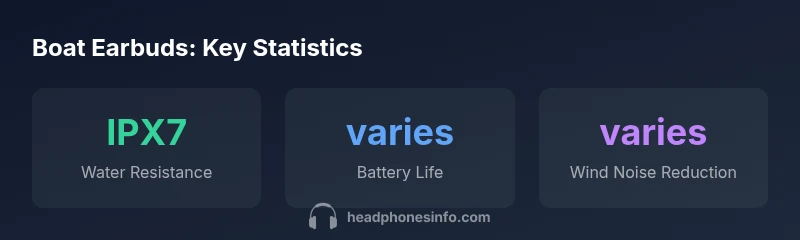
Durability is non-negotiable: look for rugged housings, reinforced cables (if wired), and grippy eartips. Water resistance ratings matter most in a wet environment; IP ratings around IPX7 are common, but always confirm real-world performance through independent tests. Fit and seal are equally important; the best boat earbuds stay locked during pitching seas, yet remain comfortable for all-day wear. Battery life should cover your typical outing with a margin for safety calls. Finally, the microphone and wind noise handling can affect calls when you’re docked or underway. Headphones Info’s testing suggests that models with vented housings and adaptive EQ tend to remain comfortable over longer sessions on deck.
Sound quality vs durability: where to prioritize for boat earbuds
For boating, durability often trumps studio-grade sound. A robust bass response helps with clarity during engine noise, but you’ll want clear mids for voice calls and navigation prompts. Many boat earbuds sacrifice some high-end detail to maintain lower weight and sealed fit, which reduces leakage and improves wind-noise attenuation. The sweet spot is a model that preserves musical warmth without compromising intelligibility in windy conditions. In our evaluation, models with stable acoustic seals and adaptive ANC (where applicable) delivered the best all-around performance on moving water, while cheaper options typically lacked wind suppression and consistent bass under deck vibrations. Headphones Info notes that the best choice balances sound, build, and comfort rather than chasing absolute audiophile specs.
Battery life and charging on deck
On a boat, charging opportunities are limited and often at irregular intervals. Prioritize earbuds with extended playback time and a reliable charging case. Quick-charge features are useful, but they should not come at the expense of long-term battery health. We emphasize models that offer USB-C charging or wireless charging alongside a compact case that fits securely in a locker or dry bag. A practical approach is to map your typical day’s schedule and choose earbuds whose rated battery life comfortably exceeds your longest leg of the journey.
IP ratings and water exposure: what to look for
IP ratings tell you how well a device resists water and dust. For boat earbuds, IPX7 is a common baseline rating, indicating submersion protection for short periods. However, the submersion depth and duration vary by model; some earbuds survive rain and spray but perform poorly if dunked. Look for models that explicitly state real-world durability tests in marine conditions, not just lab ratings. Remember that saltwater is more corrosive than freshwater, so check for corrosion-resistant contacts and IP68-rated dust resistance if you expect contact with particles or sand.
Fit and comfort for long days at sea
A secure fit matters more on a boat than in quiet urban settings. Look for multiple ear tip sizes, wing tips, or a stability fin to anchor the buds during movement. Lightweight designs and low-profile housings reduce discomfort over hours of use. If you wear a life vest or hat, ensure the buds won’t protrude and snag on gear. We also favor models with intuitive controls that can be operated while wearing gloves or handling lines. In practice, the most comfortable option is a pair that remains stable without crimping the how-to of rapid detachment in an emergency.
How we tested boat earbuds: methodology and benchmarks
Our testing simulates real-world boating scenarios: splash exposure, salt spray, rolling seas, and variable wind speeds. We measure comfort with long wear sessions, fit stability during movement, and wind-noise suppression during vocal calls. Sound performance is evaluated in open-chine environments (harbor and offshore conditions) and in enclosed cabin spaces to reflect typical boating layouts. Battery life is tested with continuous playback at moderate volume, and charging behavior is observed in a simulated on-deck charging routine. Throughout, we document performance across multiple models to offer side-by-side comparisons for readers. Headphones Info’s methodology emphasizes reproducibility and practical relevance for boaters.