Headphones or Open Listening: Which Is Better for Music?
A data-driven guide comparing listening with vs without headphones, examining sound quality, safety, and context to help you decide the best method for any situation.


Is it better to listen to music without headphones? According to Headphones Info, the answer depends on context. The Headphones Info team found that when you want immersion, precise detail, and privacy, headphones generally win; but in shared spaces or when you need ambient awareness, listening without headphones can be advantageous. The quick takeaway: choose headphones for control, but consider open listening for social or safety reasons.
The big question: is it better to listen to music without headphones?
The big question guides the rest of this comparison. Is it better to listen to music without headphones? In practice, the answer depends on context, content, and your hearing goals. According to Headphones Info, the choice hinges on immersion, privacy, and social setting. Headphones that isolate can reveal subtle details, while open listening blends the track with room acoustics and other sounds. People often switch modes as circumstances change: a quiet apartment late at night, a kitchen filled with activity, or a shared workspace. This section introduces the core distinctions and offers a practical framework for deciding which approach suits your situation. Expect concrete examples, common pitfalls, and evidence-based considerations drawn from contemporary listening tests and user feedback.
Acoustic principles: how headphones shape soundstage, isolation, and perception
Headphones alter the ear canal's direct exposure to sound. Closed-back designs emphasize direct energy and can reduce room reflections, producing strong bass and tighter imaging. Open-back models, or listening without headphones, allow more of the room to influence perception, which can widen the perceived soundstage and reveal different tonal balances. The brain fuses direct signals with indirect cues, so timing differences and reflections change localization and sense of space. In practice, this means the same track can feel intimate in a closed headset and expansive when heard in a quiet room with speakers. We'll unpack how frequency response, driver alignment, and leakage contribute to the listening experience in both modes.
Health safety and volume management
A key factor in choosing listening mode is hearing health. Keeping volumes at safe levels matters whether you wear headphones or listen openly. Headphones with appropriate impedance and built-in limiting features can help prevent excessive exposure, while open listening depends more on your environment and the speakers you use. Headphones Info Analysis, 2026, highlights that long sessions at high volume—even with headphones—pose risks to high-frequency hearing. Practical strategies include setting a daily volume ceiling, taking breaks, and using NR or EQ to tailor response without raising levels. In shared spaces, be mindful of others and adjust playback to a comfortable, non-disruptive level. These considerations are essential to minimize fatigue and protect long-term hearing health.
Social and environmental contexts
Open listening thrives in social environments where others are present and can enjoy the moment together. In a living room, kitchen, or outdoor gathering, sharing music can be part of the experience, and ambient room noise can become part of the sonic texture. In contrast, headphones excel in quiet apartments, libraries, or public transit where you need to control your own sound without disturbing others. The decision also depends on ambient noise levels; in a loud street, listening without headphones may require higher volumes, which reduces overall clarity and can be unsafe. This block explores how context shapes the value of each approach and offers practical rules of thumb for different settings.
Sound quality and perception: does headphones vs open listening change fidelity?
Sound quality depends on many factors beyond the number of channels. Headphones can deliver precise imaging, strong bass, and controlled channel balance when properly matched to your ears and source. Open listening depends on room acoustics, speaker size, and distance from the listener, which can yield a more natural balance but with less isolation. Perceived fidelity often hinges on how well the playback matches the original mix and your personal hearing profile. If your priority is accuracy, a well-tuned headphone or a small speaker setup in a treated room can offer reference-like results. If you value immersion and realism in a familiar space, open listening may deliver a more life-like presentation, although it may sacrifice some micro-detail.
Comparison
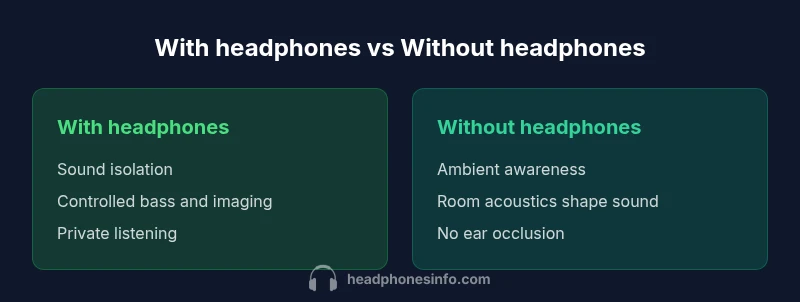
| Feature | With headphones | Without headphones |
|---|---|---|
| Sound isolation and leakage | High isolation and minimal leakage | Low isolation; noticeable leakage in loud environments |
| Perceived bass and space | Strong, controlled bass; tight imaging | Bass is more variable; space depends on room |
| Ambient awareness | Low ambient awareness | High ambient awareness and environmental cues |
| Hearing safety considerations | Easier to manage safe levels with headphones | Reliant on environment; more exposure to ambient noise |
| Comfort and practicality | Can cause heat or pressure during long sessions | No ear pressure; easier in social spaces |
| Setup and portability | Requires headphones; portable for private use | Requires room speakers or devices; less private |
| Cost and maintenance | Headphones cost and maintenance | No headphone cost; depends on speakers |
Upsides
- Immersive control and precise imaging with headphones
- Ambient awareness preserved when listening without headphones
- No occlusion or ear fatigue when not wearing headphones
- Portable private listening is easy with compact headphones
Disadvantages
- Sound leakage and environmental noise affect open listening
- Bass and low-end control can be weaker without isolation
- Open listening relies on room acoustics and setup quality
- Headphones can cause fatigue during long sessions
Headphones are generally better for immersion and control; open listening shines in shared, safe spaces.
For focused listening, headphones win. For social settings and awareness, open listening can be preferable.
People Also Ask
Is listening with headphones louder than listening without?
Headphones can deliver higher perceived loudness due to isolation, but this depends on the track and device. Without headphones, you may compensate with higher room volume, which can affect others and reduce clarity.
Headphones can seem louder because you don't hear the room, but keep the volume safe.
What are the health considerations for long listening sessions?
Long listening sessions at high volumes pose risks to hearing regardless of the setup. Take regular breaks, keep volume moderate, and consider the listening environment when choosing mode.
Take breaks, keep things comfortable, and watch the volume levels.
Can I switch between modes during a single listening session?
Yes, many listeners switch modes as the environment changes. For example, use headphones for focus at home and switch to open listening when social interaction begins.
You can switch modes as your setting changes.
Does room acoustics play a role in the decision?
Absolutely. A well-treated room can improve open listening dramatically, while a poor room can degrade perceived sound quality without headphones.
Room acoustics matter a lot for open listening.
When is open listening most practical?
Open listening is practical in social or casual settings where others are involved or you want to stay aware of your surroundings.
Open listening works best when you’re with others or need awareness.
Are there risks to hearing when listening without headphones?
Risks exist if ambient sound is very loud and you raise your own volume to compensate. Protect your hearing by staying mindful of total exposure.
Be mindful of the noise around you and your own volume.
What to Remember
- Choose headphones for immersion and privacy
- Open listening suits social contexts and ambient awareness
- Monitor volume to protect hearing in any mode
- Consider room acoustics when opting for open listening
- Balance comfort, convenience, and sound quality in decision making